
Newsroom


In a study published in Nature Nanotechnology, researchers from the Hefei Institutes of Physical Science of the Chinese Academy of Sciences, Anhui University, Forschungszentrum Jülich in Germany, and Wuhan University of Technology, developed an atomic-column-resolved electron magnetic circular dichroism (EMCD) method capable of imaging antiferromagnetic order at the atomic scale.
Antiferromagnetic materials, with antiparallel atomic spins and zero net magnetization, are fast and resistant to external magnetic interference, making them ideal for high-speed, high-density spintronic devices. However, their zero net magnetization makes conventional imaging difficult, as neutron- or synchrotron-based methods have limited resolution and cannot easily probe microscopic regions or interfaces.
In this study, the researchers developed the EMCD method using aberration-corrected transmission electron microscopy. Chiral reversal signals from opposite sides of a magnetic atomic column could be detected via electron energy loss spectroscopy, which enabled the extraction of magnetic information from individual atomic columns. By optimizing the diffraction geometry and signal acquisition scheme, the signal strength was further enhanced by an order of magnitude.
The EMCD method was demonstrated in two representative antiferromagnets, G-type DyFeO3 and C-type α-Fe2O3, revealing atomic-scale magnetic order. At the DyScO3/SmFeO3 interface, it further captured a magnetic dead layer only one unit cell thick, showing significant suppression of magnetic order near the interface. These findings provide crucial evidence for understanding interfacial magnetic coupling and guiding interface engineering in spintronic devices.
This atomic-resolution imaging method overcomes limits in magnetic characterization, providing a powerful tool to study microscopic magnetic structures.
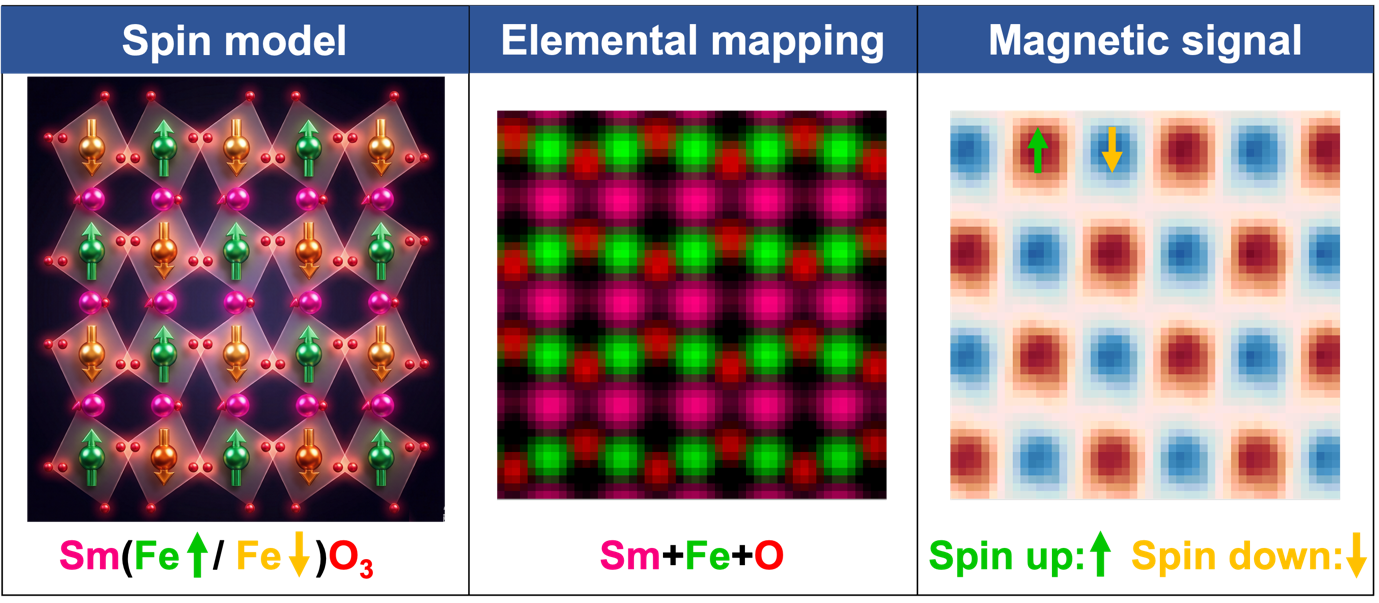
Atomic spin model of SmFeO3 (left), atomic-resolution elemental distribution (middle), and atomic-resolution magnetic signal (right). (Image by LIU Yizhou)

