Newsroom


Cellular differentiation and a division of labor are essential to living systems, as distinct cell types performing specialized functions arise in defined proportions and spatial arrangements. In synthetic biology, how to program cells to autonomously diversify into multiple functional subtypes while their relative abundance and task allocation remain precisely controlled is a challenge.
A study published in Nature and led by ZHONG Chao's team from the Shenzhen Institute of Advanced Technology of the Chinese Academy of Sciences and George M. Church's group from the Wyss Institute for Biologically Inspired Engineering, Harvard University, developed a recombinase-based programmable platform which enables a single founder cell to autonomously generate multiple descendant cell types in controlled differentiation ratios and fate-branching to proceed according to preset genetic rules.
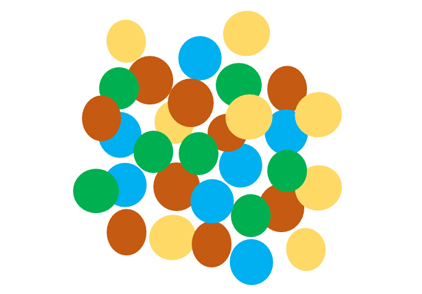
The researchers developed a recombinase-based differentiation platform that directs bifurcation in cell-fate decisions. In bacterial, yeast, and mammalian cells, it yielded stable, quantifiable relationships among cell types as if installing genetic "signposts" that route induced cells along alternative trajectories toward distinct fates. The tunable range of descendant ratios was expanded to approximately 0.1-99.9%, creating a programmable "cellular palette" for specifying fate proportions.
Also, the researchers constructed a supporting mathematical modeling framework which directly linked genetic design parameters to population composition. "In simple words, now you can decide if you want a biological event to happen at one-in-three odds or one-in-a-thousand," said Tzu-Chieh Tang, a co-first author and corresponding author of this work. "We are teaching cells to do ratio computation."
Moreover, the researchers employed the differentiation platform to regulate both differentiation outcomes and ratio-dependent division of labor among descendant cell types. Cell differentiation was transformed from an empirical process into a predictive engineering discipline. As proof of concept, founder cells were programmed to differentiate into two populations producing distinct pigments. Descendant cells displayed a continuous color gradient from deep purple to bright orange, demonstrating tunable phenotypes.
When distributed distinct enzymatic tasks for cellulose degradation across descendant cell types, the platform preserved system performance while reducing the metabolic burden that would otherwise fall on a single cell, demonstrating coupling of programmable differentiation to functional specialization.
Furthermore, the platform prescribed the emergence of cellular diversity from a single ancestor. "This work doesn't simply program what individual cells do. It begins to address how cell populations can be designed to develop coordinated structure and function, which is essential for building more sophisticated living systems,” said ZHONG.
This work establishes a rational framework for constructing multicellular systems, applicable to engineered living materials, organoid assembly, and next-generation biomanufacturing. Quantitative control over the differentiation, division of labor, and self-organization of engineered living materials is essential to the development of new therapeutic systems.
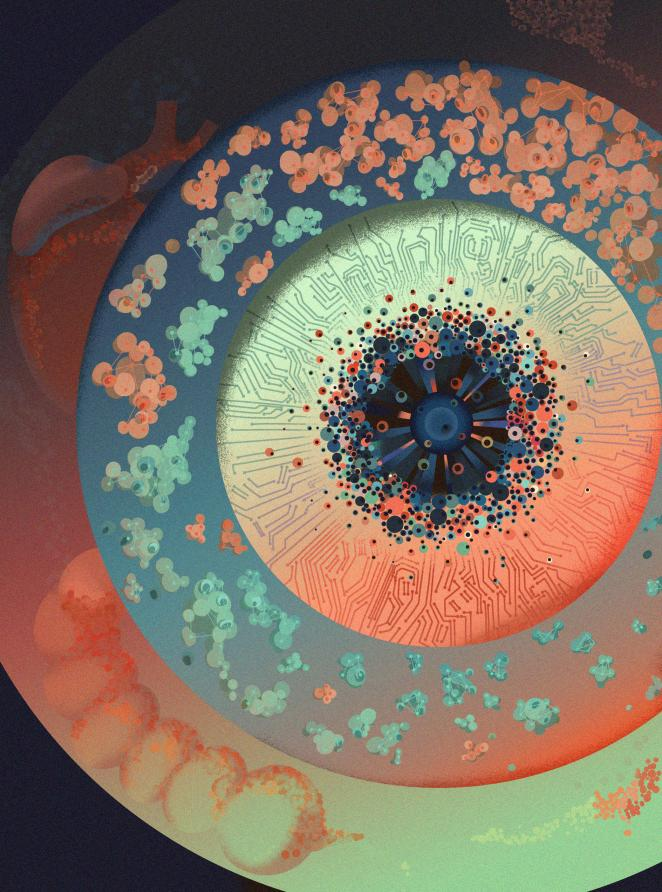
A synthetic gene circuit uses recombinase switches and feedback control to regulate population proportions. (Imade by Olga Aleksandrova)