
Newsroom


A research team from the Innovation Academy for Precision Measurement Science and Technology (APM) of the Chinese Academy of Sciences, has developed a second-generation liquid-nitrogen cryogenic calcium-ion optical clock with a total systematic uncertainty of 4.4 × 10⁻¹⁹, corresponding to an error of no more than one second over roughly 72 billion years of continuous operation. This represents the best reported systematic uncertainty for any optical clock to date.
The findings were recently published in Physical Review Letters.
Optical clocks use the stable energy-level transitions of atoms or ions as frequency references and are currently the world's most precise timekeeping instruments. Their systematic uncertainty directly defines the accuracy and reliability of future timekeeping standards.
Among optical clock architectures, calcium ions offer distinct advantages: a simple energy-level structure that simplifies laser systems, and a "magic trapping frequency" at which micromotion-induced second-order Doppler and Stark shifts theoretically cancel, strongly suppressing related frequency uncertainties. Realizing these advantages in high-performance clocks, however, requires overcoming critical technical challenges—in particular, precise control of the blackbody radiation shift and ion thermal motion. The blackbody radiation shift scales with the fourth power of temperature; at room temperature (≈ 300 K), it is highly temperature-sensitive and has long been the dominant limitation for calcium-ion optical clocks.
To address this challenge, the team pioneered a liquid-nitrogen cryogenic strategy. Cooling the ion environment to the liquid-nitrogen regime (≈ 80 K) theoretically reduces blackbody radiation intensity by roughly a factor of 200 compared with room-temperature operation, substantially suppressing the blackbody radiation shift at its source. Building on their earlier demonstration of 3 × 10-18 uncertainty, the team achieved a major performance improvement in the second-generation system through comprehensive technical innovations.
For thermal control, the team optimized the clock's mechanical design, thermal-link architecture, and temperature-monitoring system. Using high-thermal-conductivity materials, refining thermal-equilibration pathways, and developing an in-situ thermal-replication device for comparative measurements, the team accurately determined the ion microenvironment temperature to be 79.5 ± 1.5 K, lowering the blackbody radiation-shift uncertainty to 3.5 × 10⁻¹⁹.
For motional control, the team applied three-dimensional sideband cooling to prepare the ion in its motional ground state. Combined with strong suppression of electric-field noise in the cryogenic environment (heating rate < 1.3 phonons per second), the uncertainty in the second-order Doppler shift was reduced to 4 × 10-20.
For magnetic-field control, the second-order Zeeman coefficient was precisely measured via high-accuracy optical-clock frequency comparisons. Combined with active magnetic-field stabilization, the associated uncertainty was reduced to 5 × 10-20.
The team also rigorously suppressed and evaluated other systematic effects using a suite of complementary techniques. These included operating at the "magic trapping frequency" to mitigate micromotion, implementing Hyper-Ramsey spectroscopy to eliminate light shifts and AOM chirp shifts, alternating measurements across multiple Zeeman transition pairs to cancel electric quadrupole shifts, and applying state-of-the-art quantum scattering theory to assess background gas collisions.
After independent evaluation and combination of all known systematic contributions, the total systematic uncertainty of the second-generation liquid-nitrogen cryogenic calcium-ion optical clock was determined to be 4.4 × 10⁻¹⁹. This result confirms both the feasibility and performance advantage of the liquid-nitrogen cryogenic approach, establishing a new technical paradigm for optical clock development.
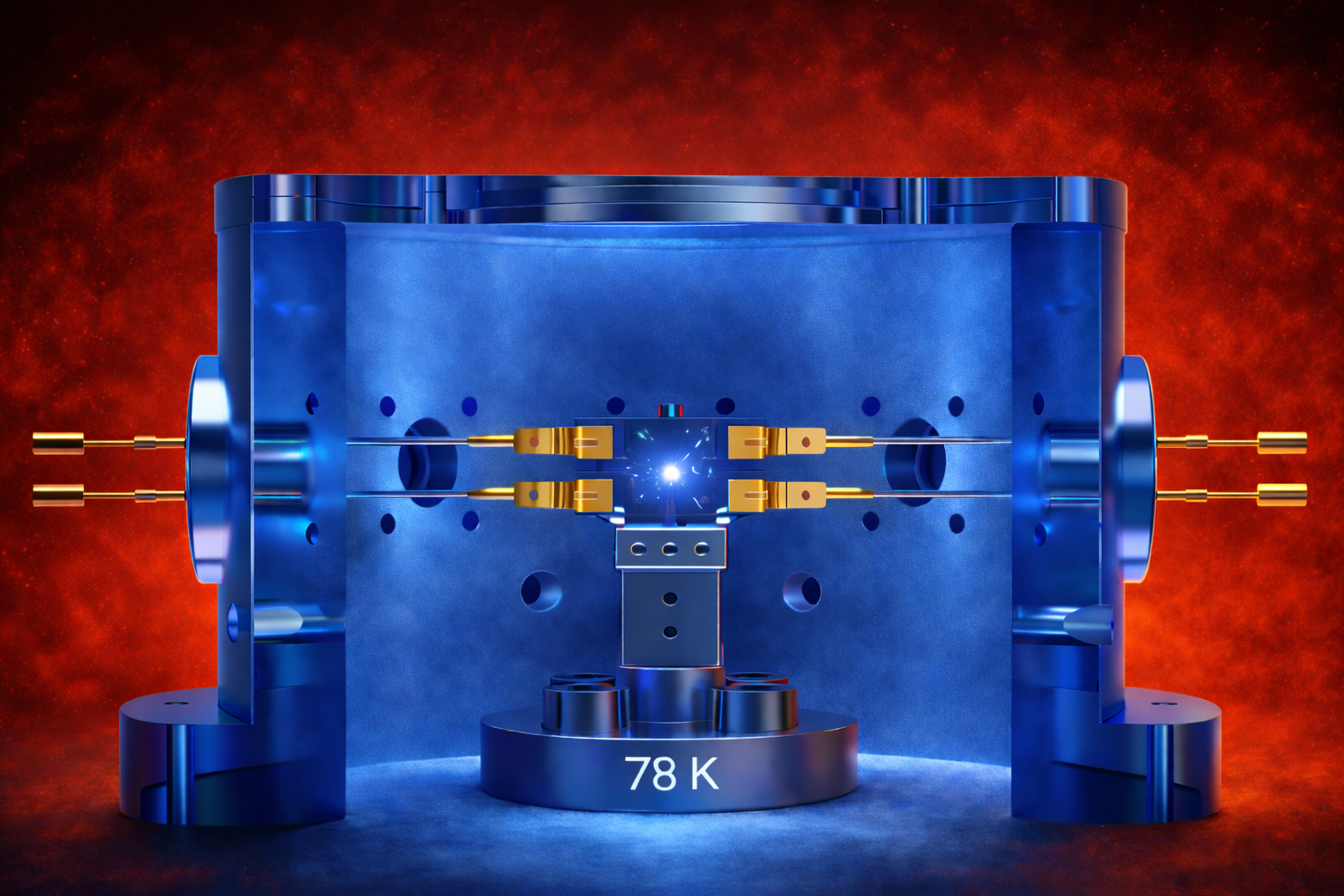
Liquid-nitrogen-cooled calcium ion optical clock. (Image by APM)
ZHANG Jiaojiao
Innovation Academy for Precision Measurement Science and Technology
E-mail: zhangjiaojiao@apm.ac.cn
