Newsroom


A study published in Plant, Cell & Environment and led by Dr. WANG Xin from the Institute of Botany of the Chinese Academy of Sciences quantified the foliar nitrogen uptake capacity of dominant canopy trees in natural tropical and subtropical forest ecosystems, and revealed distinct regulatory mechanisms across leaf ages.
Using canopy cranes at two field stations in southern China, researchers conducted in situ stable isotope (15N) labeling experiments to quantify the nitrogen uptake capacity in mature and old leaves of 13 dominant canopy tree species. They also examined how leaf functional traits, soil conditions, and meteorological conditions regulate foliar nitrogen uptake.
Researchers found substantial variation in foliar nitrogen uptake capacity among species. Leaves with higher nutrient demand and greater stomatal density generally exhibited greater nitrogen uptake capacity. Photosynthetically active radiation (PAR) was identified as the primary meteorological factor promoting nitrogen uptake for both leaf ages, while higher soil fertility suppressed nitrogen uptake only in mature leaves.
Besides, researchers showed that although average foliar nitrogen uptake capacities were similar between mature and old leaves, the mechanisms differed substantially. In physiologically active mature leaves, nitrogen uptake was closely linked to leaf functional traits including stomatal structure and nutrient demand. In old leaves, environmental factors, especially soil texture and PAR, played a more dominant role.
This study provides field-based evidence that canopy uptake can serve as a supplementary nutrient source in natural tropical and subtropical forests. Also, it highlights the importance of considering canopy nitrogen uptake when evaluating forest nitrogen cycling under increasing atmospheric nitrogen deposition.
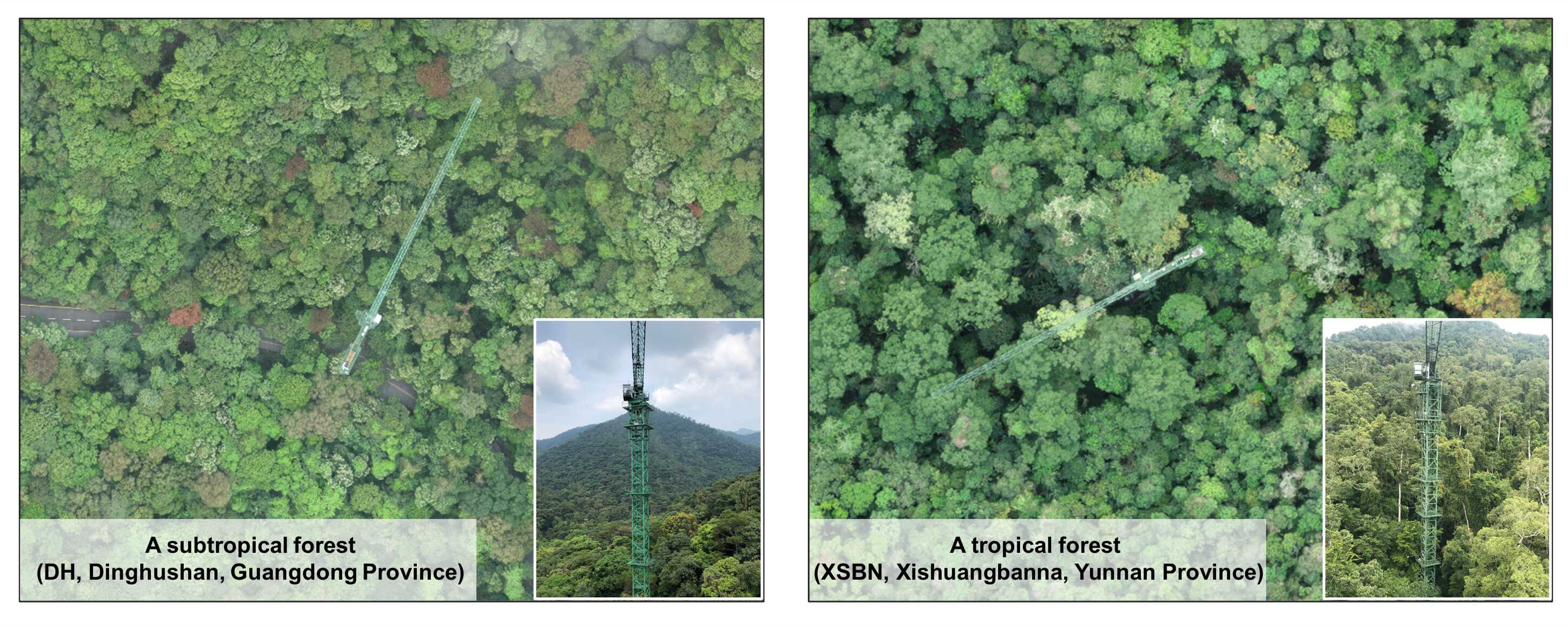
Canopy crane facilities and aerial views of the two forest plots in southern China. (Images by WANG Xin and YAN Zhengbing)