
Newsroom


A new academic volume led by the Kunming Institute of Botany (KIB) of the Chinese Academy of Sciences has been published by Springer, offering a comprehensive examination of human–nature relationships across Asia under the framework of the Belt and Road Initiative. Titled Ethnobiology and Development in Asia: The Belt and Road Initiative, the book brings together extensive case studies to explore how local knowledge and practices contribute to biodiversity conservation and sustainable development. Its e-book version was released on February 13.
Against the backdrop of global challenges, including climate change, biodiversity loss and shifts in the international environment, the book is the first to focus on the dynamic interactions between humans, biota and the ecological environment in Asian regions along the Belt and Road from an ethnobiological perspective. Drawing on 49 case studies from 12 Asian countries including China, India, Nepal, Pakistan, Myanmar, Laos, Thailand, Vietnam, Indonesia, Japan, Mongolia, and Tajikistan, it vividly illustrates how local communities have proactively conserved biodiversity and cultural heritage and explored ways to achieve a harmonious coexistence between humans and nature in response to socioeconomic changes.
Despite the unprecedented ecological, economic, and social transformations facing human society, the book clearly states that local communities have not waited passively. Instead, they have continuously improved their livelihoods and actively safeguarded the biodiversity and ecological environment on which they depend through local wisdom and actions.
Comprising two volumes, the book offers a comprehensive analysis of the human-nature relationship in Asia. Volume 1 depicts the mutually beneficial and reciprocal relationship between humans and nature across the vast geographical expanse of Asia from ancient times to the present—this enduring bond exists in the steep Himalayas, vast deserts, arid grasslands, humid montane forests and dense tropical rainforests. Volume 2, which examines history, the present and the future, emphasizes that the exchange, integration and innovation of biodiversity and cultural diversity have always been a powerful driving force for the development of human society.
In addition, Volume 2 showcases seven representative case studies that reveal how rural and urban communities strike a balance between short-term interests and long-term development, providing valuable insights into the win-win coexistence of humans with each other and with nature.
This book embodies the wisdom and collaboration of 155 researchers and practitioners from 18 countries. It stands as a significant achievement of China in advancing high-quality international cooperation in the field of ethnobiology under the framework of the Belt and Road Initiative, and also highlights the unique value of ethnobiological knowledge in promoting biodiversity conservation and in-depth global exchanges.
Supported by the Southeast Asia Biodiversity Research Institute, the Bureau of International Cooperation of the Chinese Academy of Sciences, and the Yunnan Provincial Department of Science and Technology, the publication marks a significant step in advancing high-quality international collaboration under the Belt and Road Initiative.
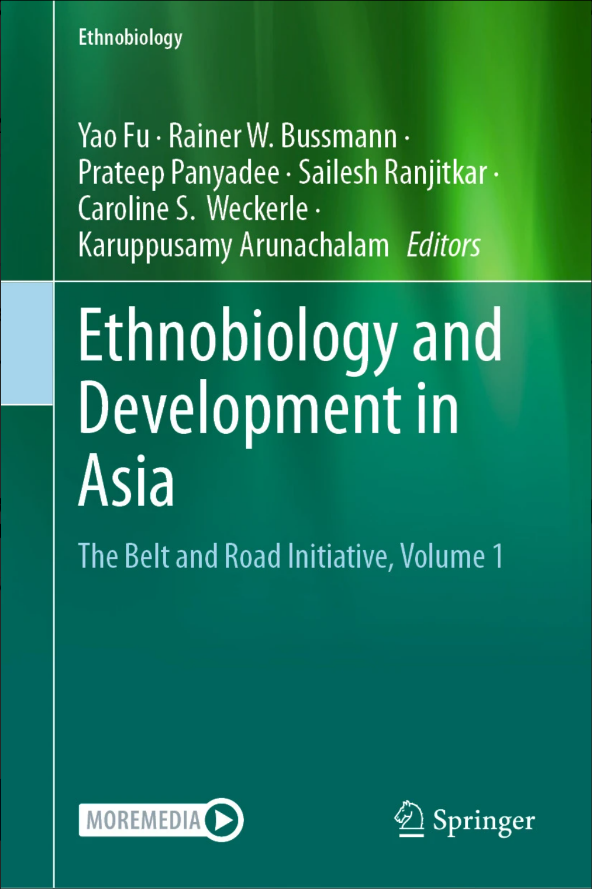
Cover of the book (Image by KIB)

