
Newsroom


Soil, the Earth's largest pool of active carbon, is critical to carbon neutrality efforts. However, amid intensifying plastic pollution, microplastics have become integrated into the soil carbon cycle.
To tackle this issue, researchers from the Wuhan Botanical Garden of the Chinese Academy of Sciences and Freie Universität Berlin explored the potential pathways through which microplastics affect soil organic carbon (SOC) dynamics from biological, geochemical, and physical perspectives.
Their findings were recently published in Nature Geoscience.
The researchers discovered that microplastics—often accompanied by other pollutants—can alter the content and quality of SOC. This happens by leaching dissolved organic matter (DOM) into the soil and interfering with the natural mineralization process of existing SOC. These changes may affect the "microbial carbon pump"—a mechanism critical for converting organic matter into stable forms—and the formation of mineral-associated organic carbon, which enables long-term carbon storage.
Furthermore, the study revealed that microplastic surfaces serve as critical interfaces: they can adsorb DOM for long-term preservation and transport, and act as "hotspots" for interactions between minerals and organic matter. In addition, microplastics disrupt soil aggregate structure and carry carbon sources, thereby altering the physical storage of SOC.
The team emphasized that future studies should seek to comprehensively understand the role of microplastics in SOC pool dynamics across local to global scales, particularly as plastic pollution continues to escalate. This is crucial for both addressing microplastic pollution and advancing carbon neutrality goals.
This work was funded by the National Natural Science Foundation of China and the Joint Fund of the National Natural Science Foundation of China and the China Postdoctoral Science Foundation.
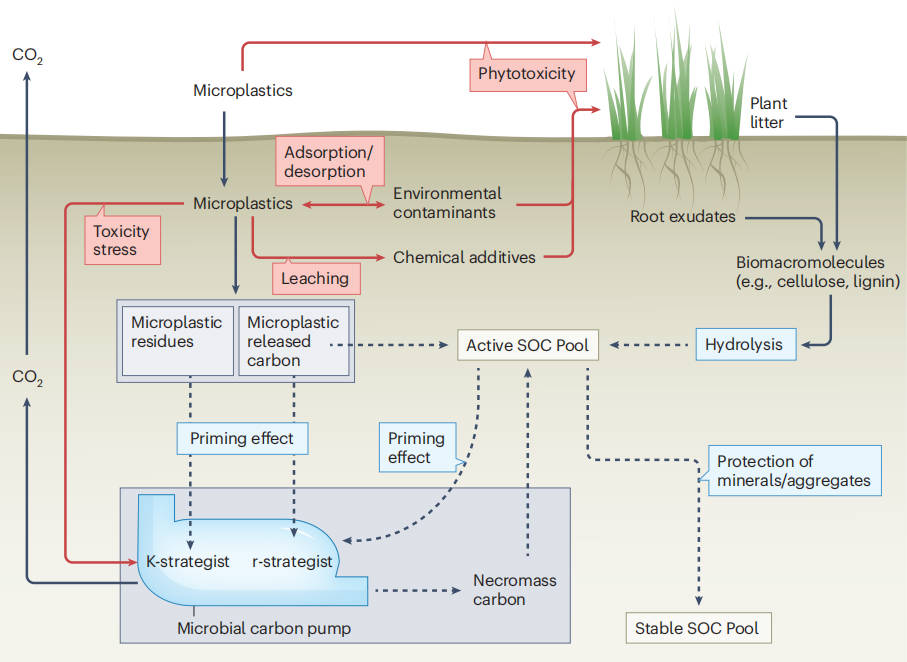
Fate of microplastic-derived carbon and its influence on SOC storage. (Image by HE Gang)
