

In a recent study, a research team from the Hefei Institutes of Physical Science achieved higher thermoelectric performance of n-type lead telluride (PbTe) by adjusting the band structure and enhancing phonon scattering.

A research team from the Shanghai Astronomical Observatory has recently completed a deep Q-band line scanning survey of the Orion Kleinmann–Low Nebula (Orion KL) using the Tianma 65-m radio telescope (TMRT).

In a recent study, a research team led by Prof. WANG Junfeng from the Hefei Institutes of Physical Science biomimetically synthesized soft ferromagnetic nanoparticles with high magnetic targeting and tumor tissue penetration based on the biomineralization mechanism of natural "biocompass" - magnetotactic bacteria.
A research team at Xi'an Institute of Optics and Precision Mechanics of the Chinese Academy of Sciences, and the collaborators, proposed a higher-order multipole model for the imaginary Poynting momentum (IPM) force, which provides the first direct experimental evidence for the ponderomotive nature of IPM.
Recently, the research group led by Prof. LIU Changsong from Institute of Solid State Physics, Hefei Institutes of Physical Science of Chinese Academy of Sciences developed a set of simulation software for accumulative displacement damage in nanocrystalline metals, which was named iterative object kinetic Monte Carlo (iOKMC) simulation software.
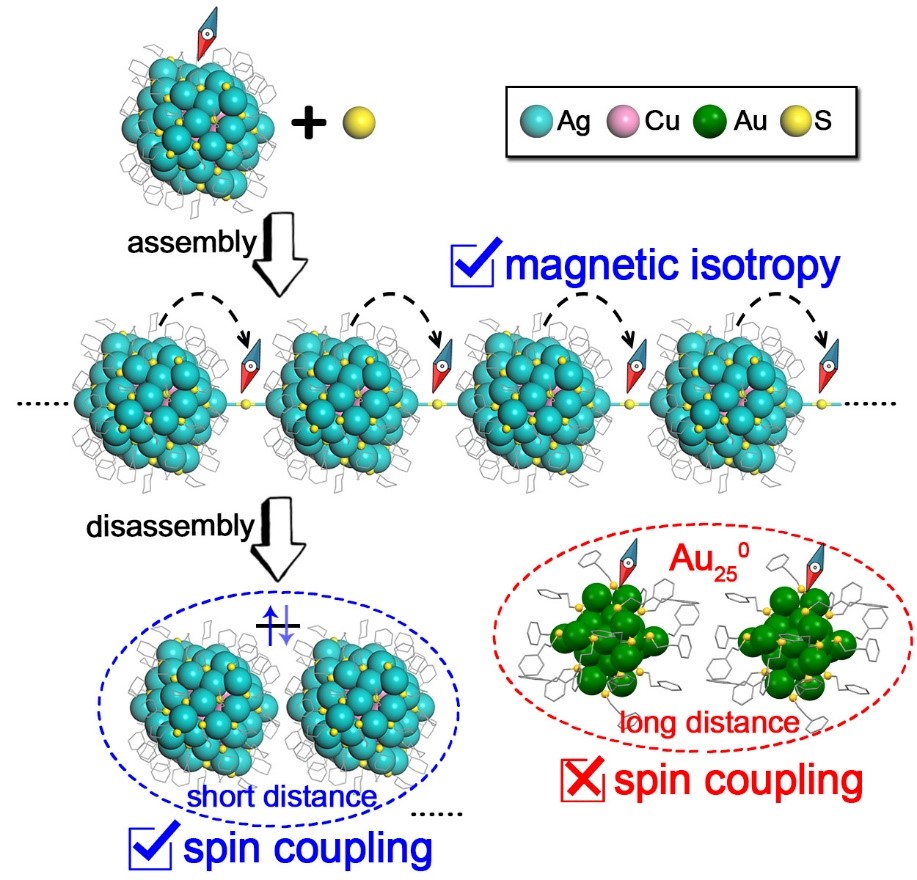
In a recent study, a research team led by Prof. WU Zhikun from the Hefei Institutes of Physical Science (HFIPS) discovered spin transfer and spin coupling through the linear assembly of silver-copper (Ag-Cu) alloy nanoclusters with sulfur.

86-10-68597521 (day)
86-10-68597289 (night)

52 Sanlihe Rd., Xicheng District,
Beijing, China (100864)
Copyright © 2002 - Chinese Academy of Sciences


