
Newsroom


Using the Five-hundred-meter Aperture Spherical radio Telescope (FAST), Dr. WEN Zhigang from the Xinjiang Astronomical Observatory of the Chinese Academy of Sciences, together with collaborators, have unveiled the most detailed scintillation characteristics to date of the millisecond pulsar B1937+21.
This study was published in The Astrophysical Journal on October 9.
Pulsars, often described as "cosmic lighthouses", emit regular radio pulses. As these signals traverse the turbulent interstellar space, they undergo scintillation, a phenomenon similar to starlight twinkling. This phenomenon is a powerful tool for studying the physical properties of the interstellar medium.
During a three-year observational campaign, the researchers systematically characterized how the pulsar's signals are scattered when traveling through the ionized interstellar medium. By analyzing data from 24 observational epochs, the researchers gained unprecedented insight into the extreme environments traversed by these pulsar signals.
Using autocorrelation function analysis and secondary spectrum techniques, the researchers precisely measured key scintillation parameters. The average scintillation timescale was determined to be 7.67 minutes, with a decorrelation bandwidth of approximately 0.56 MHz. The study notably captured persistent parabolic scintillation arcs across all observational frequencies.
A particularly significant finding was the annual variation in arc curvature. By developing refined scattering screen models, the researchers determined that the dominant scattering material to be located approximately 2.73 kiloparsecs from the pulsar. This finding provides new methods for accurately locating interstellar scattering media.
This work significantly improves the accuracy of pulsar timing arrays. These advancements are crucial for detecting gravitational waves and establishing more precise space-time references, which could open new avenues in fundamental physics research.
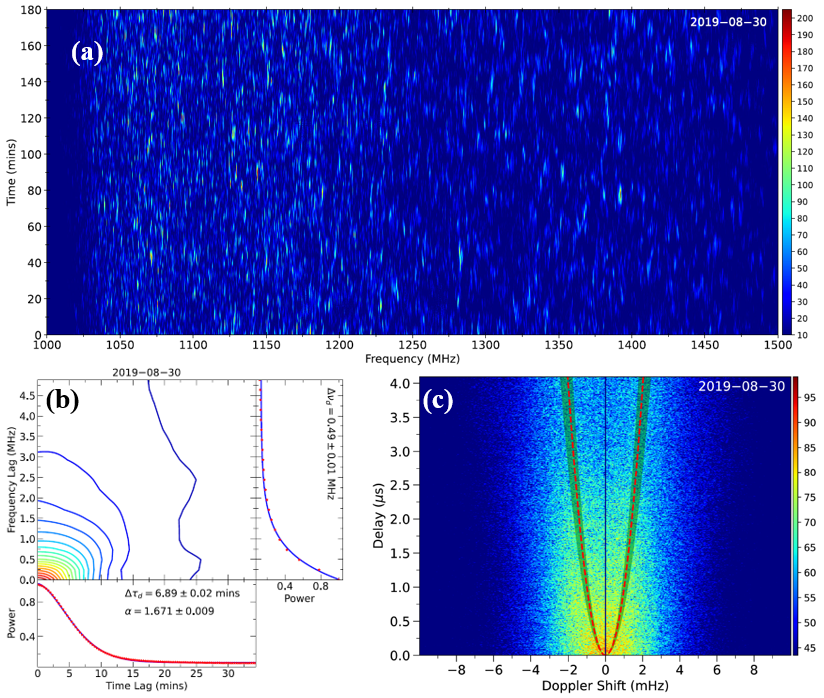
Dynamic spectrum (a), autocorrelation function (b), and secondary spectrum (c) of the millisecond pulsar B1937+21 at a frequency of 1250 MHz. (Image by WEN Zhigang)

