Newsroom


Researchers led by Associate Professor LI Xiangyang and Professor WANG Xianlong from the Hefei Institutes of Physical Science of the Chinese Academy of Sciences, together with Professor LI Xingxing from University of Science and Technology of China, have discovered a novel class of homochiral organometallic nanosheets that exhibit room-temperature multiferroic and topological properties.
Results were published in Nano Letters.
Multiferroic and magnetic topological materials are critical for advancing electronic technologies, but their widespread application has been limited by low Curie temperatures. Chirality, essential in fields like chiral sensing and molecular recognition, offers potential for enhancing these materials' multifunctionality, though research remains scarce. Notably, two-dimensional (2D) homochiral multiferroic and magnetic topological materials with room-temperature magnetic order are yet to be reported. Coupling chirality with multiferroic or topological properties is also an intriguing but challenging goal.
In this study, the researchers designed organometallic nanosheets using 4-(3-hydroxypyridin-4-yl)pyridin-3-ol (HPP) as an organic linker and transition metals (TM = Cr, Mo, and W) as the nodes. These materials, referred to as TM(HPP)2, exhibit robust room-temperature multiferroic and topological properties. The homochirality of the materials is driven by the chiral nature of the HPP organic linkers, while structural variations in chirality induce a Weyl phonon topological phase transition.
The room-temperature magnetism is attributed to strong d-p direct spin coupling between the TM cations and HPP doublet anions, while the ferroelectricity results from the breaking of spatial inversion symmetry. The coupling of ferroelectricity and chirality enables the effective control of light absorption and phonon topology through an applied electric field.
Additionally, these materials are topologically nontrivial, exhibiting a quadratic nodal point around the Fermi level.
This research achieves two significant advancements. It raises the Curie temperature of multiferroic and magnetic topological materials to room temperature, making them viable for use in ambient conditions. In addition, it integrates chirality into multiferroic and magnetic topological materials, expanding their multifunctionality and introducing new physical phenomena.
The study promises to influence a wide range of fields, including chirality, magnetism, ferroelectricity, topological materials, and multifunctional materials.
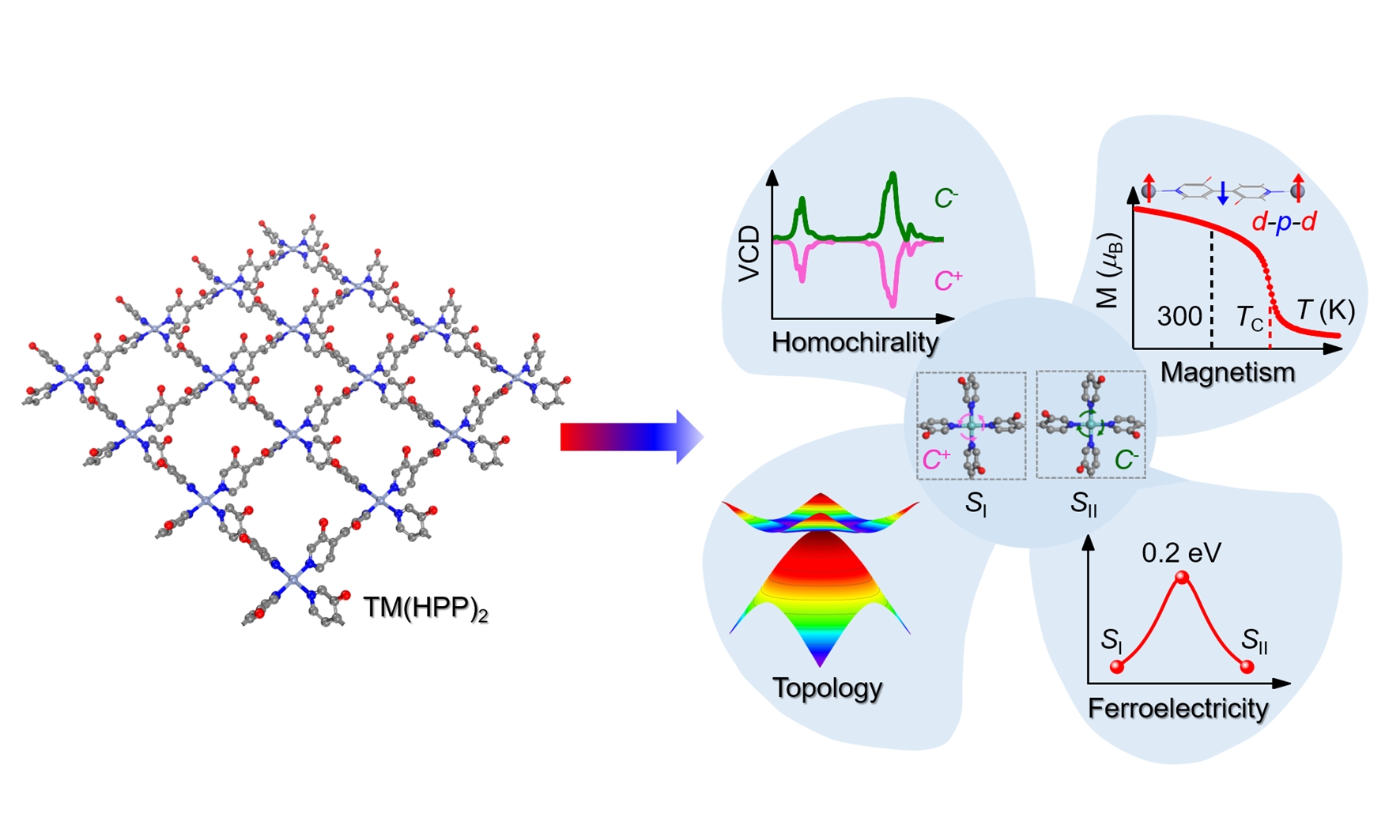
A class of homochiral multiferroic and magnetic topological organometallic nanosheets that can work at room temperature. (Image by ZHAO Jing)