Newsroom


A comprehensive systems analysis reveals that Pakistan's agricultural sector is on an unsustainable trajectory. Current input-intensive practices cannot meet future food security needs without increasing ecological stress. Published in Agricultural Systems, the study presents the first quantitative framework for transitioning to sustainable agriculture through integrated Water-Energy-Food (WEF) nexus management. This framework has broad relevance for semi-arid regions worldwide.
Led by Prof. CHEN Yaning from the Xinjiang Institute of Ecology and Geography (XIEG) of the Chinese Academy of Sciences, the study addresses a critical issue for Pakistan and other water-stressed countries: how to increase agricultural productivity when essential natural resources are steadily diminishing.
Pakistan's agriculture consumes nearly 90% of the country's freshwater resources, yet its wheat yields are half the global average. To better understand these imbalances, the researchers analyzed three decades of agricultural, hydrological, and energy data (1991–2021) using advanced econometric modeling and projected future trends through 2031.
They found that achieving a 15.1% increase in productivity by 2031 would require a 82.25% increase in pesticide use, a 19% increase in fertilizer application, and continued land expansion by 5.42%. Meanwhile, agricultural water availability is projected to decrease by 4.22%, and energy availability is projected to decrease by 6.15%.
These results underscore the need to move beyond conventional input-intensive agriculture and toward a WEF Nexus perspective, where resource efficiency, renewable energy adoption, balanced agrochemical use, and institutional coordination are all integrated to achieve sustainable productivity gains.
"Traditional approaches that rely on expanding cultivated areas or increasing chemical inputs are no longer viable," said Hassan Iqbal, first author of the study. "WEF Nexus-based strategies provide a sustainable alternative by addressing resource interdependencies and operating within ecological limits."
A major insight from the study is the identification of resource-efficiency thresholds. Short-term gains can be achieved through intensive inputs, but the long-term analysis shows a significant negative correlation between water withdrawal and productivity (r = 0.31) and a minimal correlation for energy use (r = 0.06). These findings underscore the importance of precision irrigation, renewable energy-based farm operations, and optimized input management.
The researchers proposed several practical policy interventions, including drip irrigation systems to reduce water use by 15–20%, solar-powered irrigation to ease energy constraints, and integrated pest management to lower chemical dependency by up to 40%. They also propose institutional reforms to improve cross-sectoral coordination.
"As semi-arid agricultural systems face increasing resource pressures and climate variability, integrated solutions that optimize existing resources become essential," said Prof. CHEN Yaning, corresponding author of the study.
The WEF Nexus framework developed in this research provides a replicable model for Pakistan and other water-scarce regions.
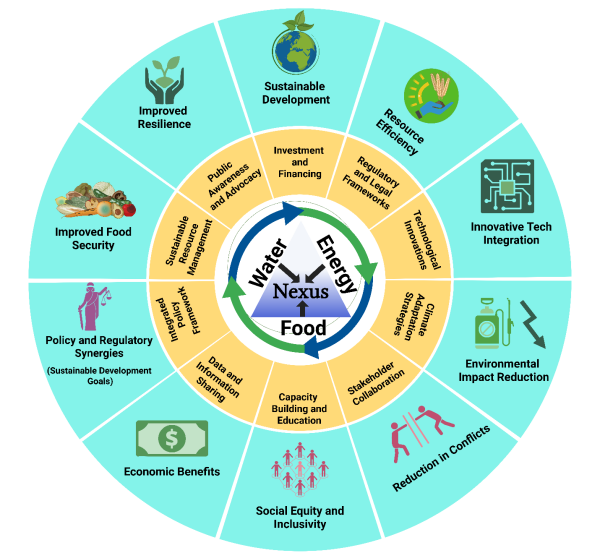
Integrated Water-Energy-Food Nexus framework illustrating key enablers and resulting benefits for sustainable agriculture and food security. (Image by XIEG)