Newsroom


Covalent organic frameworks (COFs) are a promising platform for heterogeneous photocatalysis due to their stability and design diversity, but their potential is often restricted by unmanageable targeted excitation and charge transfer.
Most COF-based photocatalytic systems for CO2 reduction focus on integrating metal catalytic sites onto COFs, typically alongside additional homogeneous photosensitizers, but the latter suffer from rapid deactivation and low recoverability, limiting the long-term operational efficiency of these catalytic systems.
In a study published in Small, Prof. CAO Rong, Prof. GAO Shuiying and colleagues from the Fujian Institute of Research on the Structure of Matter of the Chinese Academy of Sciences reported a bimetallic COF photocatalyst (PBCOFRuRe) that employs a novel in situ synthesis strategy to integrate sensitization center (Ru) and catalytic site (Re) onto conjugated COF. The design of PBCOFRuRe aims to enhance charge transfer efficiency and construct a photocatalytic system with long-term stability.
Researchers first constructed the COF photocatalyst, namely PBCOFRuRe, through in situ Schiff-base condensation of Pyrene with MBpy (M=Ru, Re) units. In this structure, Ru and Re are anchored within bipyridine as the photosensitive center and catalytic site, respectively. PBCOFRuRe was confirmed to have excellent crystallinity, porous nature and high CO2 adsorption capacity, and the Ru and Re coordination environment was elucidated, providing comprehensive structural characterization of PBCOFRuRe.
PBCOFRuRe exhibited an extraordinary carbon monoxide yield of 8306.6 μmol g-1 h-1 and selectivity exceeding 99.8% in photocatalytic CO2 reduction, outperforming most reported COFs. This superior performance is attributed to the efficient, rapid charge transfer along its stable conjugated framework, which effectively converting CO2 into CO. By anchoring metal sites within COFs, the reactivity loss of catalyst is minimized, resulting in superior recoverability and long-term stability compared to physically mixed photosensitizer systems.
Moreover, researchers used femtosecond transient absorption spectroscopy (fs-TAS) to investigate the ultrafast dynamic charge transfer kinetics in PBCOFRuRe, and the results were correlated with its photocatalytic activity. It was confirmed that the light-induced charge transfer from Ru to Re along the stable conjugated structure of PBCOFRuRe. And in situ diffuse reflectance infrared Fourier transform spectroscopy (DRIFTS) identified *COOH as a key reaction intermediate, revealing the mechanism for CO2 reduction by PBCOFRuRe.
This study demonstrates the synthetic feasibility of in situ integration of sensitizers and catalytic sites within COFs, highlights the effectiveness of bimetallic heterogeneous photocatalysis, and presents a new strategy for the design and synthesis of advanced photocatalysts.
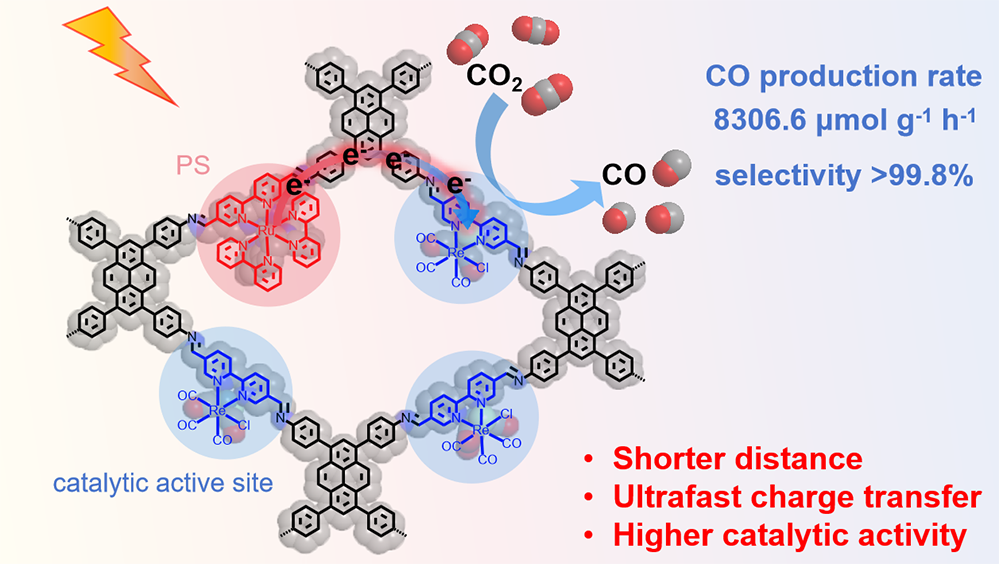
In situ integration of metallic catalytic sites (Re) and photosensitive centers (Ru) within covalent organic framework (PBCOFRuRe) for the enhanced photocatalytic reduction of CO2. (Image by Prof. CAO’s group)