
Heterometallic doping technology plays a crucial role in materials science, and is widely used to achieve structural or performance modifications that single-metal components cannot attain.
In a study published in Angew. Chem. Int. Edit., Prof. FANG Weihui and her colleagues from Fujian Institute of Research on the Structure of Matter of the Chinese Academy of Sciences employed Hard and Soft Acids and Bases (HSAB) theory to explore synthetic strategies for heterometallic materials, highlighting its advantages in designing and synthesizing discrete heterometallic clusters (intra-cluster assembly) and continuous heterometallic cluster-based materials (inter-cluster assembly).
Based on HSAB theory, researchers classified synthetic strategies, showcasing the diversity of heterometallic materials. They summarized three effective strategies for constructing heterometallic clusters, soft-hard ligand strategy, auxiliary ligand strategy, and metal-ligand strategy.
They discussed the influence of flexible ligands on conformation and their role in the formation of nested and cyclic clusters, and the importance of controlling the number of metal-oxo clusters and the role of auxiliary ligands in promoting cluster growth were emphasized, providing guidance for constructing larger and more complex structures.
Researchers underscored the significance of guiding theories in heterometallic framework synthesis, and pointed out that porous structures offer more possibilities for substance and charge transfer in host-guest chemistry and catalytic reactions.
From the perspective of design methodology, clusters with regular spatial orientations can serve as secondary building units for potential frameworks, theoretically expandable into frameworks through appropriate linking. Carefully selected secondary building units and linkages can generate frameworks with pre-designed characteristics, reflecting the concept of controllable design synthesis.
Besides, researchers broadened the application scope of heterometallic cluster-based materials to include catalysis, magnetism, and gas storage and separation. This shows the potential application of heterometallic materials across multiple fields.
This study aims to advance the development of heterometallic cluster-based materials in a controllable and predictable manner.
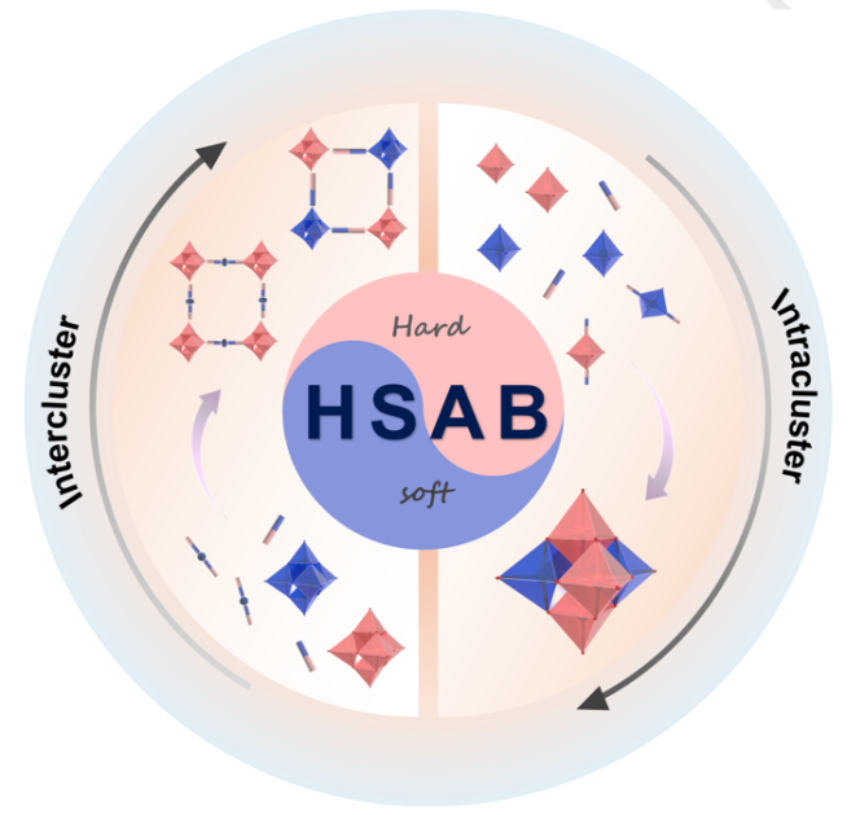
Schematic diagram of HSAB theory used in the construction of cluster-based heterometallic materials (Image by Prof. ZHANG's group)

86-10-68597521 (day)
86-10-68597289 (night)

52 Sanlihe Rd., Xicheng District,
Beijing, China (100864)
Copyright © 2002 - Chinese Academy of Sciences


