
Newsroom


A new study has developed a method to estimate rubber yields across Hainan Island, one of China's main natural rubber-producing regions. Using high-resolution remote sensing data, meteorological data, and a limited set of field measurements, the team mapped annual dry rubber yields from 2021 to 2025.
The study, led by Prof. LIAO Jingjuan from the Aerospace Information Research Institute of the Chinese Academy of Sciences (AIRCAS), was published in the International Journal of Digital Earth on October 17.
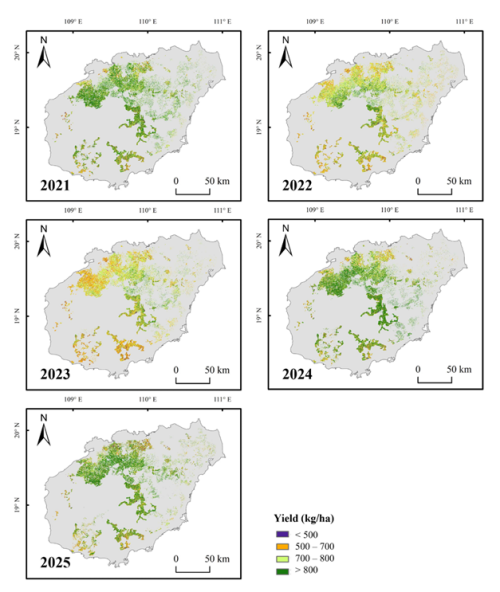
Rubber yield distribution on Hainan Island from 2021 to 2025. (Image by AIRCAS)
Natural rubber is a key raw material widely used in manufacturing, infrastructure, and transportation. Accurate yield estimation can help stabilize global supply chains and inform field management and industrial policies. Conventional methods rely on manual counting and sampling, which are costly and time-consuming and make it difficult to survey large-scale, remote, or scattered planting areas.
Existing methods for rubber yield estimation are broadly classified into statistical models and physical models. Statistical models can be accurate, but they require extensive field data for training and offer limited insight into the biological processes that determine yield. Physical models such as CASA can represent photosynthesis and other ecological processes, but they rely on fixed empirical parameters and estimate potential yields under ideal conditions. Actual yields vary with management practices, biotic stress, and environmental conditions.
To bridge the gap between potential and actual yield, the researchers developed a multi-stage coupled framework that couples the CASA model, SOLARFLUX, a conversion module, and a parameter calibration scheme.
SOLARFLUX uses a digital elevation model to estimate high-resolution solar radiation model and derive photosynthetically active radiation (PAR). The CASA model calculates net primary production (NPP), and a conversion coefficient is used to estimate actual yield from potential yield. The researchers used a grid search algorithm to calibrate the conversion coefficient and the land reflectance parameters (LRP) of the CASA model, choosing the combination that minimized the root mean square error (RMSE).
The researchers calibrated the model using yields measured at 53 plots on Longjiang Farm from 2022 to 2024 and validated it at the regional scale using 2009 survey data from 80 plots on five farms in western Hainan Island. They then applied the calibrated model across the island. The model achieved a coefficient of determination (R²) above 0.95, and calibration reduced the relative error from 21.99% to 16.62%.
Estimated total rubber yield across the island declined each year from 2021 to 2023, before rebounding markedly in 2024. Yield levels varied little among regions, while plantation patterns differed. Plantations were densely clustered in contiguous areas in northern and northwestern Hainan and covered substantial areas in central and southern Hainan, where they were more fragmented and dispersed.
Calibrating physical model parameters with a limited number of measured samples improved yield estimates and allowed the researchers to apply the model from individual plots to the whole island.
According to the researchers, the framework could be adapted to estimate crop yields in other regions with limited field data. The yield maps could help guide plantation management, ecological monitoring, and agricultural policy in Hainan, and support assessments of the rubber industry's sustainability.
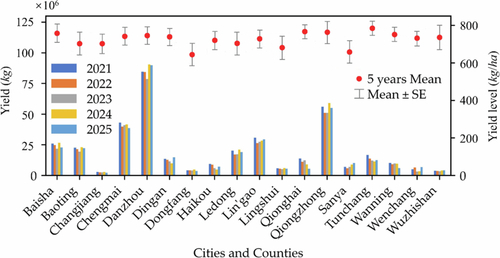
Statistical estimates of rubber yield by county/city in Hainan Province, 2021–2025. (Image by AIRCAS)
