Newsroom


A research team led by Prof. CHEN Cheng from the Hefei Institutes of Physical Science of the Chinese Academy of Sciences has used two polarimetric instruments to retrieve cloud optical and microphysical properties with high spatial resolution.
The Directional Polarimetric Camera (DPC) and the Particulate Observing Scanning Polarimeter (POSP), both independently developed by the team, are carried onboard the GaoFen-5(02) (GF-5(02)) satellite.
The findings were published in Journal of Quantitative Spectroscopy and Radiative Transfer and IEEE Transactions on Geoscience and Remote Sensing.
Cloud particle size is an important factor for understanding cloud formation, optical properties, and their impacts on climate. However, obtaining accurate cloud particle size information from satellite observations remains challenging, particularly at high spatial resolution.
For the DPC instrument, the team developed an approach to better utilize the polarization signals captured from different viewing angles. The method integrates information from neighboring pixels and adjusts the analysis area according to cloud conditions. This allows the cloudbow signals, which contain information about cloud particle size, to be used more effectively.
The resulting cloud particle size products have a spatial resolution of about 3.3 km, close to the original resolution of DPC observations. The method enables global mapping of cloud effective radius (CER) and cloud effective variance (CEV) for water clouds at a fine spatial scale.
For POSP, the team combined observations at two infrared wavelengths and corrected for the influence of cloud reflectance on the measurements. This increased the proportion of pixels with valid retrievals by 52.06%.
Using POSP observations, the team retrieved global cloud optical thickness (COT) and cloud effective radius (CER) for both water and ice clouds. The results were consistent with widely used cloud products from the Moderate Resolution Imaging Spectroradiometer (MODIS) and the Visible Infrared Imaging Radiometer Suite (VIIRS).
According to the researchers, the results could help deepen understanding of cloud processes and their impacts on climate.
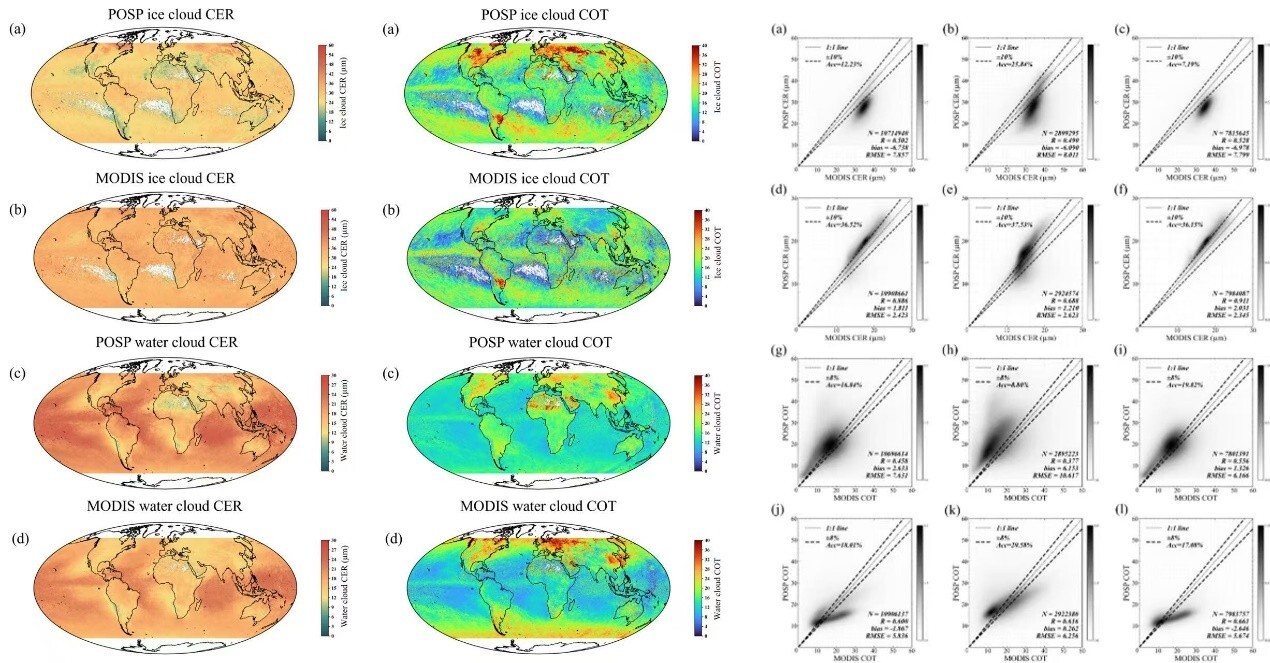
Global retrieval results and comparative validation of CER and COT from POSP/GF-5(02). (Image by YU Haixiao)