
Newsroom


A research team led by Prof. FENG Jian at the Institute of Genetics and Developmental Biology (IGDB) of the Chinese Academy of Sciences has uncovered a cytokinin–NODULE INCEPTION (NIN) regulatory module associated with spontaneous root nodule formation in alfalfa (Medicago sativa).
The findings were published in the Journal of Integrative Plant Biology on September 29.
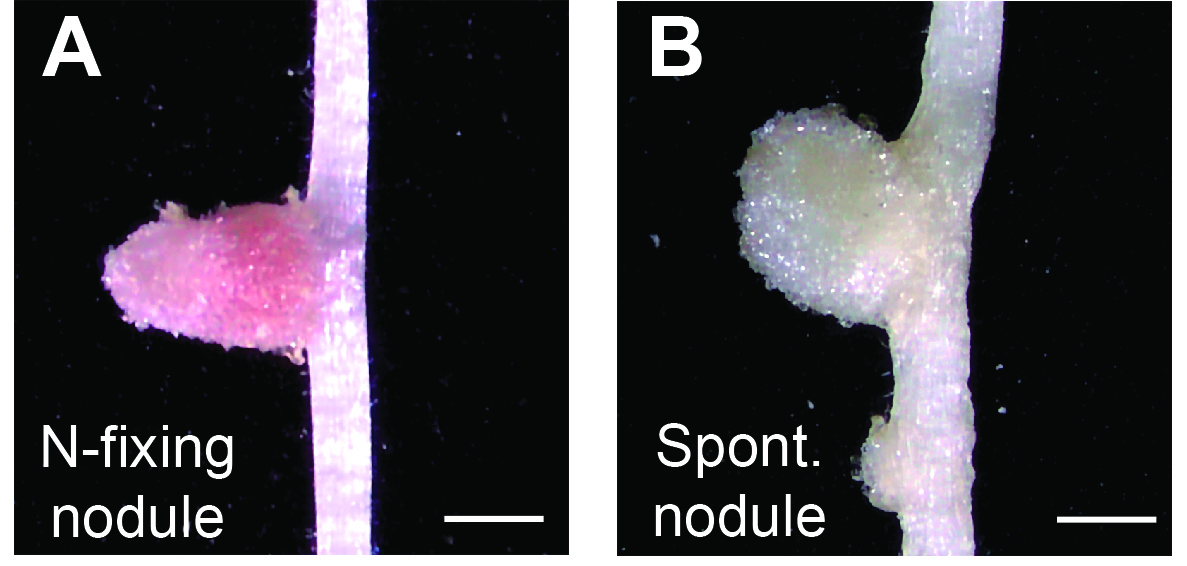
A rhizobia-induced nitrogen-fixing nodule (left) and a spontaneous nodule formed under sterile conditions (right). (Image by IGDB)
Legumes normally form nitrogen-fixing nodules in response to rhizobial signals. However, alfalfa can also produce spontaneous nodules in the absence of rhizobia, offering a natural system for investigating how plants initiate nodule development without bacterial infection.
The researchers examined 68 alfalfa accessions and found that all of them formed spontaneous nodules, although at varying frequencies. Zhongmu-3 was selected for further analysis. Compared with rhizobia-induced pink nodules, spontaneous nodules were smaller and white, lacked intracellular bacteria, and accumulated abundant starch granules. Even after subsequent rhizobial inoculation, these nodules remained uncolonized.
Cytokinin measurements revealed enrichment of trans-zeatin riboside (tZR) in spontaneous nodules relative to adjacent roots, without corresponding increases in other measured cytokinins. Applying tZR or the synthetic cytokinin 6-benzylaminopurine (6-BA) also induced the formation of structurally similar nodules.
Transcriptome analysis revealed shared activation of NIN and other nodulation-associated genes in spontaneous and cytokinin-induced nodules. Homologues of co-induced genes showed similar expression changes during rhizobia-induced nodulation in Medicago truncatula, indicating that part of a conserved developmental programme can operate without infection.
Chromatin analysis further revealed increased accessibility around the cytokinin-responsive element (CE) of the NIN promoter and near the transcription start site. The researchers also found that the type-B response regulators MsRR3 and MsRR10 bound the CE region in yeast and activated a CE-driven reporter in Nicotiana benthamiana leaves.
Together, these findings support a model in which cytokinin promotes NIN expression through MsRR3 and MsRR10 to initiate spontaneous nodule organogenesis, providing clues for reconstructing aspects of nodule development in non-legume crops. Spontaneous nodules do not fix nitrogen; establishing functional symbiosis will require additional host factors and effective rhizobial infection mechanisms.
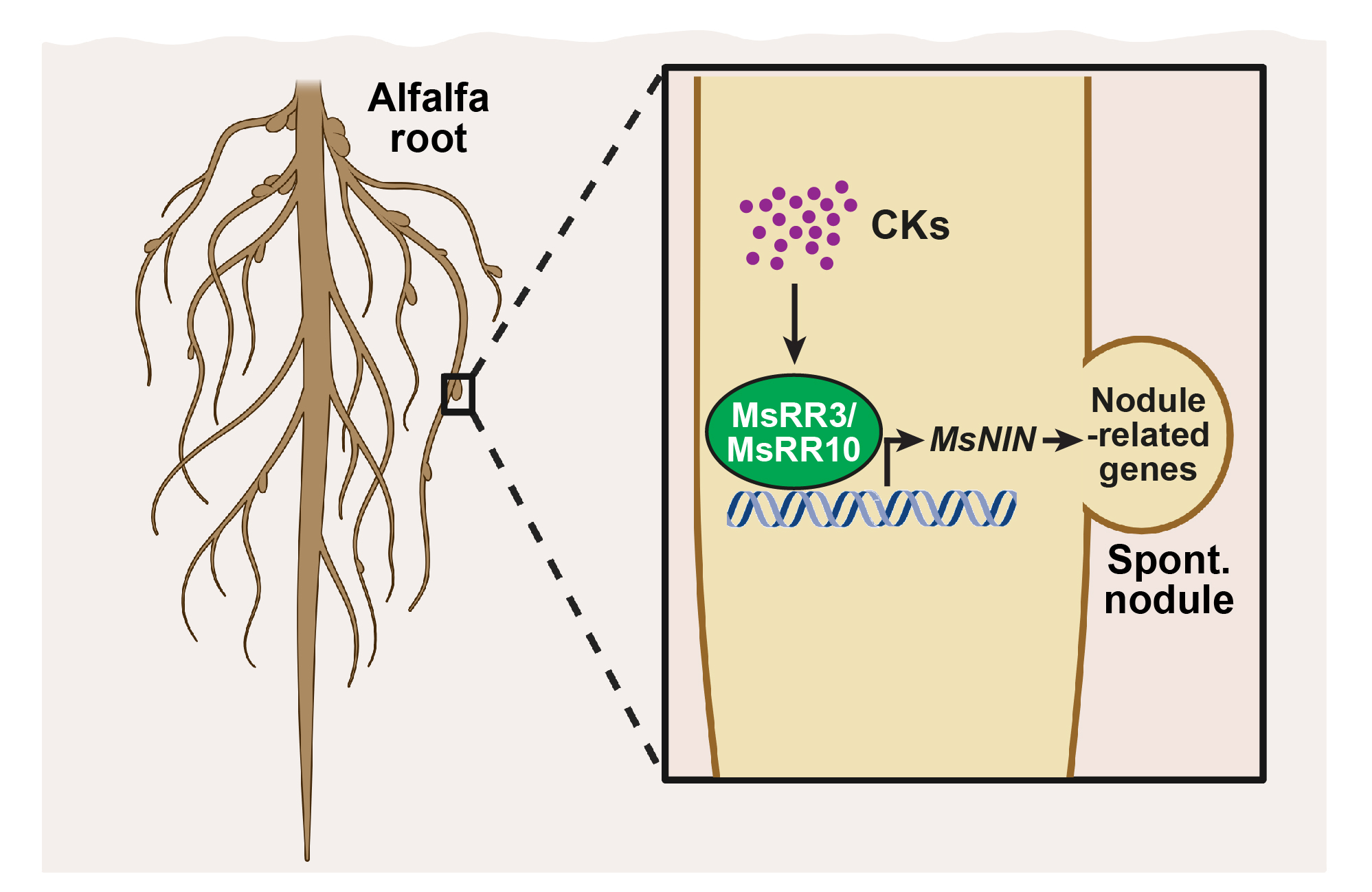
Model of cytokinin–NIN regulation of spontaneous nodulation in alfalfa. (Image by IGDB)
