
Newsroom


Stars used to calibrate the James Webb Space Telescope (JWST) must have precisely characterized spectra so that their fluxes can be measured accurately. Yet some stars that appear single may in fact harbor unresolved companions that alter their predicted radiation. One such object, HD 158485 — an A-type star in the JWST calibration program — has now been shown to be a binary system whose two stars both pulsate.
Researchers from the Xinjiang Astronomical Observatory of the Chinese Academy of Sciences made the discovery using long-term observations from NASA's TESS satellite. Their study provides the first orbital solution and dynamical mass ratio for the system, and has been published in The Astrophysical Journal Letters.
The team identified six stable δ Scuti pulsation modes, which fall into two groups with opposing light-travel-time variations. These signals trace the orbital motion of the two stars, yielding a period of 382.80 days, an eccentricity of 0.242 and a mass ratio of 0.818. An orbital model built from earlier TESS data also predicted the timing variations of a later observing campaign with accuracy, providing an independent check of the result.
The finding carries implications for JWST calibration. Using the measured mass ratio, the team compared a two-star atmosphere model with a conventional single-star model. The resulting fluxes differ by about 1.6% between one and five μm and by 2.5% between five and 28 μm. Those differences do not represent a measured error in JWST calibration, but they do show how an unresolved binary can shift predicted infrared fluxes even when a single-star model reproduces its optical spectrum well.
The study shows that stellar pulsations can expose binaries that conventional observations leave unresolved, and it underscores the need to account for hidden companions when evaluating calibration standards for high-precision space astronomy.
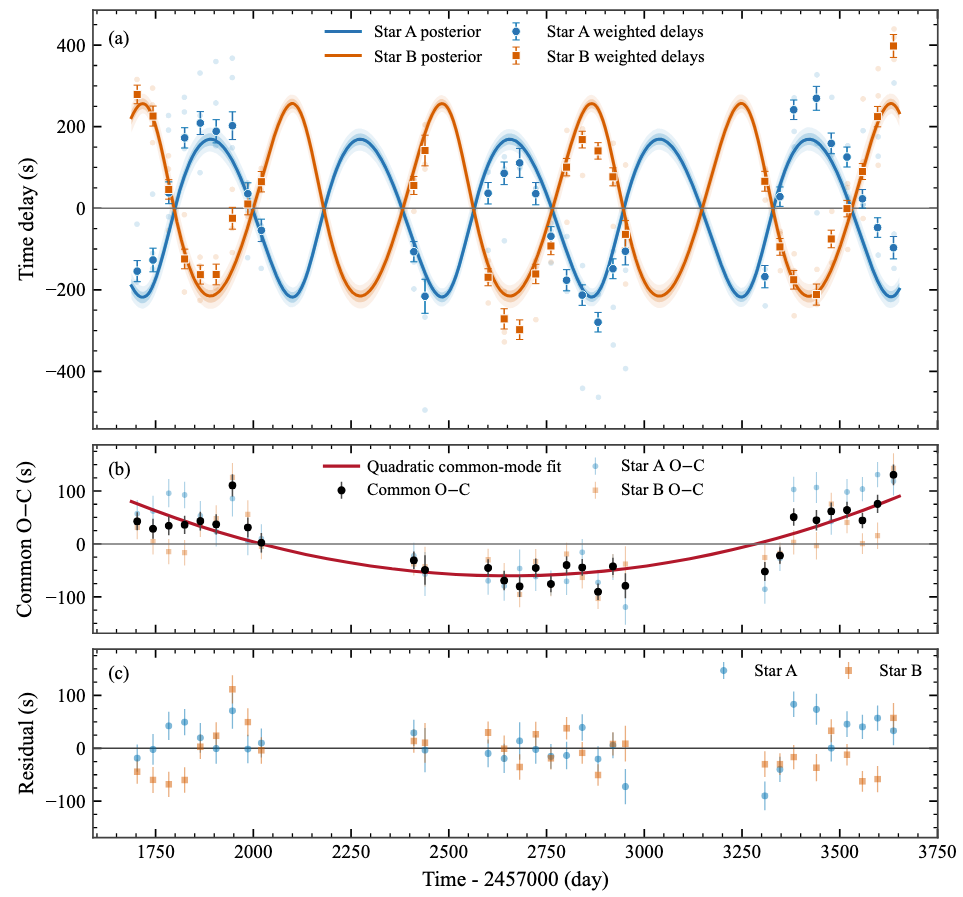
Pulsation timing results for HD 158485. The two groups of pulsation modes show opposite time delays, revealing the orbital motion of both stars. (Image by LV Chenglong)
