
Newsroom


A new study finds that the apparent "early galaxy crisis" suggested by recent James Webb Space Telescope (JWST) observations may not indicate a breakdown of the standard cosmological model. Instead, the phenomenon could result from a structural degeneracy in the interpretation of reionization observations.
The study, led by researchers from Shanghai Astronomical Observatory (SHAO) of the Chinese Academy of Sciences (CAS) and collaborators, was published in The Astrophysical Journal Letters on July 24.
JWST has discovered surprisingly bright galaxies at redshifts (z > 10), corresponding to an epoch when the Universe was only a few hundred million years old. These galaxies appear to have formed earlier and more efficiently than expected, prompting suggestions that they could challenge the standard ΛCDM cosmological model.
The new study links this apparent tension to a long-standing puzzle in reionization studies: estimates of the ionizing escape fraction have varied by several factors for more than a decade. The researchers found that global reionization observations mainly constrain the product of the escape fraction and the star-formation efficiency, rather than either quantity separately. This degeneracy means that seemingly different escape-fraction estimates may actually represent different views of the same underlying physical relationship.
Using the shape of the JWST ultraviolet luminosity function to independently constrain the star-formation efficiency, the researchers were able to resolve this degeneracy. Their analysis shows that the high-efficiency region previously associated with the JWST early-galaxy crisis is significantly excluded, even when stochastic bursty star formation is taken into account.
The team further reconstructed the evolution of the ionizing escape fraction over z = 7–12. They found that a moderate escape fraction of about 10% to 16% can naturally connect low-redshift direct measurements with high-redshift reionization constraints, offering a consistent explanation for how early galaxies released ionizing photons and transformed the Universe from a neutral to an ionized state.
"JWST observations are rapidly changing our understanding of the cosmic dawn," said WANG Zihan from University of Oxford, first author of the study. "Our results suggest that the so-called early galaxy crisis may not originate from the standard cosmological model itself, but from a degeneracy among the physical parameters inferred from reionization observations. Clarifying this relationship helps place JWST's bright early galaxies into a more consistent framework for understanding reionization."
"This study reveals a structural limitation in early-Universe inference and opens a path for future work," said SHAN Huanyuan from SHAO, corresponding author of the study. "By combining JWST spectroscopy, 21 cm reionization experiments, cosmic microwave background measurements, and large-scale galaxy surveys, we hope to trace how the first galaxies produced and released ionizing photons, and how this process influenced later galaxy formation and cosmic structure. Reionization may provide a key link between the first galaxies, structure formation, and fundamental cosmological parameters."
According to the researchers, the study suggests that some apparent "crises" in the early Universe could arise from limitations in the interpretation framework rather than from problems with the standard cosmological model. By turning a parameter degeneracy into a quantitative tool, the work provides a new way to use JWST and future 21 cm observations to probe the physics governing the first galaxies.
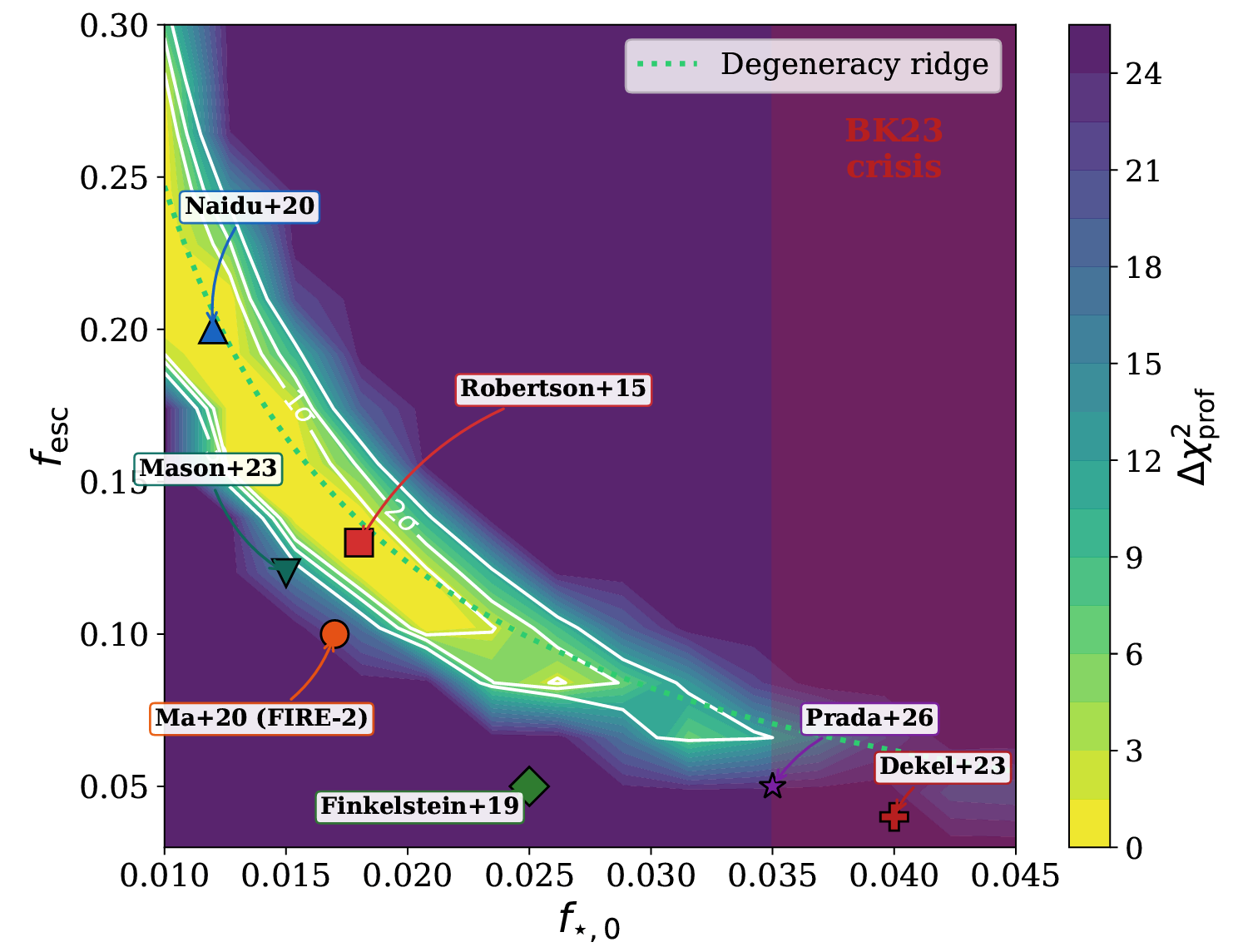
JWST ultraviolet luminosity functions break the reionization-parameter degeneracy. The red shaded region marks the high star-formation-efficiency regime previously associated with the early galaxy "crisis", while the joint observational constraints significantly exclude this region, indicating that JWST's bright early galaxies do not necessarily require anomalously high star-formation efficiencies. (Image by SHAO)
