
Newsroom


A research team led by Prof. WANG Hui at the Hefei Institutes of Physical Science (HFIPS) of the Chinese Academy of Sciences (CAS), in collaboration with Prof. FAN Kelong's group at the Institute of Biophysics (IBP) of the CAS, has found that the coordination number of the metal center governs sustained catalysis in single-atom nanozymes through a balance between substrate adsorption and catalytic turnover.
Based on this design principle, the researchers developed an FeN3 single-atom nanozyme that maintains high catalytic activity and effectively inhibits tumor growth in mice.
The findings were published in Angewandte Chemie International Edition.
Nanozymes are artificial materials that mimic the catalytic activity of natural enzymes. In cancer research, they can use hydrogen peroxide (H2O2) already present in tumors to produce highly reactive hydroxyl radicals (·OH), which damage cancer cells. However, effective cancer therapy requires catalysts to remain active over extended periods, a feature of nanozymes that has received relatively little attention.
In this study, the team prepared three iron single-atom nanozymes, each with a different nitrogen coordination number: FeN4, FeN3 and FeN2.
FeN3 stood out. It showed the highest catalytic activity, with a maximum reaction rate 1.9 times that of FeN2 and 4.1 times that of FeN4. More importantly, it maintained its activity during prolonged reactions, continuing to convert H2O2 into ·OH, while FeN2 gradually lost its catalytic ability.
The researchers attributed this advantage to the balanced binding strength at FeN3 sites. These sites bind H2O2 strongly enough to activate it, while permitting facile release of the reaction products, thereby regenerating the active sites for subsequent catalytic cycles and maintaining catalytic activity.
In tumor cells, FeN3 increased oxidative damage by continuously producing ·OH and reducing glutathione, a molecule that helps cells defend themselves against oxidative stress. This triggered two forms of cell death: apoptosis and ferroptosis.
Animal experiments further showed that FeN3 achieved the strongest inhibition of tumor growth among the three nanozymes, along with evidence of immune activation.
"Our findings highlight the importance of balancing substrate binding and catalytic turnover when designing nanozymes for sustained antitumor activity," said Prof. WANG.
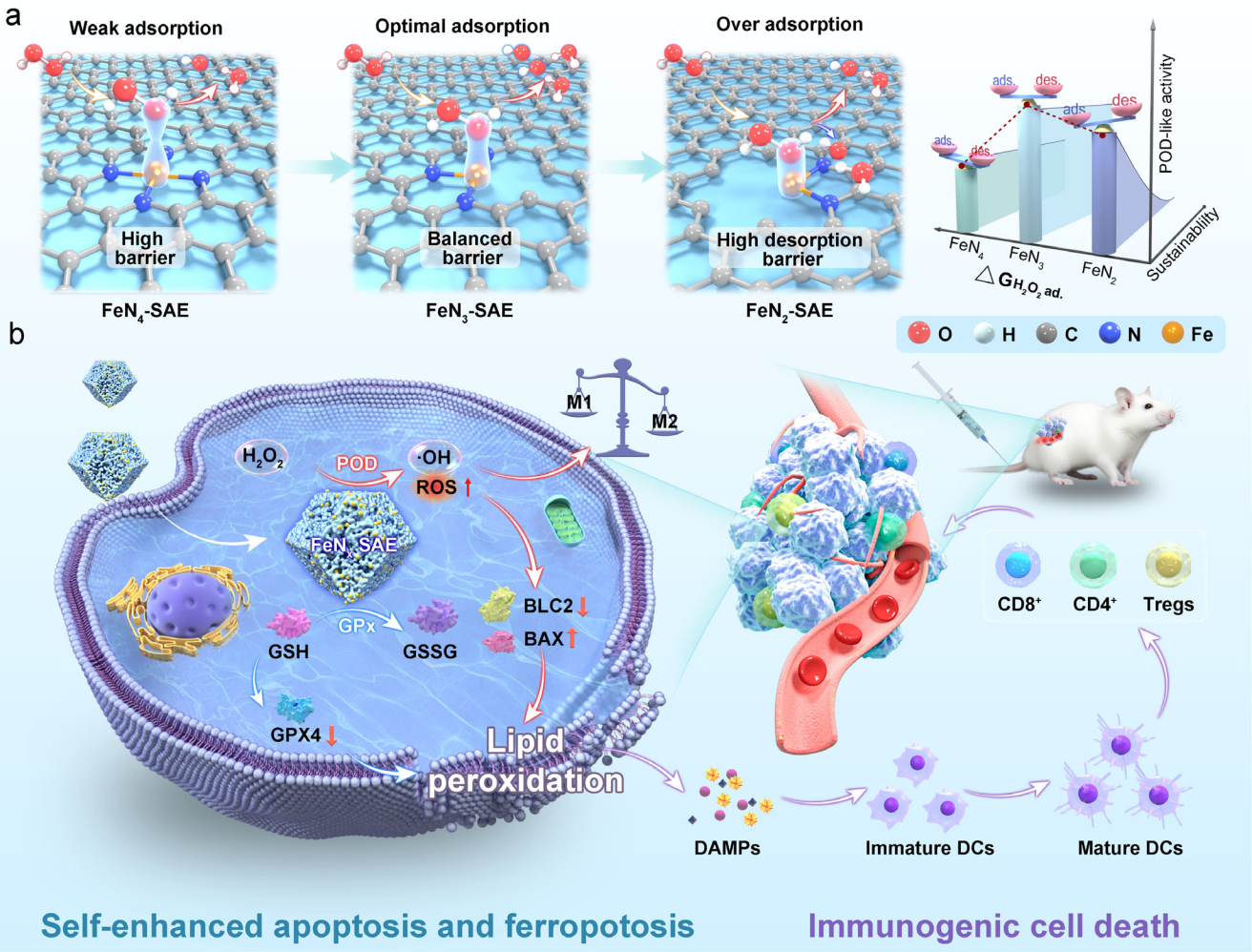
Schematic illustration of Fe–N coordination number regulation in sustained peroxidase-like catalysis by iron single-atom nanozymes and tumor treatment. (Image by SHI Xinyi)
