
Newsroom


Platinum (Pt)-based nanoalloys are among the most promising cathode catalysts for fuel cells and metal–air batteries, but their commercialization remains hindered by performance loss under operating conditions. Understanding how atoms rearrange on catalyst surfaces during the oxygen reduction reaction (ORR) is essential for designing more durable catalysts.
A research team led by Prof. HAN Lili from the Fujian Institute of Research on the Structure of Matter (FJIRSM) of the Chinese Academy of Sciences, together with collaborators from Tianjin University of Technology and Tianjin University, has traced the structural degradation of a representative PtZn nanoalloy at the three-dimensional (3D) atomic level.
By combining atomic electron tomography (AET), synchrotron X-ray techniques and theoretical calculations, the study shows how bulk stability and localized surface reconstruction coexist during electrochemical cycling. The work was published in Angewandte Chemie International Edition.
The researchers used carbon-supported PtZn nanoparticles with a face-centered tetragonal (fct) structure as a model ORR catalyst and subjected them to repeated cyclic voltammetry cycling. Ex situ and in situ X-ray measurements showed that the overall fct bulk structure remained largely intact, with only minor changes in particle size.
However, atomic electron tomography revealed a very different picture at the surface. After aging, Zn was lost much faster than Pt — reaching about 50% Zn loss after 10,000 cycles while Pt loss stayed below 1%. This unequal dissolution produced uneven Pt-rich surface layers rather than a uniform Pt skin.
Further 3D atomic analysis showed that surface atoms gradually shifted from the fct structure of PtZn toward the face-centered cubic (fcc) structure of Pt. The surface coordination number dropped, the average surface bond length expanded from 2.68 Å to 2.73 Å, and obvious normal strain appeared in the segregation regions.
Theoretical calculations supported the experimental observations. The escape energy of Zn atoms was lower than that of Pt atoms, explaining why Zn leaves first and triggers Pt segregation. Energy comparisons also showed that, once Zn depletion becomes severe, the fcc-Pt surface becomes thermodynamically favored over the original fct structure. Density functional theory calculations further indicated that this surface transformation raises the ORR reaction barrier and weakens catalytic activity.
According to the researchers, this study provides a cross-dimensional framework for linking ensemble-averaged X-ray data with real-space atomic reconstructions. Rather than treating catalyst degradation as uniform bulk decay, it clarifies that PtZn deactivation is dominated by localized surface reconstruction while the interior lattice remains stable.
The findings offer guidance for designing defect-tolerant Pt surfaces or stabilized shells that resist Zn dissolution in future ORR catalysts, the researchers added.
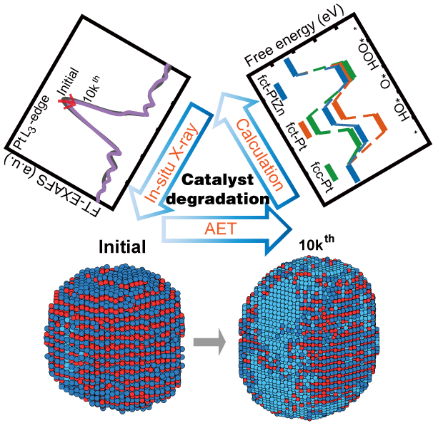
Elucidation for the degradation mechanism of Pt-alloy ORR catalyst through a cross-dimensional coupling of AET, in situ X-ray and theoretical calculations. (Image by Prof. HAN's group)
