Newsroom


In a study published in Angewandte Chemie International Edition, a research team led by Profs. WEN Zhenhai and HUANG Junheng from the Fujian Institute of Research on the Structure of Matter (FJIRSM) of the Chinese Academy of Sciences has developed a fluorine-engineered graphene electrocatalyst with precisely tailored sp2-C-F bonding.
The catalyst enables highly reversible O2-H2O2 interconversion and delivers outstanding performance in zinc-based batteries.
Rechargeable zinc-air batteries (ZABs) are highly promising next-generation energy storage technologies, offering ultrahigh theoretical energy density, intrinsic operational safety and abundant zinc resources. However, their practical deployment has long been hindered by sluggish four-electron (4e-) oxygen electrocatalysis, including the ORR during discharge and OER during charge. These multistep proton-coupled electron transfers face high energy barriers, leading to large voltage polarization, low round-trip efficiency and accelerated catalyst degradation.
The two-electron (2e-) O2-H2O2 interconversion pathway has attracted growing attention for its faster intrinsic kinetics and better reversibility. Nevertheless, developing high-performance bifunctional catalysts remains challenging: metal-based catalysts are prone to performance-degrading Fenton-like side reactions, while conventional metal-free carbon catalysts face an inherent conductivity-selectivity trade-off.
In this study, the researchers developed a facile thermal defluorination strategy to synthesize a series of fluorinated graphene (FG-X) with gradient fluorine contents. Using commercial highly fluorinated graphene as the precursor, stepwise pyrolysis under inert atmosphere tunes C‑F bonding from insulating sp3‑C‑F to conductive sp3‑C‑F, while restoring the conjugated sp2 carbon network.
The optimized FG‑3 (~3.1 at.% F) achieves an optimal balance between electrical conductivity and catalytic activity, with a well‑recovered graphitic structure, uniform fluorine distribution, high surface area and improved wettability.
Electrochemical evaluations confirmed FG‑3's exceptional bifunctional activity for 2e-‑ORR and POR, with 97.4% H2O2 selectivity and 98.0% Faradaic efficiency. The assembled primary zinc‑oxygen battery delivers a peak power density of 569 mW cm-2; the rechargeable version realizes a 98.0% round‑trip efficiency at 2 mA cm-2, retains 97.6% efficiency after 1500 cycles, and operates stably for over 820 hours in ambient air.
Mechanistic studies combining operando spectroscopy and first‑principles simulations revealed that sp2‑C‑F bonds induce localized electrostatic polarization on adjacent carbon sites, stabilizing the key *OOH intermediate and lowering the kinetic barrier.
According to the researchers, this work establishes a clear structure‑property relationship for fluorinated carbon electrocatalysis, offering a general strategy for carbon material engineering and paving the way for durable metal‑air batteries and on‑site H2O2 electrosynthesis.
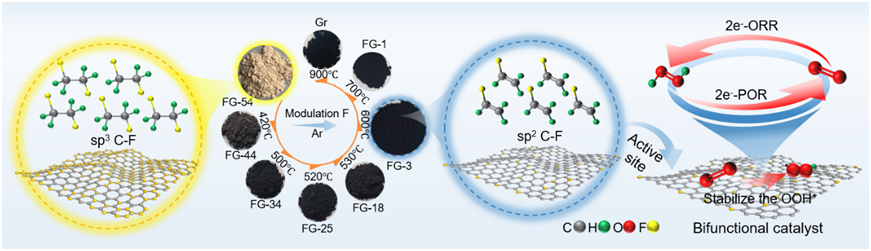
Schematic illustration of the thermal defluorination strategy for synthesizing fluorinated graphene and its application in bifunctional oxygen-peroxide electrocatalysis. (Image by Prof. WEN's group)