Newsroom


Researchers have recently developed a patient-derived organoid (PDO) platform to investigate drug resistance in triple-negative breast cancer (TNBC).
The platform revealed that overactive PI3K-AKT signaling plays a key role in resistance to sacituzumab govitecan (SG), and showed that this resistance can be reversed using a clinically available PI3K inhibitor.
Led by Prof. LIU Qingsong from the Hefei Institutes of Physical Science of the Chinese Academy of Sciences, along with Prof. QI Xiaowei's research group from Southwest Hospital, Army Medical University, the study was published in Cell Reports Medicine on November 25.
TNBC accounts for roughly one in five breast cancers and carries a poor outlook. SG, an antibody-drug conjugate directed against TROP-2, was approved by the FDA in 2021 and has since become a standard option for metastatic TNBC. However, a large share of patients gain little benefit from it, and no reliable marker is available to predict who will respond.
To build a clinically faithful testing platform, the researchers constructed a living organoid bank from breast tumor specimens and successfully derived 40 TNBC lines from 53 samples after optimizing the culture conditions. Drug screening across the PDO panel, quantified with a growth-rate-adjusted metric, matched the actual treatment outcomes of the corresponding patients, including a case whose SG resistance in the organoid anticipated the patient's lack of clinical benefit.
According to the researchers, a key innovation of this study is the mechanism underlying this resistance. Integrative transcriptomic and single-cell analyses traced SG resistance to a persistent epithelial cell population that survives through the combined effects of PI3K-AKT signaling, inflammatory signals, and cues from the extracellular matrix. This resistance route is distinct from TROP-2 loss or the mutations previously implicated in SG failure.
In preclinical models, combining SG with alpelisib, an FDA-approved PI3Kα inhibitor, restored durable tumor control in both PDOs and patient-derived xenografts, including in tumors lacking PIK3CA mutations. This finding indicates that pathway activity, rather than genotype alone, should guide patient selection.
The study shows that patient-derived organoids can help researchers understand drug resistance and identify more effective treatment combinations for cancer patients.
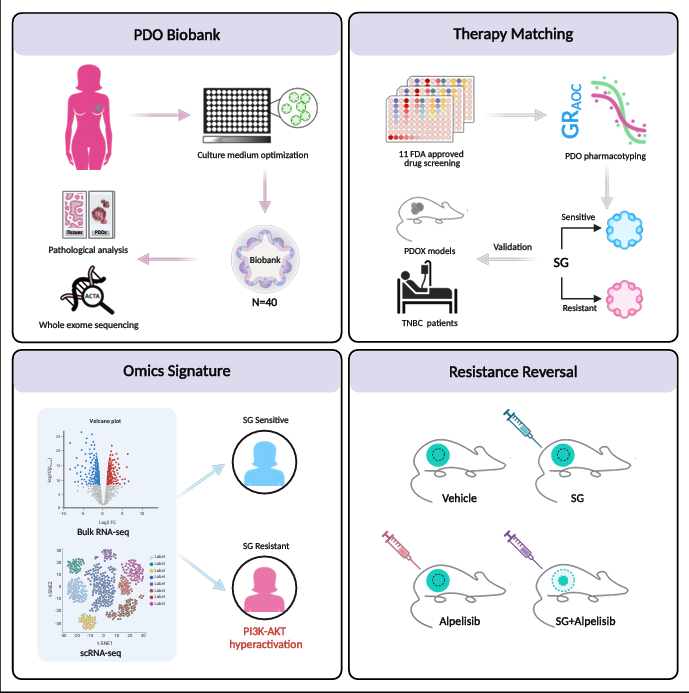
Using a PDO biobank, we traced SG resistance to PI3K-AKT signaling and showed that combining SG with the PI3K inhibitor alpelisib overcomes resistance. (Image by WANG Wenchao)