
Newsroom


Industrially relevant cell lines include both direct production hosts for recombinant proteins, vaccines, and viral vectors, and biomedical models that serve as references for host-cell engineering and comparative studies. These cell lines support the development and worldwide supply of recombinant therapeutics, viral vaccines, and gene therapies.
However, their genomic, transcriptomic, and epigenomic profiles, along with phenotype information extracted from scientific literature, remain scattered across different repositories, projects, and publications. Differences in reference genomes and analytical workflows further complicate data integration, making it difficult to systematically characterize these cell lines.
Recently, the National Genomics Data Center (NGDC), part of the China National Center for Bioinformation (CNCB), has released iCellOmics, an open-access multi-omics database for industrial cell lines. The work was published online in Nucleic Acids Research on November 10.
According to the researchers, this work integrates, for the first time, multi-omics data and literature-curated gene–phenotype knowledge for multiple industrially relevant cell lines within a unified data analysis framework, addressing the lack of resources for integrated multi-omics analysis across industrial cell lines.
The current release of iCellOmics covers 17 industrially relevant cell lines and integrates six data categories: reference genomes and annotation information for seven species, encompassing 144,018 protein-coding genes; 170,408,888 genomic variants with functional annotations from 55 whole-genome sequencing projects across 15 cell lines; 673 differential-expression comparisons from 241 bulk transcriptome sequencing projects; 1,047,274 cells from 30 single-cell transcriptome sequencing projects; 287,089,415 chromatin-accessibility peaks from 171 ATAC-seq projects; and 37,213 gene–phenotype relationships extracted from 6,312 publications, involving 6,605 gene/protein entities and spanning 104 standardized phenotype subcategories.
iCellOmics supports both "cell line-centric" data browsing and "gene-centric" cross-omics retrieval. Users can browse the available data across different modules by cell line or use the Gene Search function to retrieve an integrated profile of a specific gene in a given cell line. This profile covers variant sites, expression comparisons, accessible chromatin regions, an overview of single-cell transcriptome data, and gene–phenotype relationships extracted from the literature.
The database also organizes literature-curated gene–phenotype relationships into an interactive knowledge graph, with switchable detailed and collapsed views. Users can filter the graph by cell line, phenotype category, entity name, relationship type, and PubMed ID. For each relationship, the database displays relevant literature context, experimental perturbations, and reported effects, offering knowledge-guided support for host-cell engineering.
In addition, iCellOmics integrates the JBrowse 2 genome browser and online GO/KEGG enrichment analysis tools. It also provides downloadable processed datasets covering reference genomes, chromatin accessibility, and single-cell transcriptomes, facilitating local analyses.
Overall, the multi-omics data and gene–phenotype knowledge available through iCellOmics provide valuable resources for basic research and support the engineering of industrial cell lines, as well as the development and optimization of high-yield, stable producer cell lines.
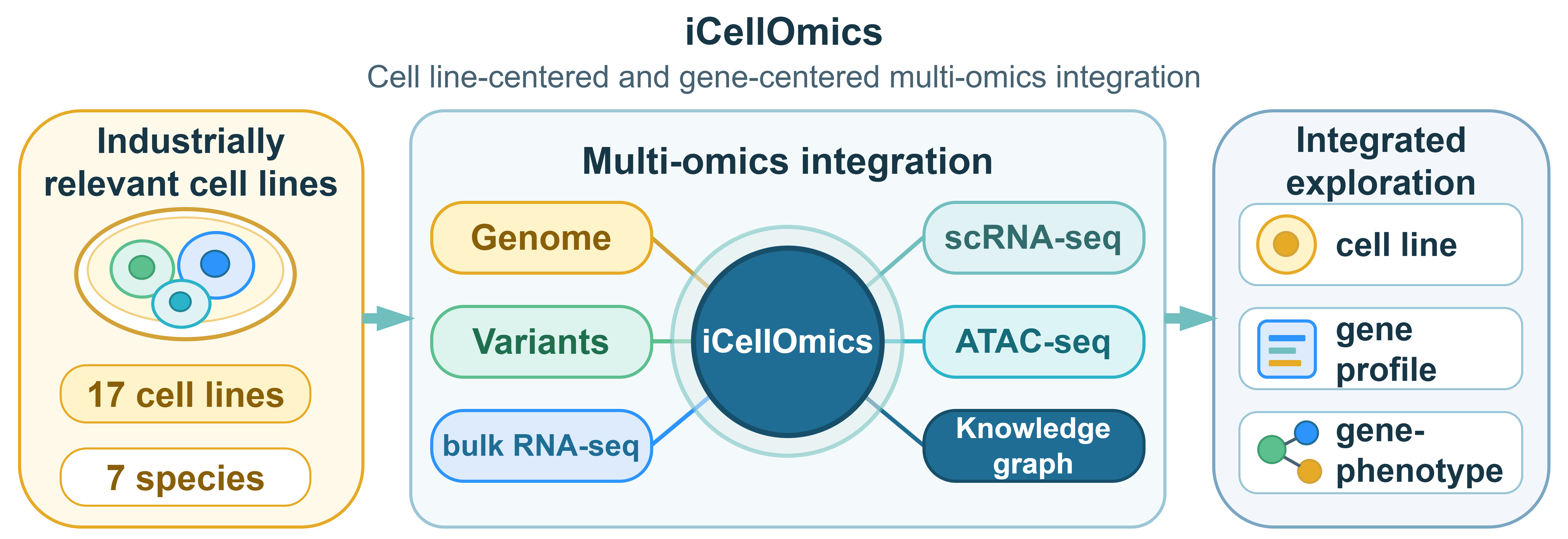
iCellOmics: Cell line-centered and gene-centered multi-omics integration (Image by CNCB-NGDC)
