
Newsroom


Although lakes cover less than 2% of the Earth's surface, they play a key role in regulating global carbon, nutrient, and biodiversity dynamics.
A recent study led by Prof. ZHANG Ke from the Nanjing Institute of Geography and Limnology of the Chinese Academy of Sciences (NIGLAS) has found that global lakes are undergoing a structural shift: they are losing their historical spatial heterogeneity and becoming increasingly synchronized across the planet.
The study, titled "Global lake synchrony signals rising planetary-scale ecological coupling", was published in the Proceedings of the National Academy of Sciences (PNAS) on November 16. It highlights how this ecological synchronization has emerged as a new hallmark of the Anthropocene, fundamentally changing how inland waters respond to large-scale environmental changes and potentially threatening Earth-system stability.
Historically, lake ecosystems fluctuated independently, with local watershed characteristics helping buffer them against broader environmental changes. This "spatial asynchrony" acted as a natural planetary shock absorber, distributing ecological disturbances across time and space. However, by integrating century-scale sedimentary archives with continuous satellite observations from approximately 2,000 lakes, the research team identified a marked acceleration in global lake synchrony since the year 2000, accompanied by a significant decline in network modularity.
Driven by environmental telecoupling including climatic extremes (such as heatwaves) and socioeconomic pressures, this widespread synchronization is aligning lake dynamics on a planetary scale. The researchers said that phytoplankton biomass and water clarity act as integrated proxies for lake metabolic activity. The increasing synchrony of these indicators suggests that the underlying carbon, nutrient, and biodiversity dynamics they reflect may also be becoming more synchronized over time.
"This loss of buffering capacity transforms lakes from passive, regionally distinct systems into active amplifiers of global environmental risks. Synchronized lakes can concentrate biophysical fluxes, potentially triggering high-amplitude global pulses, such as simultaneous greenhouse gas emissions or widespread aquatic hypoxia, thereby exacerbating the triple planetary crisis," ZHANG said.
Addressing this challenge, the study highlights a "scale mismatch" in current environmental governance, which traditionally manages water bodies as isolated local resources. Prof. ZHANG and his co-authors propose a paradigm shift: treating interconnected lake networks as a dynamically coupled "Planetary Commons."
To operationalize this concept, the team introduced the framework of Strategic Planetary Lake Areas (SPLAs). By tracking macroscale synchrony and modularity metrics, policymakers can identify prime candidate regions—such as rapidly converging regional sub-networks—for targeted polycentric governance. The ultimate objective is not to eliminate synchrony, but to safeguard the localized ecological processes that maintain landscape heterogeneity.
"This research not only redefines the critical importance of inland waters in global change studies but also introduces a macroscale dimension to international sustainable development agendas," ZHANG said. "The work emphasizes that preserving the diversity of ecological responses is essential for maintaining long-term Earth-system stability in an increasingly interconnected world."
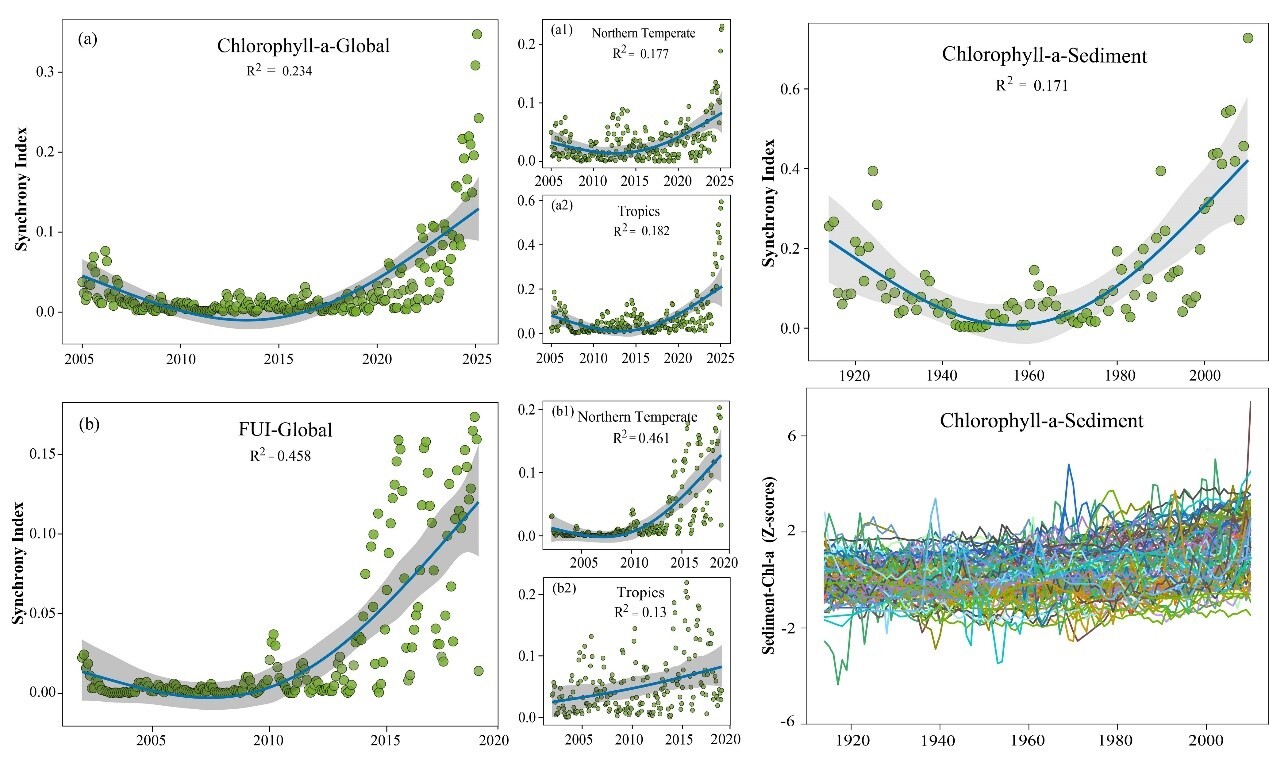
Increasing ecological synchrony among lakes revealed by satellite observations and long-term sedimentary records. (Image by NIGLAS)

