
Newsroom


A new study has revealed how Ppp1r3g negatively regulates innate antiviral immunity and suppresses platelet activation in fish, offering new insights into the mechanisms underlying grass carp hemorrhagic disease.
The study was led by Prof. CAO Hong from the Institute of Hydrobiology (IHB) of the Chinese Academy of Sciences (CAS) and published in PLOS Pathogens.
In recent years, hemorrhagic disease in grass carp caused by grass carp reovirus (GCRV) has remained a persistent threat to the grass carp aquaculture industry. A characteristic feature of GCRV infection in fish is extensive hemorrhage across multiple organs and tissues, which is often accompanied by vascular wall disruption and circulatory necrosis.
At present, the prevention and control of grass carp hemorrhagic disease rely primarily on vaccination and integrated disease management, while specific therapeutic strategies targeting GCRV infection remain limited.
Protein phosphatase 1 regulatory subunit 3G (PPP1R3G) is one of the regulatory subunits of protein phosphatase 1 (PP1). Previous studies have primarily focused on its roles in glycogen and lipid metabolism. However, the role of ppp1r3g in fish innate immune responses and GCRV-induced hemorrhagic disease remains poorly understood.
In this study, the researchers established ppp1r3g-deficient rare minnow (ppp1r3g−/−) and ppp1r3g-chimera grass carp (ppp1r3g-chimera) as in vivo models. Following GCRV infection, both models exhibited enhanced resistance to GCRV, accompanied by markedly increased expression of interferon and GCRV-induced antiviral genes.
Compared with the wild-type (WT) controls, both ppp1r3g−/− rare minnow and ppp1r3g-chimera grass carp larvae exhibited substantially less muscle hemorrhage, accompanied by increased expression of several coagulation-related genes and decreased expression of selected anticoagulation-related genes.
Mechanistically, the researchers revealed that Ppp1r3g competes with integrin-β3 (Itgb3) for binding to 14-3-3ζ and promotes Itgb3 degradation in a proteasome-dependent manner, which inhibits the formation of the 14-3-3ζ-Itgb3 complex, suppressing platelet activation.
This study discovers the role of Ppp1r3g in fish innate immunity and elucidates its regulatory mechanism in the coagulation pathway. According to the researchers, these findings reveal a potential new strategy for the green prevention and control of grass carp hemorrhagic disease, highlighting the Ppp1r3g–14-3-3ζ–Itgb3 axis as a potential target for disease management.
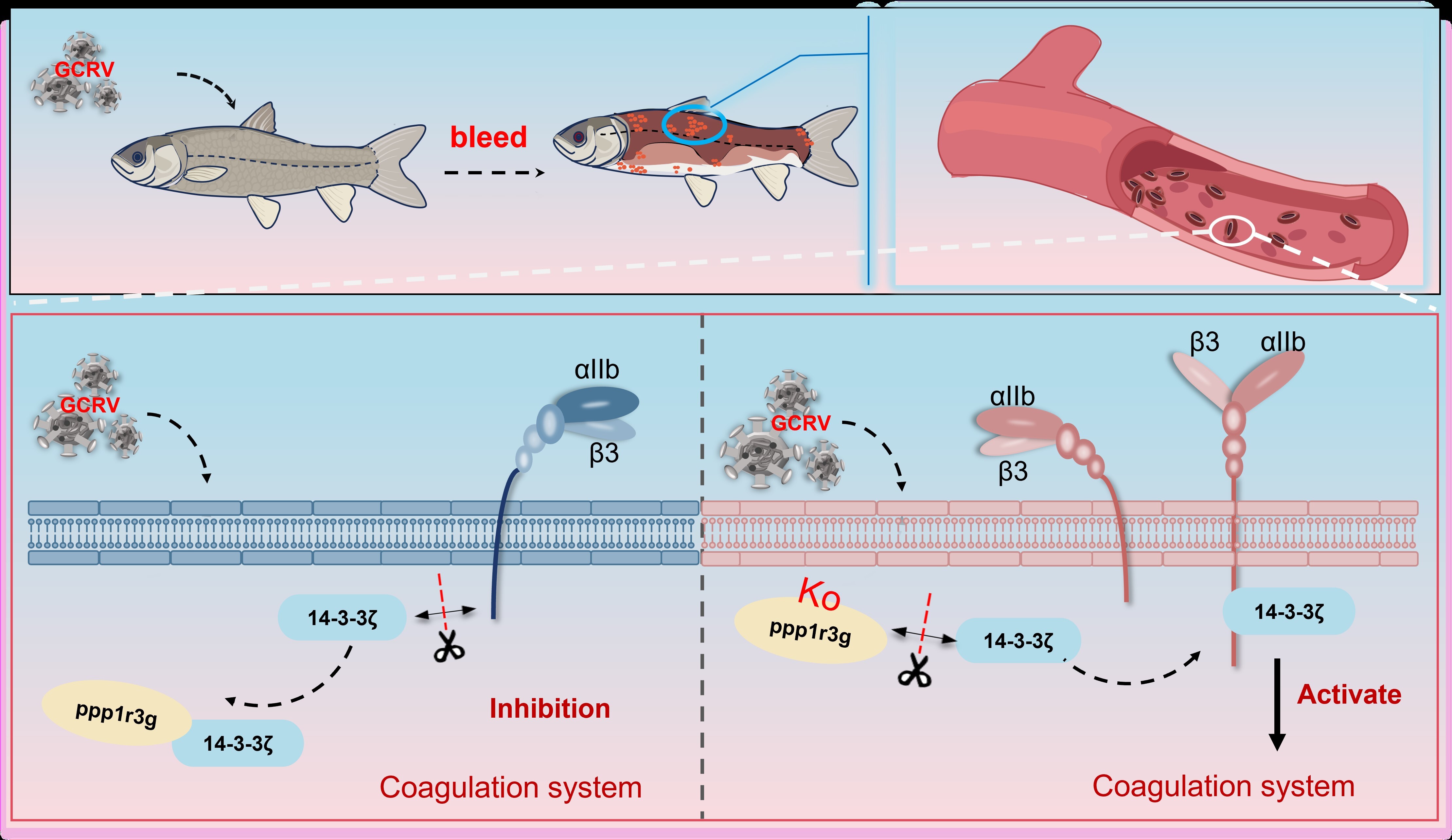
Model explaining the Ppp1r3g-mediated negative regulation of platelet and coagulation system activation in fish. (Image by IHB)
