
Newsroom


A new study has identified previously unrecognized germinal center-like structures in the gut of common carp, providing new evidence for the early evolution of mucosal adaptive immunity.
Led by Prof. XU Zhen from the Institute of Hydrobiology (IHB) of the Chinese Academy of Sciences (CAS), the study was published in Science Bulletin.
Germinal centers are specialized sites where B cells undergo proliferation, selection and differentiation to support the production of high-affinity antibodies and long-lasting immune memory. In mammals and birds, these reactions take place within highly organized secondary lymphoid organs.
Teleost fish, however, lack the classical lymphoid architecture found in mammals, raising an important question: can their mucosal tissues independently organize similar immune responses?
To investigate this question, the researchers examined the gut immune response of common carp following viral infection. By combining single-cell transcriptomics, fluorescence in situ hybridization and immunofluorescence, they identified previously unknown lymphoid aggregates in the intestinal tissue and termed them gut-associated germinal center-like structures, or GaGCLs.
The researchers found that GaGCLs share several important features with mammalian germinal centers. B cells within these structures underwent extensive proliferation and apoptosis, while B cells expressing the chemokine receptors C-X-C motif chemokine receptor 4 (CXCR4) and CXCR5 displayed distinct spatial distributions.
The structures showed expression of key germinal center-associated genes, including activation induced cytidine deaminase (AICDA) and marker of proliferation Ki-67 (MKI67), indicating that the core molecular program underlying germinal center reactions is conserved in the teleost gut.
Viral infection also promoted the accumulation of IgM-positive B cells within GaGCLs, together with increased B cell proliferation and apoptosis. Following primary infection, germinal center-like B cells gradually gave rise to memory-like B cells.
After viral rechallenge, these memory-like cells were associated with increased plasma cells, IgM-positive B cells and antibody responses, suggesting that the structures contribute to the establishment and recall of mucosal B cell responses.
The researchers also identified T follicular helper-like cells and revealed extensive interactions between these cells and germinal center-like B cells. The conserved molecular programs and cell-cell communication networks further support the functional similarity between teleost GaGCLs and mammalian germinal centers.
The findings demonstrate that a functional germinal center-like immune response can be dynamically assembled in the teleost gut without the structural framework of conventional secondary lymphoid organs. Rather than requiring a pre-existing anatomical structure, the immune system can build a temporary organization in response to pathogen stimulation.
According to the researchers, this discovery provides a new perspective on the evolution of mucosal adaptive immunity. It suggests that the functional components of sophisticated germinal center-like responses may have emerged in vertebrate mucosal tissues before the evolution of highly organized secondary lymphoid organs.
The study therefore supports a model of "function preceding form" and points to an ancient origin of mucosal adaptive immunity in early vertebrates, they said.
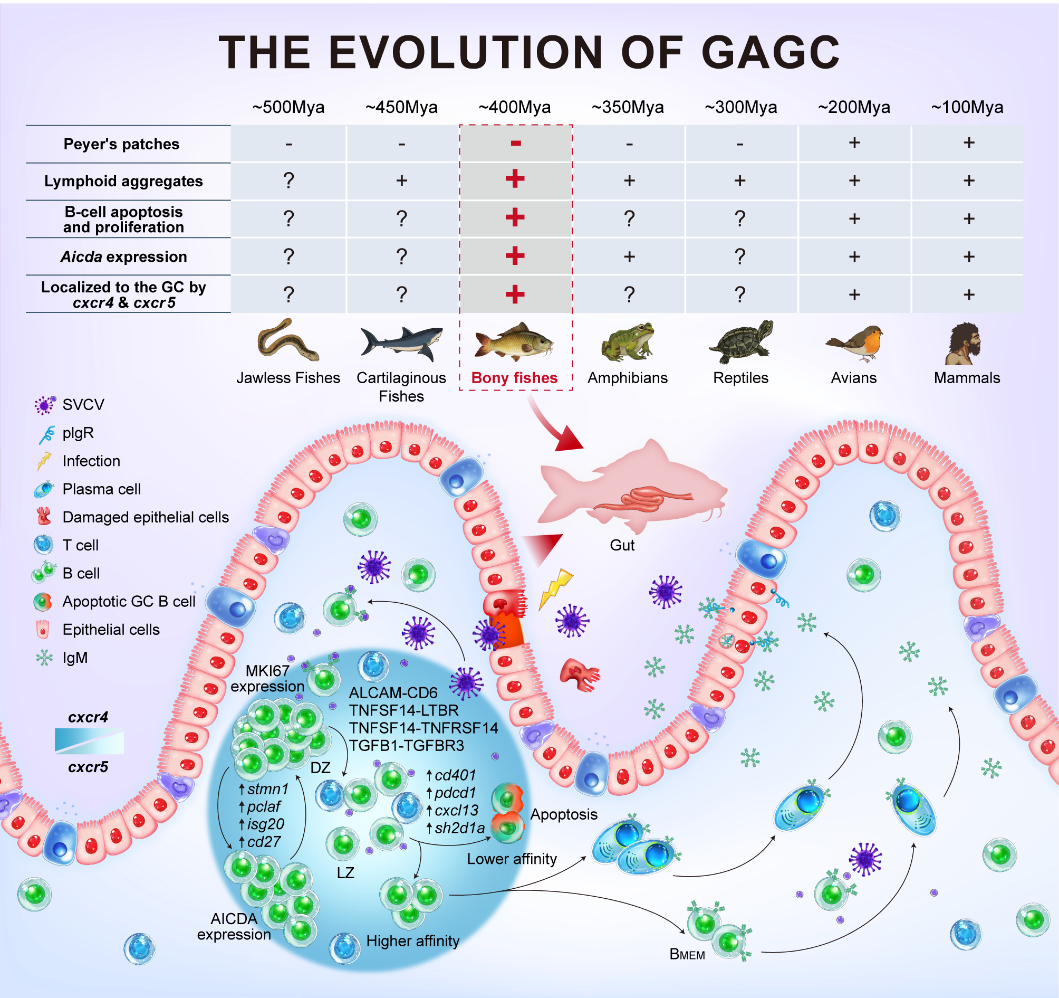
Schematic of the gut-associated germinal center-like structures in the teleost fish. (Image by IHB)
