Newsroom


A new study has demonstrated how a supramolecular cage can use the product of a catalytic reaction to trigger its own structural transformation, linking chemical catalysis with adaptive molecular reorganization.
The study was conducted by a research team led by Prof. SUN Qingfu and Prof. CAI Lixuan at the Fujian Institute of Research on the Structure of Matter (FJIRSM) of the Chinese Academy of Sciences (CAS) and published in Angewandte Chemie International Edition.
Supramolecular chemistry has long sought to emulate the dynamic structural adaptation and induced-fit behavior of natural enzymes. However, using the product generated by an in situ substrate reaction as a chemical stimulus to drive precise host reorganization remains a formidable challenge. para-Quinone methides (p-QMs), as important reactive intermediates, have been largely unexplored in confined aqueous cavities.
In this study, the researchers reported an adaptive Pd4L2 coordination cage (1) assembled from a novel bipyridine-spaced ligand and a cis-capped Pd(II) salt. The cavity of cage 1 can catalyze the dehydration of p-QM precursors, and the resulting catalytic products further induce an adaptive transformation of the supramolecular structure.
The solution structure of cage 1 was unambiguously confirmed by 1D and 2D NMR, DOSY, and ESI-TOF-MS. Single-crystal X-ray diffraction revealed a truncated octahedral geometry with a hydrophobic cavity volume of approximately 838 Å3. Upon encapsulation of the guests, the crystal structure showed a pronounced distortion of the host structure, with diagonal Pd···Pd distances changing from 17.787 × 18.237 Å to 16.328 × 19.780 Å and 17.832 ×18.464 Å, providing direct structural evidence for the induced-fit adaptability of cage 1.
Remarkably, upon encapsulation of the p-QM precursor (S1) within the hydrophobic microenvironment of cage 1, S1 underwent spontaneous dehydration to alkene product P1 in water at 50 °C with a high yield of 87% and a first-order catalytic constant kcat of 5.5 × 10⁻³ min-1. Control experiments established that neither the metal salt, free ligand, nor pure water alone catalyzed the reaction. Introducing competing guest G1 (diphenyl sulfoxide) reduced kcat to 2.7 × 10⁻³ min-1, confirming the essential role of cavity encapsulation.
The cage catalyst also retained high efficiency over five consecutive cycles. Importantly, the system exhibited a broad substrate scope.
Crucially, the in situ generated alkene products acted as a chemical stimulus, driving the transformation of the Pd4L2 cage (1) into an unprecedented Pd6L3 conjoined cage (2) through a product-induced fit mechanism, as validated by two single-crystal structures of (P1)4⊂2 and (P5)4⊂2. Notably, extraction of the hydrophobic product with dichloromethane fully reverted the system to cage 1, demonstrating the reversibility and product dependence of the transformation.
According to the researchers, this work achieves a seamless coupling of catalysis with subsequent host structural adaptation, exemplifying a "host–guest coadaptation" mechanism and offering fresh insights into adaptive supramolecular catalysis and guest-responsive materials.
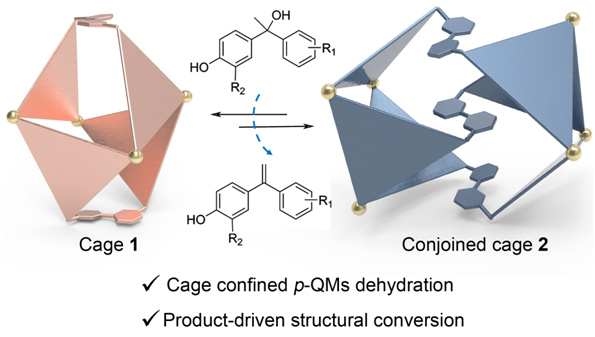
An adaptive Pd4L2 cage catalyzes the dehydration of p-QM precursors and undergoes product-triggered transformation into a Pd6L3 conjoined cage. (Image by Prof. SUN's group)