Newsroom


A new study has revealed how water-triggered reconfiguration of a lanthanide-organic cage simultaneously regulates fullerene chiroptical response and radical persistence.
The study, published in Angewandte Chemie International Edition, was led by SUN Qingfu at the Fujian Institute of Research on the Structure of Matter of the Chinese Academy of Sciences.
In biological systems, external signals can trigger structural changes that regulate molecular recognition and reactivity. Reproducing such allosteric behavior in synthetic molecular cages could enable active control over encapsulated molecules. However, achieving both chiral induction in intrinsically achiral C60 and stabilization of its short-lived radical anion within a single adaptive host has remained challenging.
In this study, the researchers assembled homochiral pseudo-cubic cages from enantiopure bowl-shaped ligands and lanthanum(III) salts. In the presence of C60, the assembly process produced a discrete host-guest complex within six hours at 70 °C in an acetonitrile/methanol mixture.
Using time-dependent NMR spectroscopy, they found that controlled water addition converted this complex into a distinct configuration without detectable accumulation of partially inverted intermediates. Two-dimensional NMR and circular dichroism measurements supported cooperative chirality inversion at all four metal vertices.
Further analyses revealed substantial structural changes in the cage following water addition. Single-crystal X-ray diffraction, complemented by structural modeling, revealed reorientation of the ligand arms, substantial cavity contraction and near-closure of the cage windows. Control experiments showed that water destabilized the empty cage, whereas encapsulated C60 stabilized the reconfigured framework through stronger contacts with the concave ligand surfaces. The reconfigured complex also showed improved water tolerance, although excessive water caused cage dissociation.
The researchers also found that adding more water accelerated the structural transformation, as shown by kinetic measurements. These findings identified complementary roles for water as a trigger and fullerene as a stabilizing guest. The researchers then examined how this structural transformation affected fullerene properties.
Circular dichroism spectroscopy showed that reconfiguration reversed the sign of the induced C60 response and increased its intensity approximately 3.5-fold. The absorption dissymmetry factor reached |gabs| = 1.62 × 10⁻², demonstrating enhanced chiral information transfer within the contracted cavity. To probe radical persistence, the researchers photochemically reduced encapsulated C60 using the NADH analogue BNAH as an electron donor.
Electron paramagnetic resonance and near-infrared absorption measurements confirmed the formation of C60 radical anions. By monitoring the decay of the characteristic 1108 nm absorption band, they determined that the radical half-life increased from 3.8 minutes before reconfiguration to 115 minutes afterward in acetonitrile at 295 K under nitrogen.
According to the researchers, the findings establish a direct link between cage reconfiguration and guest function, showing how a mild chemical stimulus can couple chirality transfer with radical stabilization. The study provides a strategy for designing adaptive molecular hosts that actively regulate the properties of encapsulated molecules.
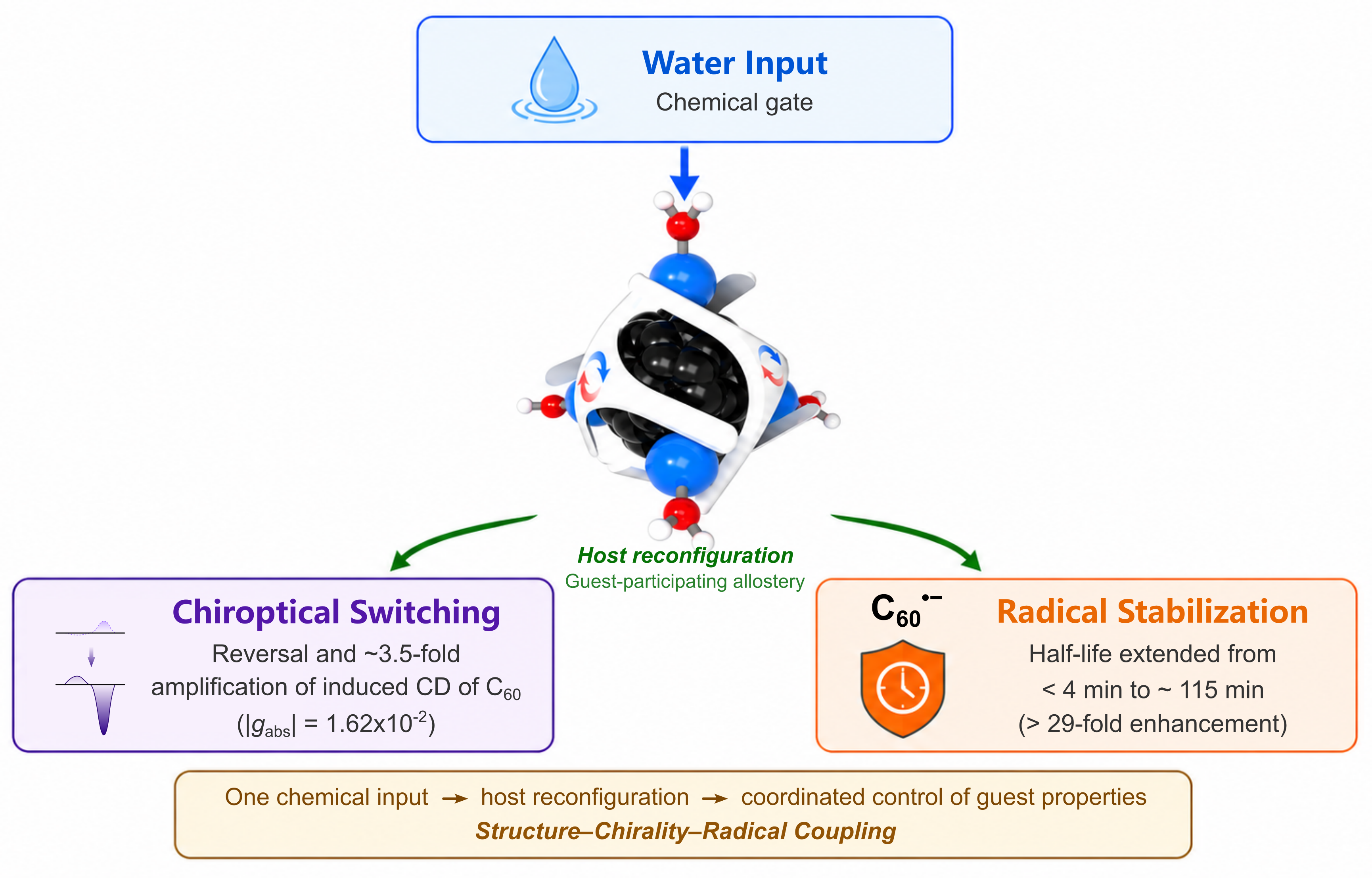
Illustration of the research (Image by Prof. SUN's group)