Newsroom


Located in an arid and semi-arid region, Pakistan relies heavily on irrigation for agriculture, with the Indus River serving as the main source of irrigation water. Severe agricultural water scarcity threatens local food security and socioeconomic development.
Previous studies have focused mainly on local irrigation districts or individual crops, with limited quantitative analysis of the spatiotemporal patterns and drivers of agricultural water scarcity at the national scale. This gap hinders the coordinated management of regional water-food-economy systems.
Recently, a research group led by SHEN Yanjun at the Center for Agricultural Resources Research at the Institute of Genetics and Developmental Biology of the Chinese Academy of Sciences (CAS), revealed provincial differences in the drivers of agricultural water scarcity in Pakistan.
The study, entitled "Changes in agriculture water scarcity and their driving factors in Pakistan", has been published in Journal of Geographical Sciences, with Associate Professor GUO Ying as the first author.
By integrating multiple datasets, including remote sensing, meteorological, hydrological, and agricultural statistics, the researchers quantified spatiotemporal variations in water availability, irrigation water requirements, and the agricultural water scarcity index across the country.
Using the Logarithmic Mean Divisia Index (LMDI) decomposition method, the researchers quantified the contributions of four major factors — climate change, runoff fluctuation, cropland expansion and cropping‑structure adjustment — to changes in agricultural water scarcity across different provinces.
The results showed that Pakistan's national irrigation water requirement increased significantly from 1990 to 2021, at a rate of 73 million m3/a, with Punjab Province accounting for more than 66% of the country's total irrigation water requirement.
The main drivers and their contribution rates of agricultural water scarcity varied markedly among provinces: water scarcity in Balochistan was mainly driven by cropland expansion (59.6 %) and runoff fluctuation (41.6 %); Punjab was dominated by runoff fluctuation (75.4 %); Sindh was jointly affected by climatic effects (37.8 %) and cropping‑structure adjustment (29.0 %).
Accordingly, the study recommends optimizing crop distribution across provinces and designated zones, promoting water-saving irrigation, and advancing reforms to water rights and water pricing.
These tailored measures could improve agricultural water-use efficiency and the security of water resources. The study provides scientific support for the sustainable management of agricultural water resources in arid and semi-arid regions worldwide facing similar water-scarcity challenges.
The research was funded by the National Key R&D Program of China and the Strategic Priority Research Program of the CAS.
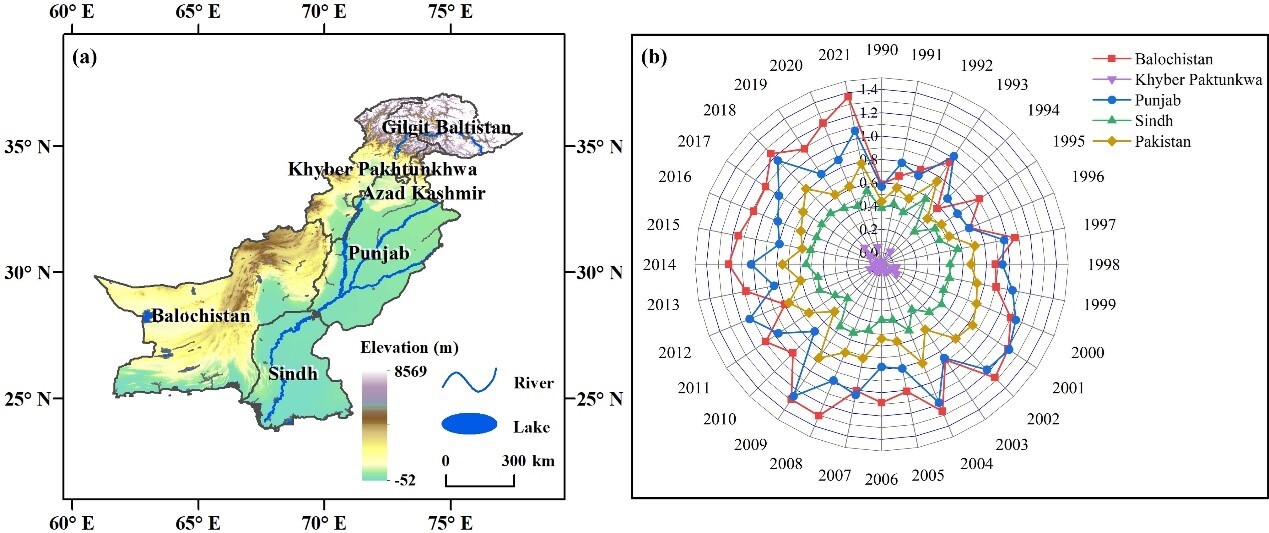
Changes in annual agricultural WSI in Pakistan and its provinces (1990–2021). (Image by SHEN Yanjun's research group)