Newsroom


A research team from the Hefei Institutes of Physical Science of the Chinese Academy of Sciences has developed a surface chemistry strategy to regulate interfacial anion transport in hard carbon anodes, improving the stability of sodium-ion batteries.
The findings were published in Nano-Micro Letters.
Sodium-ion batteries are promising for large-scale energy storage, with hard carbon emerging as a leading anode material. However, interfacial instability caused by uncontrolled electrolyte decomposition can reduce initial Coulombic efficiency and accelerate battery degradation. Existing strategies offer limited control over ion transport and interfacial chemistry.
In this study, the researchers introduced synergistic pyridinic nitrogen and carbonyl sites onto the hard carbon surface, creating a "capture-repel" microenvironment. Theoretical simulations showed that these functional sites promote PF6- adsorption while repelling solvent molecules, thereby establishing an anion concentration gradient that drives anions toward the electrode interface.
The researchers found that this directed transport also lowers the decomposition barrier of PF6-, favoring an anion-dominated decomposition pathway and the formation of an inorganic-rich solid electrolyte interphase (SEI).
The modified hard carbon anode showed higher initial Coulombic efficiency and better rate capability, while maintaining stable performance during extended cycling.
Further interfacial analysis revealed a thinner, more uniform, and mechanically stronger SEI. Tests using a pouch full cell further demonstrated the strategy's potential for practical applications.
According to the researchers, the findings highlight the role of surface chemistry in controlling interfacial reactions and provide a new approach to designing stable hard carbon anodes for sodium-ion batteries.
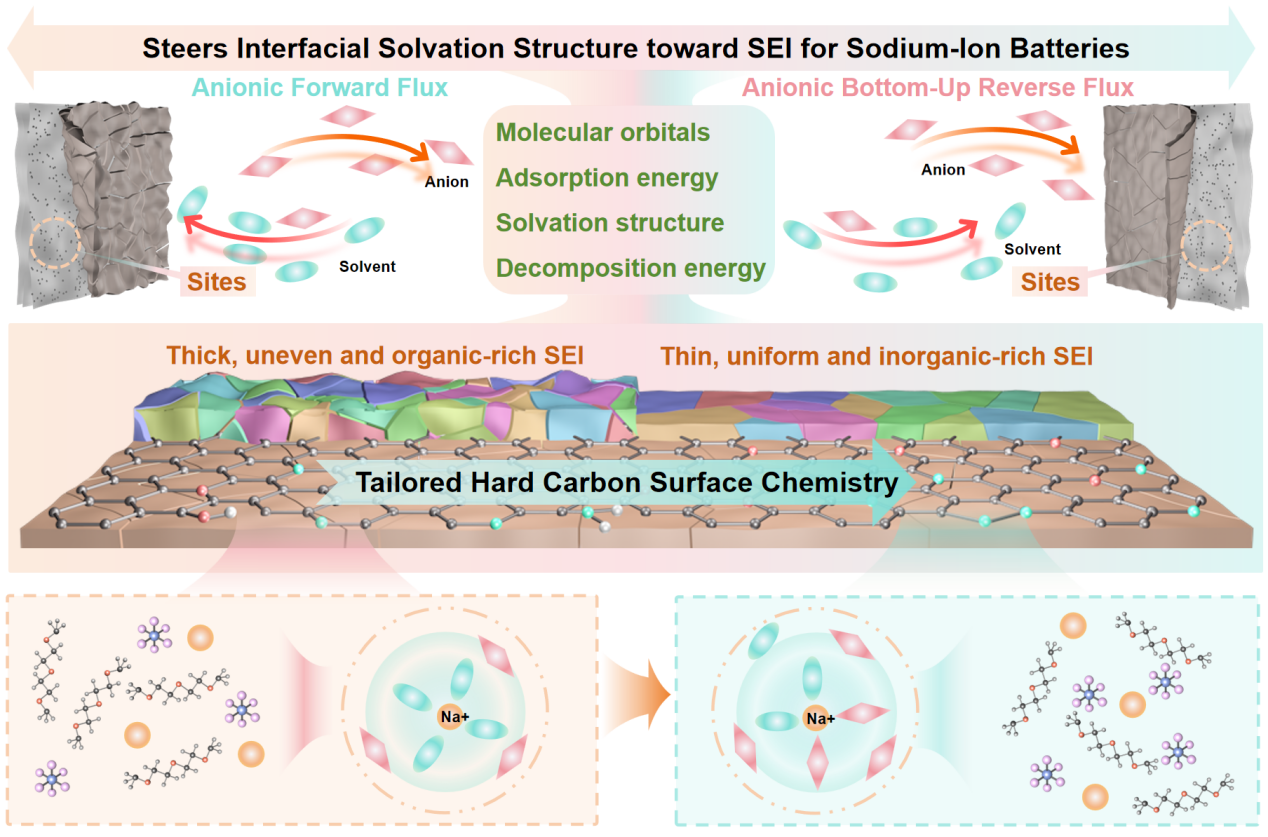
Anionic bottom-up reverse flux for steering interfacial solvation structure by molecular-level surface design. (Image by WANG Peiyao)