
Newsroom


A recent study in Nature Energy has quantified how cell-to-cell inconsistency limits the performance, lifetime, and resource utilization of electric vehicle (EV) battery packs under real-world operating conditions. The work revealed that a small number of faster-ageing cells can severely constrain an entire pack's performance and lifespan.
The study was led by Prof. CHEN Zhongwei from the Dalian Institute of Chemical Physics (DICP) of the Chinese Academy of Sciences (CAS), Prof. ZOU Changfu from Chalmers University of Technology, and researchers from Beijing Institute of Technology and Zeekr Technology Europe AB.
EV battery packs typically consist of many individual cells. Differences in raw materials, manufacturing processes, cell grouping, local temperature distribution, and real-world usage can cause cells within the same pack to age at different rates.
As a result, a series-connected pack exhibits a classic "weakest-cell" effect: during charging, the lower-capacity cell hits the upper voltage limit first; during discharge and high-power operation, the higher-resistance cell reaches safety constraints earlier; and once the fastest-ageing cell crosses the retirement threshold, the whole pack may have to be taken out of service prematurely.
While previous studies have mostly relied on laboratory test data, the long-term, system-level consequences of cell inconsistency under actual driving and operating conditions have not been systematically quantified until now.
To address this issue, the researchers developed a fleet-scale framework for cell-level ageing diagnosis and system-level performance evaluation. The dataset covers electric passenger cars equipped with nickel-manganese-cobalt (NMC) batteries and electric buses equipped with lithium-iron-phosphate (LFP) batteries, with vehicle operation spanning more than three years and individual vehicle mileage reaching up to 300,000 kilometers.
Using voltage, current, temperature, and state-of-charge signals routinely recorded during vehicle operation, the researchers combined battery model identification with neural networks to estimate the ageing trajectories of individual cell capacity and internal resistance under unified reference conditions.
According to the researchers, this approach helped reduce the influence of seasonal variation and differences in state of charge and operating conditions, enabling more consistent comparisons of cell ageing.
Based on these estimates, the researchers then established six metrics—covering cell state of health dispersion, pack health utilization, lifetime utilization, state-of-charge utilization, power capability utilization, and energy-resource utilization—to quantify the effects of cell-to-cell inconsistency.
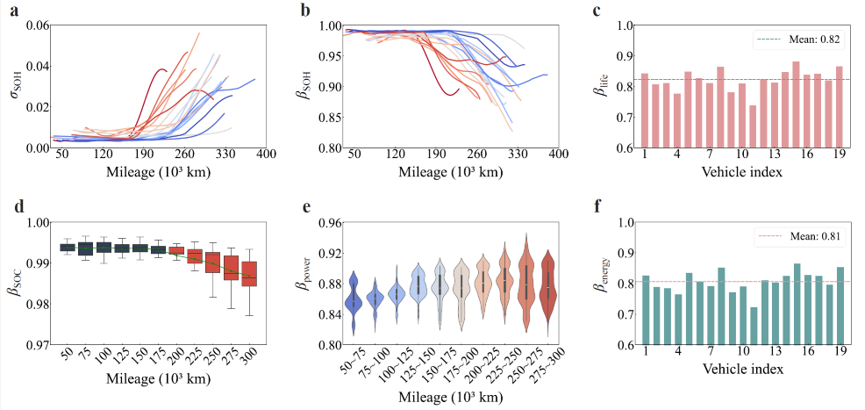
Quantitative evaluation of the impacts of cell-to-cell inconsistency on EV battery pack state of health, lifetime, state-of-charge utilization, power capability, and lifetime energy-resource utilization based on real-world operation data. (Image by ZHOU Litao)
The researchers found that, in the passenger-car fleet, cell-to-cell variation in state of health remained generally small at lower mileage. However, after accumulated mileage exceeded roughly 170,000 km, individual cells in many vehicles began to enter accelerated ageing regimes, and differences among cells increased markedly—although the onset and severity varied across vehicles.
Using a unified retirement threshold, cell-to-cell inconsistency reduced the usable pack-level state of health by 6.2% for electric passenger cars and 7.5% for buses. Relative to the average lifetime of the constituent cells, pack lifetime was shortened by 17.7% and 22.8%, respectively. Power capability losses caused by internal-resistance heterogeneity reached 12.9% and 15.1%, respectively. By contrast, under the charging and balancing strategies used in the studied vehicles, the impact of state-of-charge imbalance on usable charged capacity was typically below 2%.
Taking premature retirement and state-of-charge imbalance into account, the lifetime energy-resource utilization of the passenger-car and bus battery packs was only 80.7% and 72.9%, respectively. In other words, when the weakest cell triggers the pack's retirement criterion, approximately 19.3% and 27.1% of potential energy resources remain under-utilized.
These results demonstrate that battery pack degradation cannot be evaluated solely by the average ageing level of its cells, as a few faster-ageing cells can significantly limit pack lifetime, power capability, and resource utilization.
The comparison between the two vehicle fleets also suggests that battery balancing strategies can affect how cell-to-cell inconsistency develops over the long term. Improving EV battery utilization therefore requires a coordinated approach covering battery manufacturing, cell grouping, and operational management.
According to the researchers, reducing initial differences between cells and optimizing cell grouping could help prevent cell-to-cell inconsistency from becoming amplified during service. At the same time, advanced balancing control and thermal management could help reduce differences in cell ageing. Reconfigurable battery systems may provide another approach to mitigating the limitations imposed by the weakest cells.
"Our findings show that the performance and lifetime of an EV battery pack are not determined solely by the average ageing level of their cells, but can be strongly constrained by a small number of faster-ageing cells," said Prof. CHEN. "By quantifying this weakest-cell effect under real-world EV operation, our study provides a basis for improving battery utilization, lifetime management, and system-level optimization."
