Newsroom


Researchers from the Xishuangbanna Tropical Botanical Garden (XTBG) of the Chinese Academy of Sciences have discovered two new species of Begonia in the karst region of Guangxi, China. The two species, Begonia renkunii and Begonia tianyangensis, were identified from specimens collected during field surveys in Baise City and have been described in the journal Phytotaxa.
The researchers collected the two previously unknown taxa from karst habitats in Debao County and Tianyang District, respectively. Detailed morphological studies confirmed that both represent species new to science.
The genus Begonia (Begoniaceae), comprising approximately 2200 species, is one of the largest angiosperm genera and is widely distributed across tropical and subtropical regions worldwide. The karst region of Guangxi is recognized as a hot spot for the Begonia section Coelocentrum, a group characterized by rhizomatous habits, four tepals in staminate flowers, three in pistillate flowers, and typically one-locular ovaries with parietal placentation.
Begonia renkuni is a perennial rhizomatous herb with creeping rhizomes reaching up to 60 centimeters in length. Its leaves are narrowly ovate, asymmetrical, and sparsely setulose above with dense red villous hairs along the veins beneath. The species was named in honor of Mr. LI Renkun, who contributed to begonia resource investigation in China and was the first to discover the species.
With fewer than 50 mature individuals known from a single population and some plants dying from drought, the species has been assessed as Critically Endangered (CR) under the criteria of the International Union for Conservation of Nature (IUCN).
The second species, Begonia tianyangensis, is morphologically similar to Begonia rhytidophylla but can be distinguished by its elongated rhizomes and internodes, shorter and wider stipules, denticulate leaf margins with short cilia, seven to eight primary veins, and smaller pistillate flowers and capsules.
Two populations of B. tianyangensis are currently known, with an estimated 500 to 1,000 mature individuals. The species has been assessed as Endangered (EN) under IUCN criteria.
In addition, the researchers examined the type specimens of Begonia fangchengensis and Begonia shaoqingii and concluded that the two names refer to the same species. Begonia fangchengensis is therefore reduced to a synonym under Begonia shaoqingii, which remains classified as Endangered (EN).
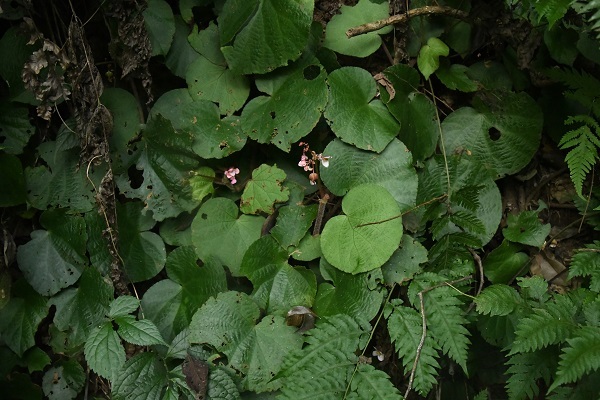
Begonia tianyangensis (Image by LI Renkun)
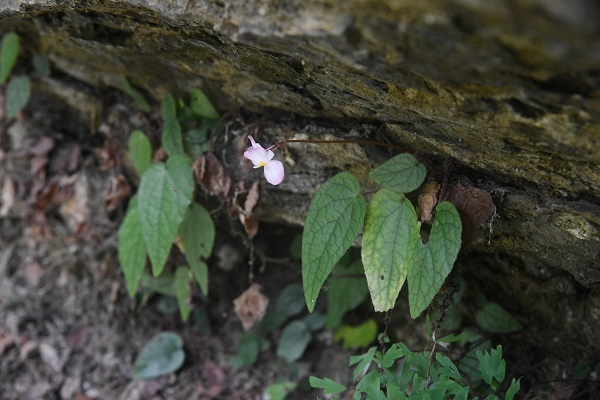
Begonia renkunii (Image by LI Renkun)