Newsroom


"Red berries grow in southern land, how many spring branches hold?" The red beans described by WANG Wei (701–761) in his poem have evoked the longing of the Chinese people for thousands of years. Today, right in the "southern land" mentioned in the poem—the Guangdong-Hong Kong-Macao Greater Bay Area—a research team has unveiled the identity of two new species of this very genus.
Recently, a team led by researcher CHEN Yousheng from the South China Botanical Garden of the Chinese Academy of Sciences formally described and named two new species in the genus Ormosia: Ormosia yangjiangensis and Ormosia taishanensis, in a paper published in the international journal Phytotaxa.
The type localities of both species are located in the Pearl River Delta and adjacent areas, within the scope of the Guangdong-Hong Kong-Macao Greater Bay Area.
According to the 2021 edition of the National Key Protected Wild Plants List, all species of the genus Ormosia are already under protection, meaning that once these two new species were published, they automatically received national second-class protection status.
Why were they "misidentified" for decades?
This discovery originated from the compilation work of the Guangdong Plant Red Book. During field surveys, researchers repeatedly found plants morphologically similar to Ormosia indurate and Ormosia xylocarpa, but their flower and fruit characteristics never matched any known species.
The key issue lies in the long flowering and fruiting cycle of the genus Ormosia, making it difficult for researchers to collect complete specimens with both flowers and fruits. Previous taxonomic studies mainly relied on leaves and dry pods, which are precisely the characteristics most prone to misinterpretation: leaf morphology varies significantly within the same species under different environmental conditions, while leaves of different species can be highly similar. Dry pods also lose many important morphological characteristics.
To clarify the truth, the team conducted repeated field surveys in Yangjiang, Taishan, and nearby areas over several years, eventually collecting complete specimens that covered the entire flowering‑to‑fruiting cycle. By integrating morphological comparisons with DNA molecular phylogenetic analyses, they confirmed that these long‑misidentified plants were actually two previously undescribed species, which they named Ormosia yangjiangensis and Ormosia taishanensis.
Ormosia yangjiangensis: Large flowers, flat pods, fewer than 500 mature individuals
Ormosia yangjiangensis is an evergreen small tree, mainly distributed in Yangxi County, Yangjiang City, with sporadic populations also found in Enping, Jiangmen. Its flowers reach up to 2.5 centimeters in length, about the size of a coin, making them relatively large among the genus Ormosia; its pods are flat like miniature knife sheaths, differing from the common rounded pods. Compared to its relatives Ormosia xylocarpa and Ormosia pubescens, O. yangjiangensis has thinner leaflets, inflorescences that are lateral or terminal, and pod ventral sutures without ridges.
However, only three wild populations of this species exist, with fewer than 500 mature individuals. Growing mostly at low altitudes along riverbanks, their roots are easily destroyed by floodwaters during the rainy season, and coupled with human logging, natural population regeneration is limited. According to IUCN criteria, Ormosia yangjiangensis is assessed as Endangered (EN).
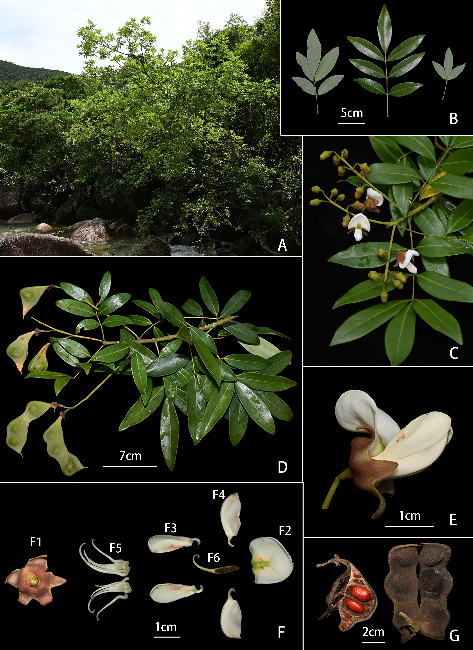
Ormosia yangjiangensis. (Image by CHEN Yousheng)
Ormosia taishanensis: Pods thick as coins, fewer than 100 remaining
If Ormosia yangjiangensis represents the "flat type", then Ormosia taishanensis is the "thick type". Its pod valves reach six to eleven millimeters in thickness, equivalent to the thickness of several stacked coins; the ventral suture has obvious ridges, and the seed hilum is three to four millimeters long. These details are key clues for distinguishing the species.
The situation for Ormosia taishanensis is even more critical: only three wild populations have been discovered, with fewer than 100 mature individuals. It has been assessed as Critically Endangered (CR) and recommended for inclusion in the list of plant species with extremely small populations, putting it at risk of extinction in the wild.
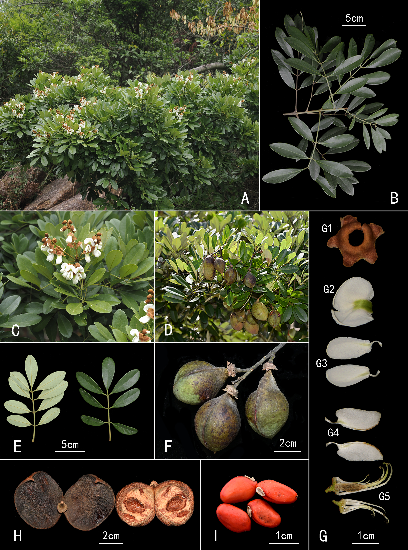
Ormosia taishanensis. (Image by CHEN Yousheng)
Flowers and fresh pods: More reliable identification evidence
According to the researchers, this study brings important scientific insights: for leguminous plants, the morphological characteristics of flowers and fresh pods are more reliable than those of leaves and dry pods.
For a long time, researchers relied on leaf morphology because leaves were easier to obtain, but the flowering period of the genus Ormosia is brief, and most specimens lack floral records. This study demonstrates that floral morphology is a key "fingerprint"—the flower buds of Ormosia yangjiangensis are pointed like tops, with mixed brown and white hairs inside the calyx lobes; the flower buds of Ormosia taishanensis are ovoid or top-shaped. These features are difficult to observe in dried specimens and can only be captured through live observation.
Similarly, characteristics such as the thickness of fresh pods and ridges on the ventral suture are lost after drying, yet these are precisely important clues for distinguishing the two new species. Relying solely on a limited number of specimens for species identification can easily lead to misclassification, according to the paper.
Conservation action: From "new species" to "national protection"
Once published, the two new species were automatically under second-class protection. Currently, they have been ex-situ conserved at the South China Botanical Garden, and the team has established the world's most species-rich germplasm resource nursery for the genus Ormosia.
The research team calls for immediate implementation of in-situ habitat conservation, establishment of population dynamics monitoring mechanisms, and focused attention on natural regeneration—without seedlings growing into saplings, even numerous adult trees represent nothing more than a "last supper".
The study also updates the dichotomous key for identifying Ormosia species in Guangdong Province, providing a standardized tool for field identification. The discovery of these two new species confirms a fact: even in densely populated areas like the Guangdong-Hong Kong-Macao Greater Bay Area, unknown life forms still await discovery. Every Ormosia tree is a unique gene bank, and every new species is a window to an unknown world. Protecting them means protecting our shared home.