
Newsroom


Researchers have recently carried out 18-26 GHz broadband spectral-line observations of the W33 giant molecular cloud. Using the German Effelsberg 100-meter radio telescope, they determined the physical and chemical properties of the dense clumps within it.
The study, led by Associate Researcher Kadirya Tursun of the star formation and evolution group at the Xinjiang Astronomical Observatory of the Chinese Academy of Sciences, in collaboration with other researchers, has been published in Astronomy & Astrophysics.
In this study, the researchers identified 44 radio recombination lines and 24 molecular lines from nine different species, including CH3OH, HC3N, SiS, c-C3H2, CH3CN, NH2D, HNCO, H2O, and CCS.
They found that the intensity ratios of the radio recombination lines are consistent with local thermodynamic equilibrium (LTE) conditions. The measured helium-to-hydrogen abundance ratio is approximately 10.7%, which agrees with cosmological predictions and typical values found in massive star-forming regions. Helium shows broader turbulent line widths than hydrogen, with the difference reaching a few kilometers per second, suggesting that their spatial distributions may differ slightly.
Water and methanol masers were detected in all three regions of W33, namely W33 Main, W33 A, and W33 B. In particular, the researchers discovered a new methanol maser associated with the transition CH3OH (102,8–101,9 E) in W33 Main for the first time.
Using rotational diagram analysis, they derived the rotational temperature and column density parameters for the CH3OH transitions. Toward W33 B1, the fractionated deuterium-to-hydrogen ratio (D/H) deduced from para-NH2D/NH3 is estimated to be 1.0×10⁻³.
According to the researchers, the results not only contribute to a deeper understanding of the ionized gas structure, molecular chemistry, and star formation activity in the W33 giant molecular cloud, but also provide a framework for future large-sample observational studies of giant molecular clouds.
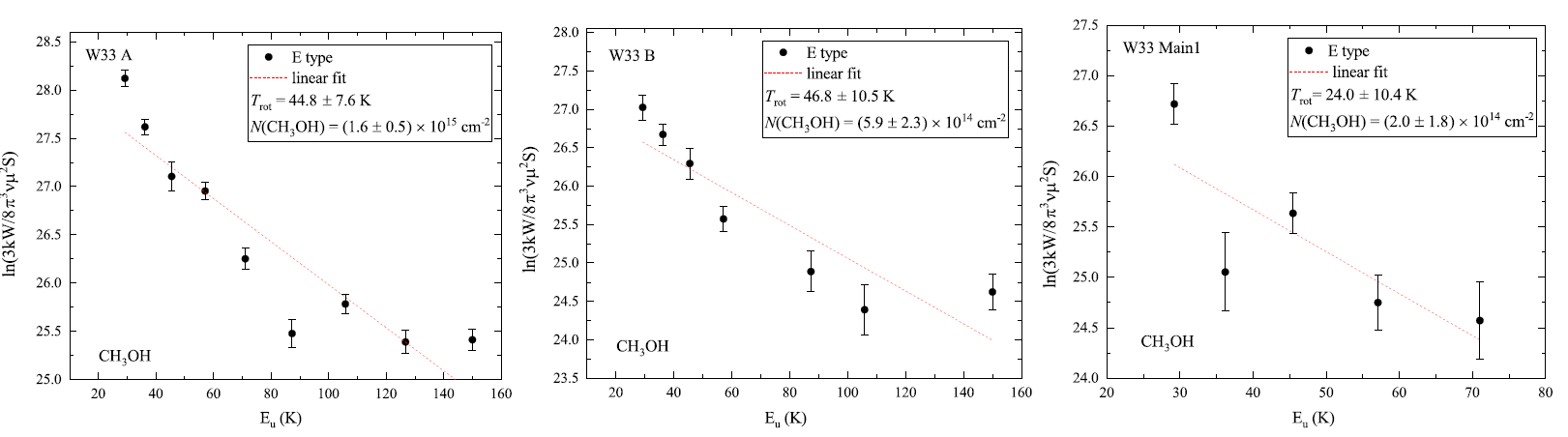
Rotation diagrams for the inverted lines of CH3OH. (Image by XAO)

