
Newsroom


Massive stars play a key role in the interstellar medium cycle, molecular cloud evolution, and star formation. Through ultraviolet radiation, stellar winds, and even supernova explosions, they continuously influence the surrounding interstellar gas. This feedback can either disperse molecular clouds or compress gas, thereby driving a new generation of star formation.
Recently, scientists have conducted a study on G35.28+0.04, a giant ring-like molecular gas structure in the Milky Way, and found that this structure may record a "relay race" of star formation spanning tens of millions of years.
The study was carried out by SUN Mingke, a Ph.D. student in the Star Formation and Evolution Group at the Xinjiang Astronomical Observatory (XAO) of the Chinese Academy of Sciences (CAS), under the supervision of Prof. Jarken Esimbek, deputy director of XAO.
The results have been published in the Monthly Notices of the Royal Astronomical Society.
G35.28+0.04 is located at a distance of 8.85 kiloparsecs. CO data from the "Milky Way Image" survey show that it is an expanding giant ring-like molecular cloud structure, with a radius of about 79 parsecs and a mass of approximately 7.8×10⁵ M⊙. This structure likely represents a "fossil imprint" left by the long-term feedback of massive stars.
Based on the CO data, the researchers investigated the kinematic properties of this ring-like structure and found that the molecular gas exhibits significant blueshifted and redshifted features, which reveal that it is expanding outward at about 7.9 km/s.
Further multi-wavelength data analysis reveals that while infrared radiation traces remain within the ring, there is a lack of prominent ionized gas radiation. This suggests that the excitation source that originally drove the expansion may have weakened or dissipated.
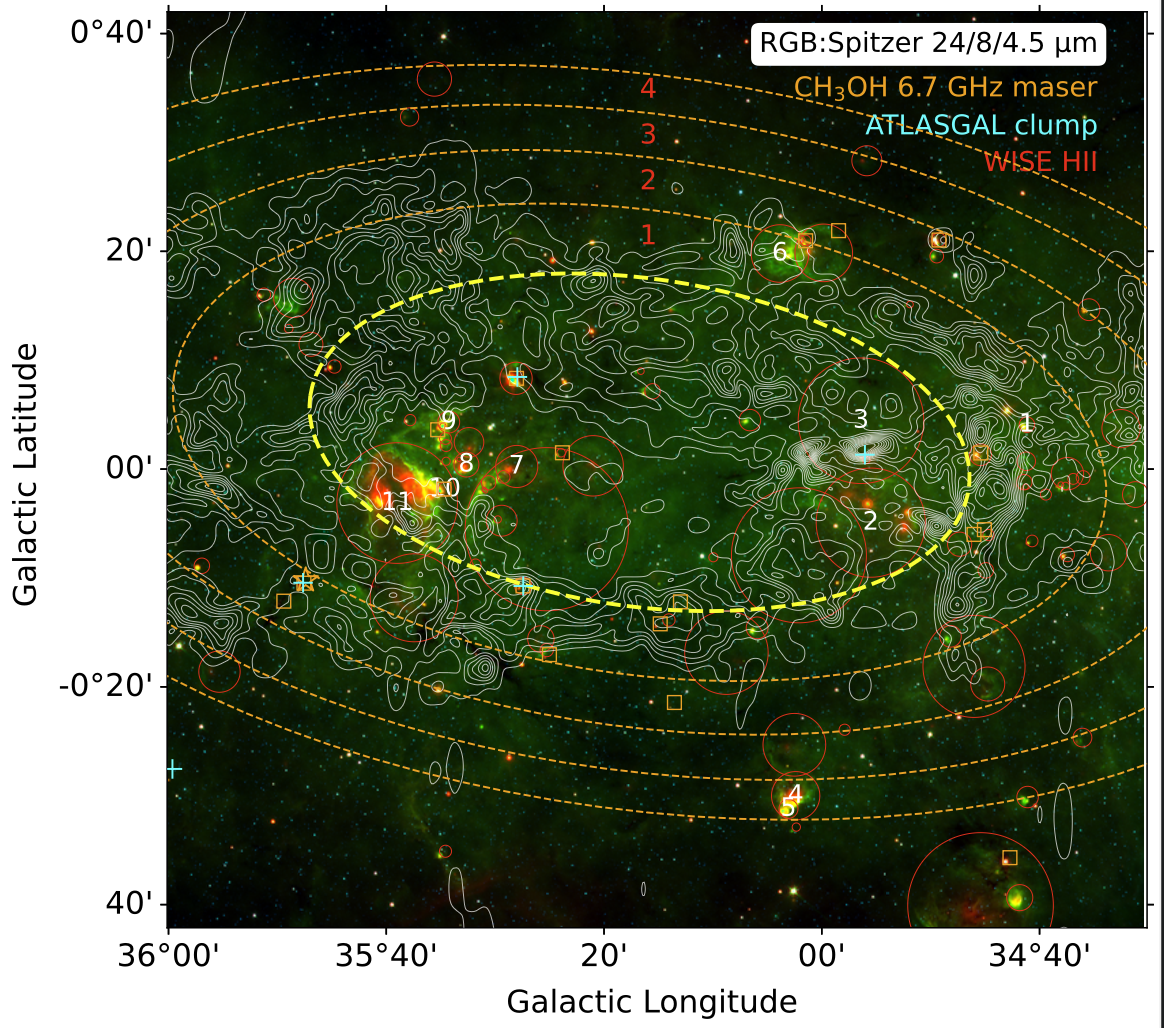
Multiwavelength view of the ring-like molecular structure G35.28+0.04. (Image by XAO)
The researchers also found that multiple H II regions ("fossil bubbles") are distributed along the edge and around the ring-like molecular cloud structure. Among them, the larger and older H II regions may be associated with the compression of gas by the expanding molecular ring, while the smaller and younger H II regions nearby may have originated from second- and third-generation star formation triggered during the expansion process.
Statistical analysis of the hydrogen molecular column density further indicates that the gas in this region contains both low-density turbulent components and high-density compressed components, with the compression effect weakening as distance increases.
According to the team, this study identifies a large-scale expanding molecular ring, G35.28+0.04, as traced by CO emission. The star formation activities within it align closely with the feedback-driven, multi-generational star formation picture.
This study provides an important sample for understanding how massive star feedback influences the interstellar medium cycle, shapes molecular gas structures, and regulates star formation on timescales of tens of millions of years, the researchers said.

