Newsroom


Breast milk is the ideal nutrition for newborns. Phosphorylated milk proteins play a critical role in delivering calcium and supporting healthy growth. Although the secretory kinase Fam20C is responsible for phosphorylating most secreted proteins, scientists have long wondered how it efficiently modifies such a diverse array of substrates.
According to a new study published on July 13 in the Journal of Cell Biology, researchers led by Prof. WANG Lei from the Institute of Biophysics of the Chinese Academy of Sciences have revealed two coordinated molecular mechanisms that maintain efficient protein phosphorylation in the Golgi apparatus during lactation.
The researchers discovered that the mature form of Fam20C forms a heterocomplex with its pseudokinase family member, Fam20A. The mature kinase is anchored to the Golgi membrane through Fam20A's transmembrane domain, which prolongs its residence in the Golgi and allows sufficient time to interact with and phosphorylate newly synthesized secretory proteins.
They also identified ERGIC2 and ERGIC3 as cargo receptors that transport the Fam20A-Fam20C complex from the endoplasmic reticulum to the Golgi apparatus. This ensures the complex is properly localized within the secretory pathway.
Further experiments showed that the expression of both the ERGIC2-ERGIC3 cargo receptor complex and the Fam20A-Fam20C kinase complex increases markedly in the mammary glands of lactating mice. Female mice lacking either Ergic2 or Ergic3 produced milk with reduced β-casein phosphorylation and lower nutritional quality, resulting in significantly impaired growth of their nursing offspring.
The researchers also found that disrupting the Golgi localization of Fam20C caused widespread changes in the phosphorylation landscape of proteins within the secretory pathway of mammary epithelial cells, demonstrating that precise intracellular localization of the kinase is essential for the efficient phosphorylation of milk proteins.
This study reveals a precise regulatory mechanism that governs secretory pathway kinases and establishes the Golgi apparatus as a central site for secretory protein phosphorylation.
The findings highlight the critical role of protein phosphorylation in maintaining milk quality and supporting neonatal nutrition. Beyond advancing the understanding of secretory protein modification, these findings may provide new strategies for improving dairy quality and for the future development of nutritionally optimized artificial milk.
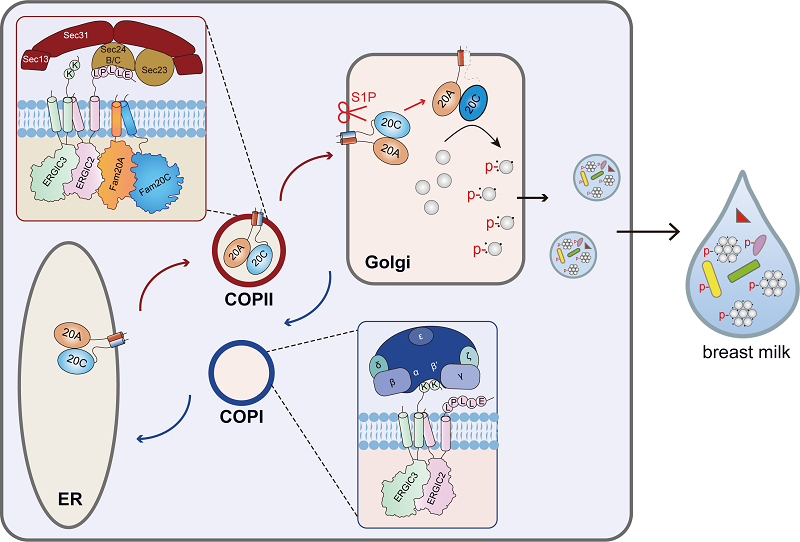
A model of how cargo receptor ERGIC2-ERGIC3 mediates Golgi localization of Fam20A-Fam20C kinase complex during lactation (Image by WANG Lei's group)