Newsroom


Laser heterodyne radiometers (LHRs) are widely used for remote sensing of atmospheric greenhouse gases due to their high spectral resolution, compact design, and suitability for field observations. However, their performance is limited by inaccurate instrument calibration, wavelength instability, and spectral distortion in conventional double-sideband detection.
Recently, researchers from the Hefei Institutes of Physical Science of the Chinese Academy of Sciences made a series of improvements in calibration methods, optical systems, and detection technologies, which improves the accuracy and spectral resolution of LHRs for atmospheric greenhouse gas measurements. Their findings were published in Optics and Laser Technology, Optics Express, and Optics Letters.
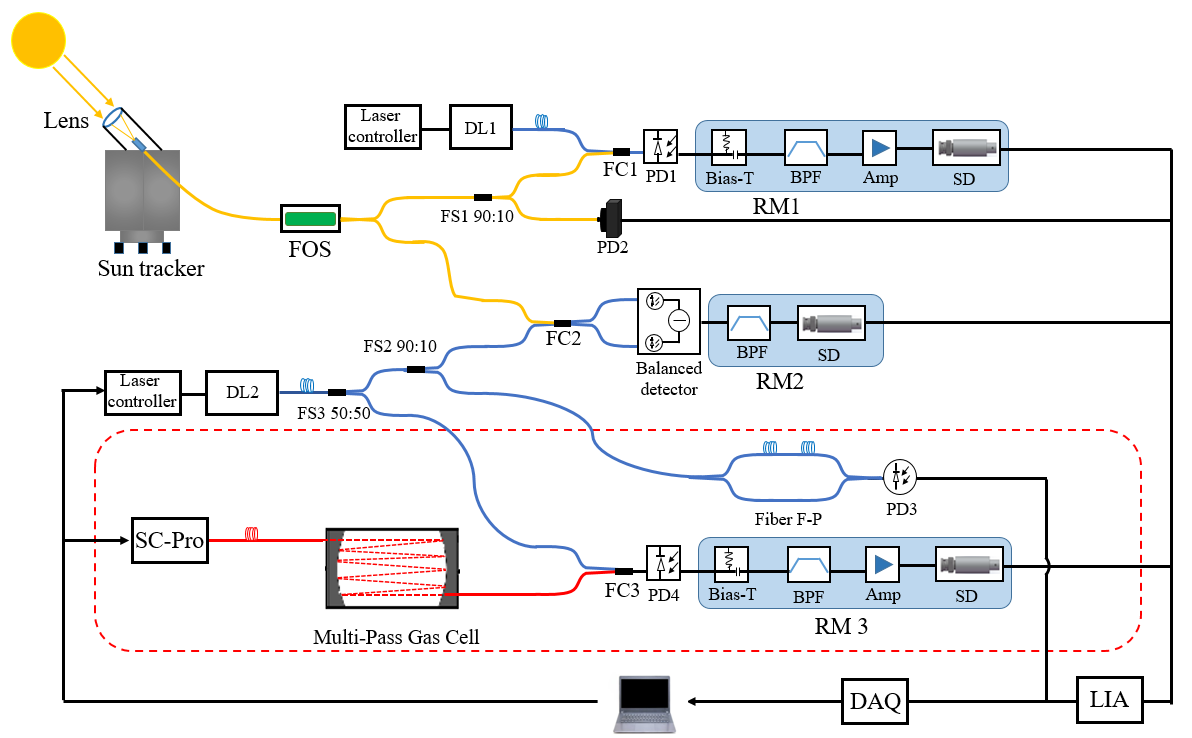
For instrument calibration, researchers proposed a new method combining gas absorption measurements with a deconvolution algorithm, enabling more accurate characterization of the instrument response. The improved calibration reduced spectral errors and enhanced the accuracy of methane concentration retrieval.
Besides, researchers developed a real-time wavelength calibration system based on an all-fiber Mach–Zehnder interferometer, providing a stable frequency reference for LHR measurements. This system was successfully applied to atmospheric carbon dioxide observations on Science Island in Hefei.
In addition, researchers designed a single-sideband laser heterodyne spectrometer to overcome the issue of spectral distortion caused by double-sideband systems. This new design eliminates central dip distortion and improves spectral resolution, enabling more accurate measurements of greenhouse gas absorption signals.
The advances of this study improve greenhouse gas monitoring and atmospheric observations with laser heterodyne spectroscopy.