Newsroom


Accurate monitoring of atmospheric CO2 is important for climate studies. Laser heterodyne radiometers (LHRs) are widely used for ground-based CO2 observations due to their compact structure and relatively low cost. However, inversion methods rely on prior atmospheric information and repeated radiative transfer calculations, which makes retrieval time-consuming and reduces the accuracy.
In a study published in Sensors and Actuators B: Chemical, a research team led by Prof. GAO Xiaoming from the Hefei Institutes of Physical Science of the Chinese Academy of Sciences developed a multimodal neural network model, MM-LHRNet, for accurate and rapid retrieval of atmospheric CO2 column concentrations.
MM-LHRNet integrates laser heterodyne spectra, temperature and pressure profiles, and solar zenith angle data. To improve its adaptability under different atmospheric conditions, researchers generated physically consistent simulated spectra using radiative transfer modeling and atmospheric reanalysis datasets for pretraining. They further optimized the model with measured spectral observations and data from the Total Carbon Column Observing Network.
Field experiments showed that MM-LHRNet achieved a retrieval standard deviation of 0.49 ppm, with a retrieval precision of about 0.11%. Compared with traditional nonlinear least-squares inversion methods, the model more than doubled the retrieval accuracy while increasing retrieval speed by over three orders of magnitude.
This study demonstrates that multimodal neural network models can achieve high-precision atmospheric CO2 retrieval and may guide future real-time greenhouse gas monitoring. MM-LHRNet enables rapid and accurate measurements of greenhouse gases.
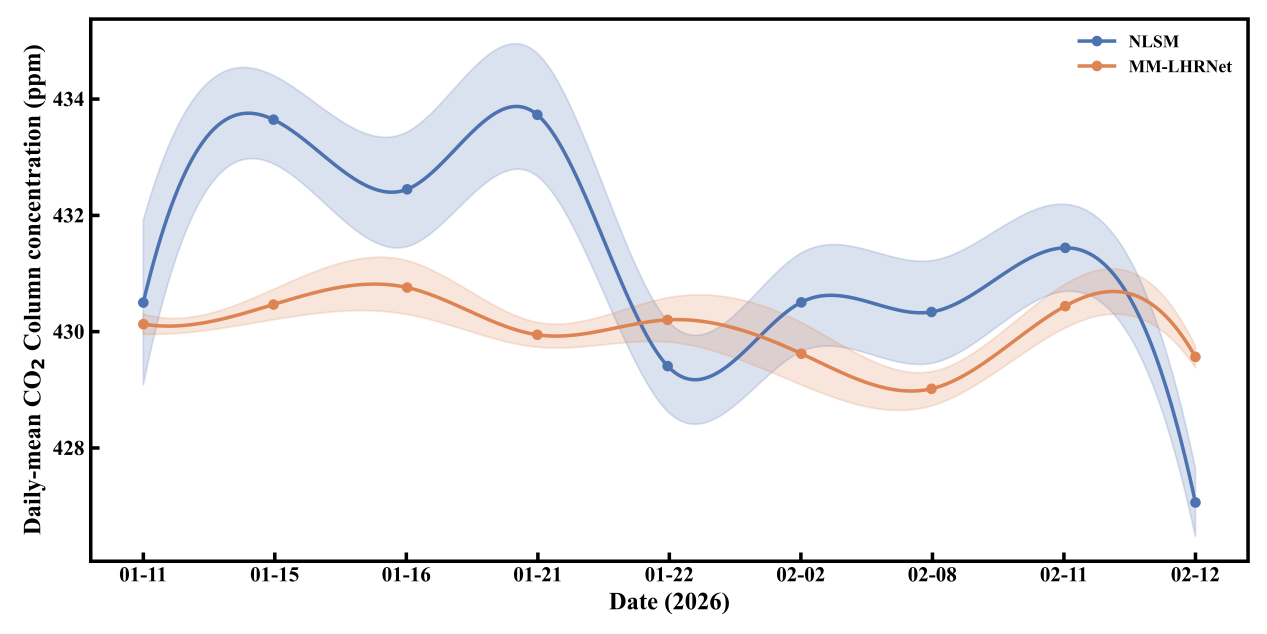
Time series of daily mean CO2 column concentrations from MM-LHRNet and NLSM. Circles denote the daily mean values. Shaded bands indicate mean ± 1σ. (Image by XIONG Hao)