Newsroom


Nanoparticles are widely used in medicine to deliver drugs, genes, or imaging agents to specific parts of the body. Once a nanoparticle reaches a cell, however, many things can happen—it can reach its target; be degraded; interact with proteins that help transport it; or interact with proteins that hinder its transport.
A long-standing problem in designing nanomedicines has been to understand what happens to nanoparticles at the cellular level, but scientists have faced many challenges. For example, optical microscopy imaging techniques only provide a generalized view of nanomedicine localization. On the other hand, proteomics approaches require cell lysis, which disrupts the natural distribution of proteins around the nanoparticle, making it difficult to understand how nanoparticles are transported within the cell. Another method—proximity labeling—enables in situ investigation of intracellular protein–protein interactions, but it relies on genetically engineered enzyme fusion, which limits its applicability across diverse systems.
Now, a research team led by Prof. LIU Yuan and Prof. JING Ji from the Hangzhou Institute of Medicine (HIM) of the Chinese Academy of Sciences, and Prof. DAI Yunlu from the University of Macau, have developed nanozyme proximity labeling (NPL), a genetic-engineering-free strategy to map the in situ interactomes and trafficking pathways of nanoparticles in live cells.
The study was published in PNAS on June 22.
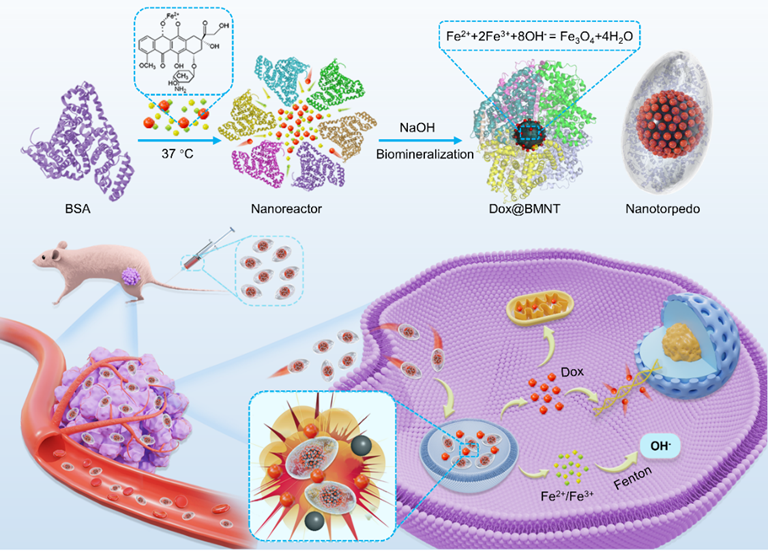
The researchers used iron oxide (Fe3O4) nanoparticles with peroxidase-like activity to covalently label nearby proteins in situ. Upon activation with hydrogen peroxide, the nanozymes labeled proximal proteins within just one minute, using a mechanism similar to ascorbate peroxidase-based proximity labeling. By isolating labeled proteins and analyzing them through mass spectrometry, the researchers identified proteins that interact with the nanozyme in the native cellular environment.
Moreover, the researchers compared the in situ interactomes of mitochondria-targeted and non-targeted nanoparticles. Mitochondria-targeted nanoparticles exhibited a 1.5 fold enrichment of mitochondrial proteins and interacted with intracellular trafficking mediators that facilitated their anchorage to mitochondria. In contrast, non-targeted nanoparticles were mainly routed to lysosomal degradation pathways.
This work provides a high-resolution, in situ snapshot of how surface modifications influence the intracellular destinations of nanoparticles. The NPL strategy requires no genetic modification and can be applied to dissect nanomedicine–biological interfaces. It enables the study of diverse intracellular trafficking pathways and interaction networks, thereby providing a powerful tool for the rational design and precise optimization of nanomedicines.