
Newsroom


Delivering treatments precisely to the brain has long stood as one of medicine's greatest unsolved challenges—and intelligent nanomedicine may now be closing in on an answer.
A review recently published in Chemical Society Reviews highlights how stimuli-responsive nanoplatforms are reshaping the future of central nervous system (CNS) therapeutics by integrating targeted delivery, neuromodulation, and real-time imaging into adaptive "brain-responsive" treatment systems.
The review was led by Prof. SHI Jianlin and Prof. LIN Han from the Shanghai Institute of Ceramics (SIC) of the Chinese Academy of Sciences (CAS).
Neurological disorders—including stroke, spinal cord injury, glioblastoma, Alzheimer's disease, and Parkinson's disease—remain among the leading causes of disability worldwide. Effective treatment is challenging due to the blood-brain barrier (BBB), the dynamic complexity of CNS lesions, and the lack of technologies capable of precisely regulating therapeutic activity in space and time.
Unlike conventional nanocarriers that function primarily as passive delivery vehicles, the intelligent systems reviewed here actively sense pathological microenvironments and respond to external physical fields, integrating lesion recognition, controlled therapeutic activation, and imaging feedback into a unified framework.
The review covers both endogenous biochemical triggers and exogenous physical modulation strategies.
Endogenous cues—including reactive oxygen species, pH changes, and dysregulated enzyme activities—serve as programmable signals for lesion-specific drug release and immunomodulation. Exogenous stimuli, such as light, ultrasound, magnetic fields, and electrical modulation, provide precise spatiotemporal control over neuromodulation, BBB permeability, and therapeutic activation. Among these, focused ultrasound is highlighted as a particularly promising translational strategy.
Researchers further discuss integrating multimodal imaging technologies—including MRI, PET, photoacoustic imaging, and NIR-II imaging—to establish imaging-guided closed-loop therapeutic systems. AI-assisted approaches are also explored to optimize BBB penetration, structure-function prediction, and therapeutic design.
Current clinical translation efforts and key challenges—including safety standardization, dosimetry, scalable manufacturing, and regulatory complexity—are comprehensively analyzed. According to the researchers, future CNS nanomedicine will increasingly rely on the convergence of responsive materials, multimodal imaging, AI-guided optimization, and clinically compatible stimulation technologies, with such adaptive systems potentially enabling personalized, real-time therapeutic regulation for complex neurological disorders.
Researchers said this work provides a comprehensive framework for researchers across chemistry, materials science, bioengineering, and clinical neuroscience, offering practical guidance for translating intelligent nanotherapeutics from laboratory research toward clinical applications.
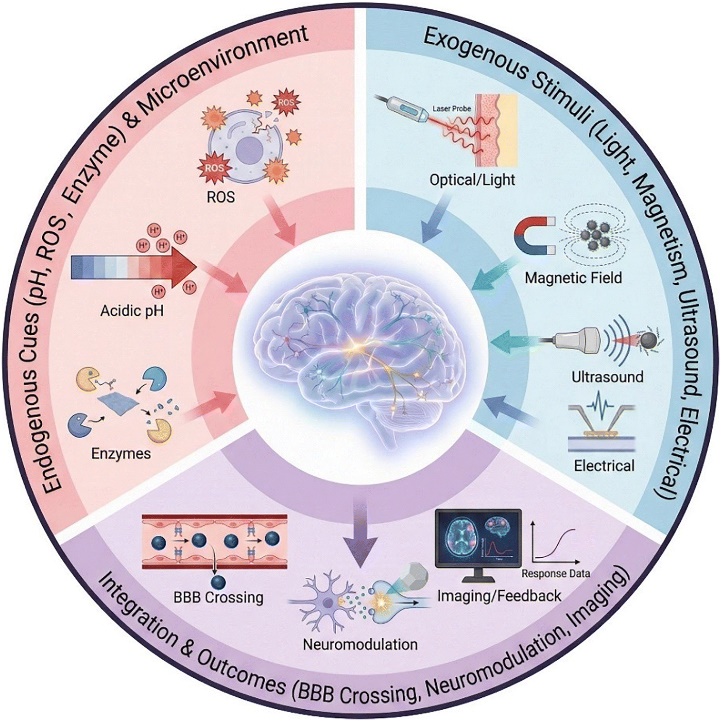
Schematic of stimuli-responsive nanoplatforms for brain-adaptive CNS therapy. (Image by SIC)
