
Newsroom


A recent industry perspective article has summarized the long-term experience and recent advances in both fundamental research and industrial application of vanadium flow batteries (VFBs), while charting pathways toward hundred-megawatt-scale long-duration energy storage systems.
The perspective, led by Prof. LI Xianfeng from the Dalian Institute of Chemical Physics (DICP) of the Chinese Academy of Sciences (CAS), was published in the newly launched "Down to Business" section of Nature Energy, marking the inaugural article of this column.
Long-duration energy storage (LDES) is essential for integrating high-penetration renewable energy into the power grid and achieving deep decarbonization of power systems. Unlike short-duration storage technologies, VFBs offer unique advantages, including high safety, long cycle life, and decoupled energy and power capacity, making them a promising candidate for large-scale LDES applications.
However, their industrialization still faces several challenges, such as limited stack power density, electrolyte stability issues, high material costs, and system reliability constraints.
In the article, the team systematically reviews their progress in key areas, including critical materials development, stack structure design, and system integration. It further analyzes the key factors influencing the transition from academic research to industrial deployment and charts potential pathways toward hundred-megawatt-scale LDES systems.
In recent years, the team has carried out systematic research on core VFB components, including ion-selective and conductive membranes, electrolyte stability, and stack flow-field engineering. Through deep collaboration with industry partners, these advances have been validated and optimized under real operating conditions.
By adopting an integrated innovation model spanning fundamental research, pilot-scale validation, and industrial translation, the team has significantly improved the techno-economic performance and engineering readiness of VFB technology.
The article also offers a forward-looking perspective on the scalable and low-cost development of VFB systems, delivering valuable insights for the advancement and commercialization of flow battery technologies more broadly.
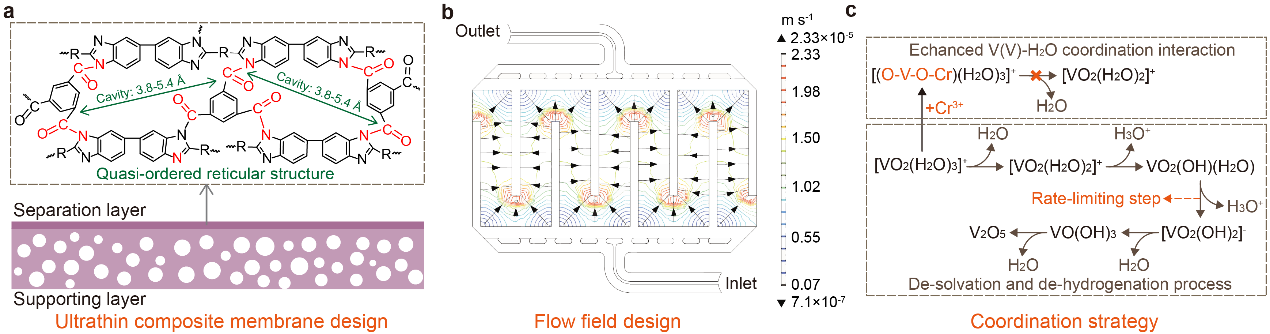
Design strategies for membranes, flow field, and electrolytes. (Image by LU Wenjing)

