
Newsroom


Vanadium flow batteries (VFBs) hold great promise for large-scale energy storage, thanks to their high safety, long cycle life, and flexible scalability. However, their deployment in cold climates is hindered by the poor low-temperature stability of vanadium electrolytes. In particular, precipitation of divalent vanadium (V(II)) ions in the negative electrolyte can lead to capacity loss and performance degradation, severely limiting the operating temperature range of VFB systems.
Recently, a research team led by Prof. LI Xianfeng from the Dalian Institute of Chemical Physics (DICP) of the Chinese Academy of Sciences (CAS) has uncovered the origin of low-temperature instability in VFB electrolytes and developed a strategy to suppress precipitation via solvation-shell engineering.
The study was published in Angewandte Chemie International Edition.
By combining single-crystal X-ray diffraction (SCXRD), in situ variable-temperature Raman spectroscopy, and density functional theory (DFT) calculations, the researchers revealed the molecular mechanism of V(II) precipitation.
They found that as the temperature drops, the dissociation of HSO₄⁻ increases, raising the concentration of SO₄²⁻ ions in solution. These sulfate anions bridge adjacent [V(H₂O)₆]²⁺ complexes through hydrogen-bonding interactions, promoting V(II) dimerization and the formation of ordered clusters that eventually grow into VSO₄·xH₂O precipitates.
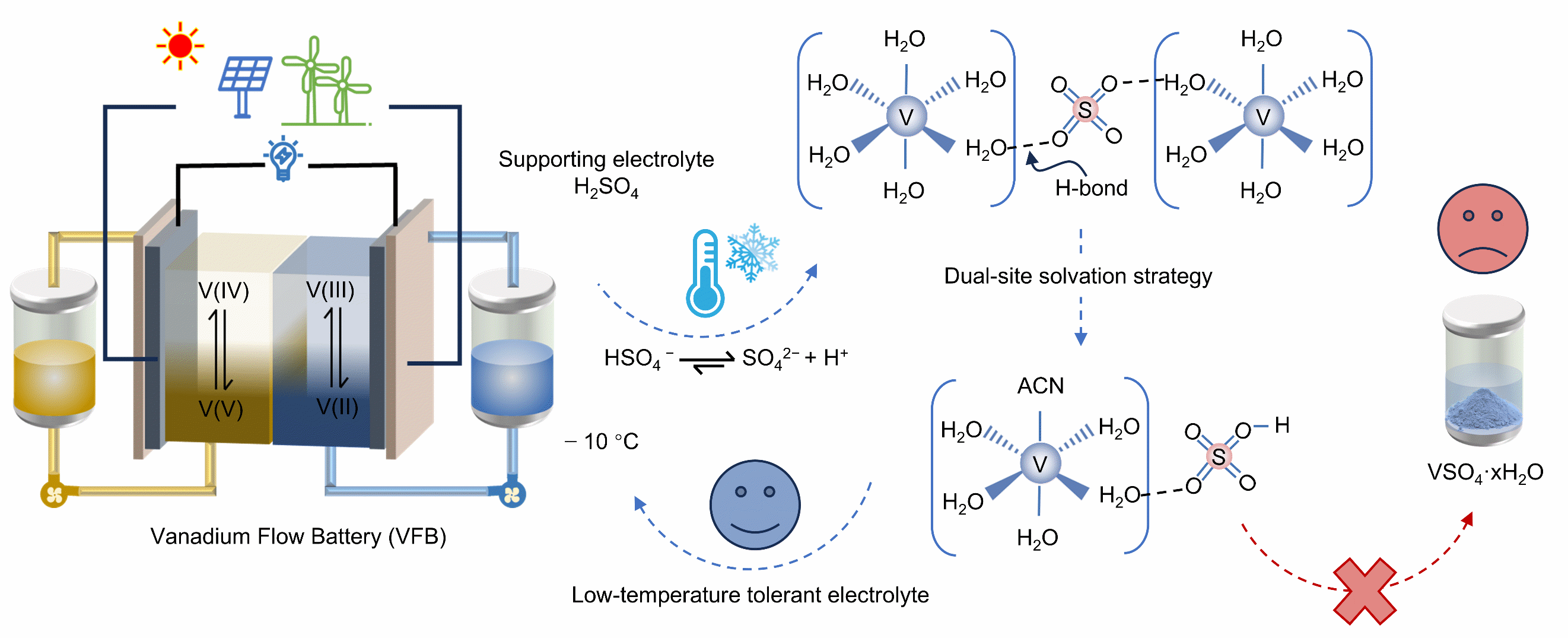
Low-temperature instability of the negative electrolyte in VFBs and the corresponding suppression strategy. (Image by ZHAN Chengbo and LI Tianyu)
To tackle the issue, the team developed a dual-site solvation engineering strategy by introducing acetonitrile (ACN) and HCl as co-additives, which simultaneously regulate the first and second solvation shells of V(II) ions. This synergistic approach effectively curbs ion aggregation and boosts electrolyte stability at low temperatures.
As a result, VFBs running on the modified electrolyte maintained an energy efficiency of over 80% for 500 cycles at −10 °C, demonstrating excellent low-temperature electrochemical performance.
"Our study provides fundamental insights into the low-temperature behavior of vanadium electrolytes and offers a rational strategy for designing highly stable, wide-temperature-range electrolytes for flow batteries," said Prof. LI.

