
Newsroom


In a recent study, scientists have proposed a blueprint to harness extremophytes—plants that thrive in multi-stress desert environments—for designing climate-resilient crops for arid lands and promoting sustainable agriculture practices.
The study, led by Mohsin Tanveer and WANG Lei from the Xinjiang Institute of Ecology and Geography (XIEG) of the Chinese Academy of Sciences (CAS), in collaboration with other researchers, was published in Global Change Biology on June 3.
Anthropogenic climate change is accelerating soil aridification and salinization, threatening over half of the global arable land and food security. Conventional crops are reaching their physiological limits under intensifying arid stress.
Josep Penuelas, research professor of the National Research Council of Spain, and co-corresponding author of the study, said: "Extremophytes do not merely survive harsh conditions; they actively regenerate ecosystem multifunctionality."
WANG from the XIEG said: "Integrating extremophytes into diversified agroecosystems transforms non-arable land into productive, self-sustaining systems, and this is the essence of a circular bioeconomy for arid regions."
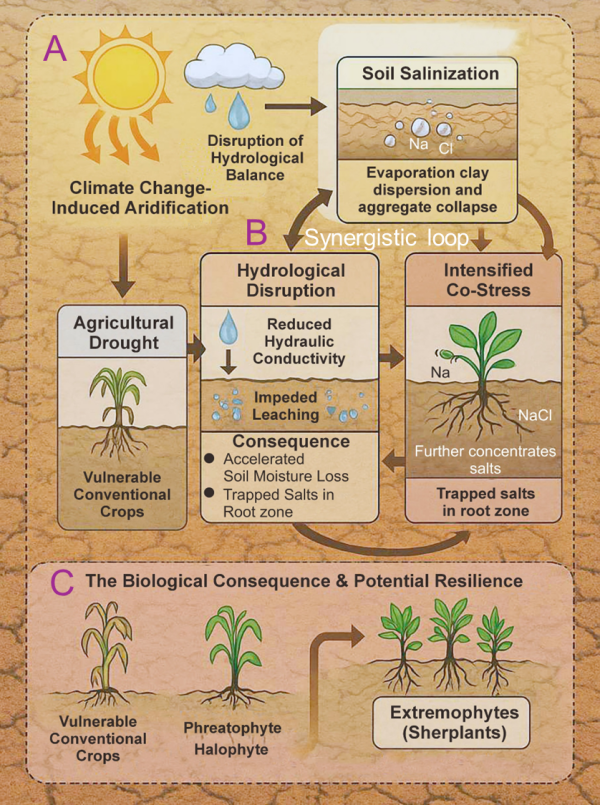
The synergistic salinity-drought feedback loop and the niche for extremophyte resistance. (Image by XIEG)
For the study, researchers synthesized the functional traits of extremophytes to identify key transferable adaptation strategies. The team focused on two core mechanisms: the precise spatiotemporal orchestration of reactive oxygen species (ROS) as signaling molecules, and the active modification of the rhizosphere through targeted root exudation to recruit stress-protective microbiomes.
The study found that extremophytes avoid oxidative damage not by eliminating ROS, but by confining ROS signals to specific tissues and cellular compartments, allowing them to trigger tolerance responses without cellular toxicity.
Furthermore, these plants release specific exudates to enrich beneficial microbes such as Truepera and Halomonas. The enriched microbes help transform barren soil into a functional ecosystem and improve soil structure, water retention, and nutrient cycling. Domesticated crops have largely lost this sophisticated adaptive trait.
"The extremophyte rhizosphere is not just a zone of nutrient exchange; it is a highly orchestrated microbial recruitment engine," said the XIEG's Tanveer, also the first author of the study. He highlighted the critical role of microbiome-mediated adaptation: "By decoding how these plants signal and select their beneficial microbiome partners, we can engineer crops that actively build a protective living buffer around their roots."
To develop a coherent framework for translating extremophyte biological mechanisms into sustainable agriculture practices, the research team proposed a circular bioeconomy model in which extremophytes such as Salicornia, Suaeda, and Alhagi are used for food, fodder, bioenergy, and phytoremediation on degraded lands. Intercropping extremophytes with cotton or spinach can reduce soil salinity by 40-51%, increasing yield and soil health.
"By restoring soil microbial networks and carbon sequestration pathways, these plants offer a nature-based solution that aligns directly with multiple UN Sustainable Development Goals, including Zero Hunger (SDG 2) and Climate Action (SDG 13)," Penuelas said.
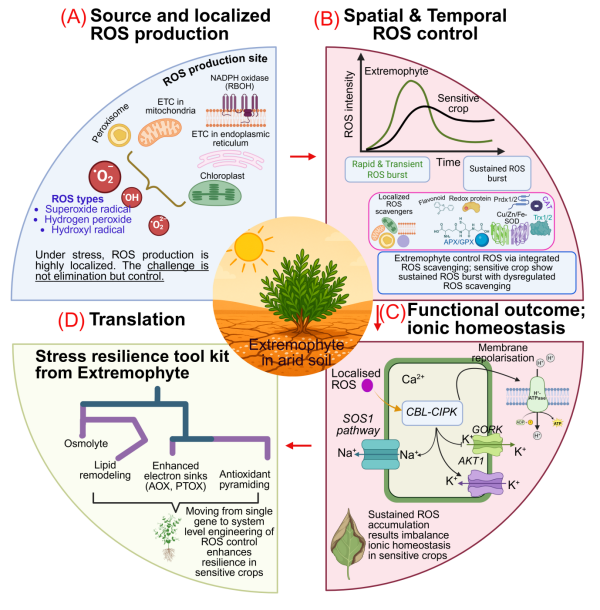
System-level strategy of reactive oxygen species control as a survival strategy in an extremophytes in an arid environment. (Image by XIEG)
