Newsroom


In a study published in Functional Ecology on June 1, a research team led by Prof. LI Dejun from the Institute of Subtropical Agriculture of the Chinese Academy of Sciences revealed that the land use type is the dominant factor regulating the climate responsiveness of soil organic nitrogen (SON) transformation. The study provides insights into the mechanisms underlying land-type-specific nitrogen management strategies and global change modeling.
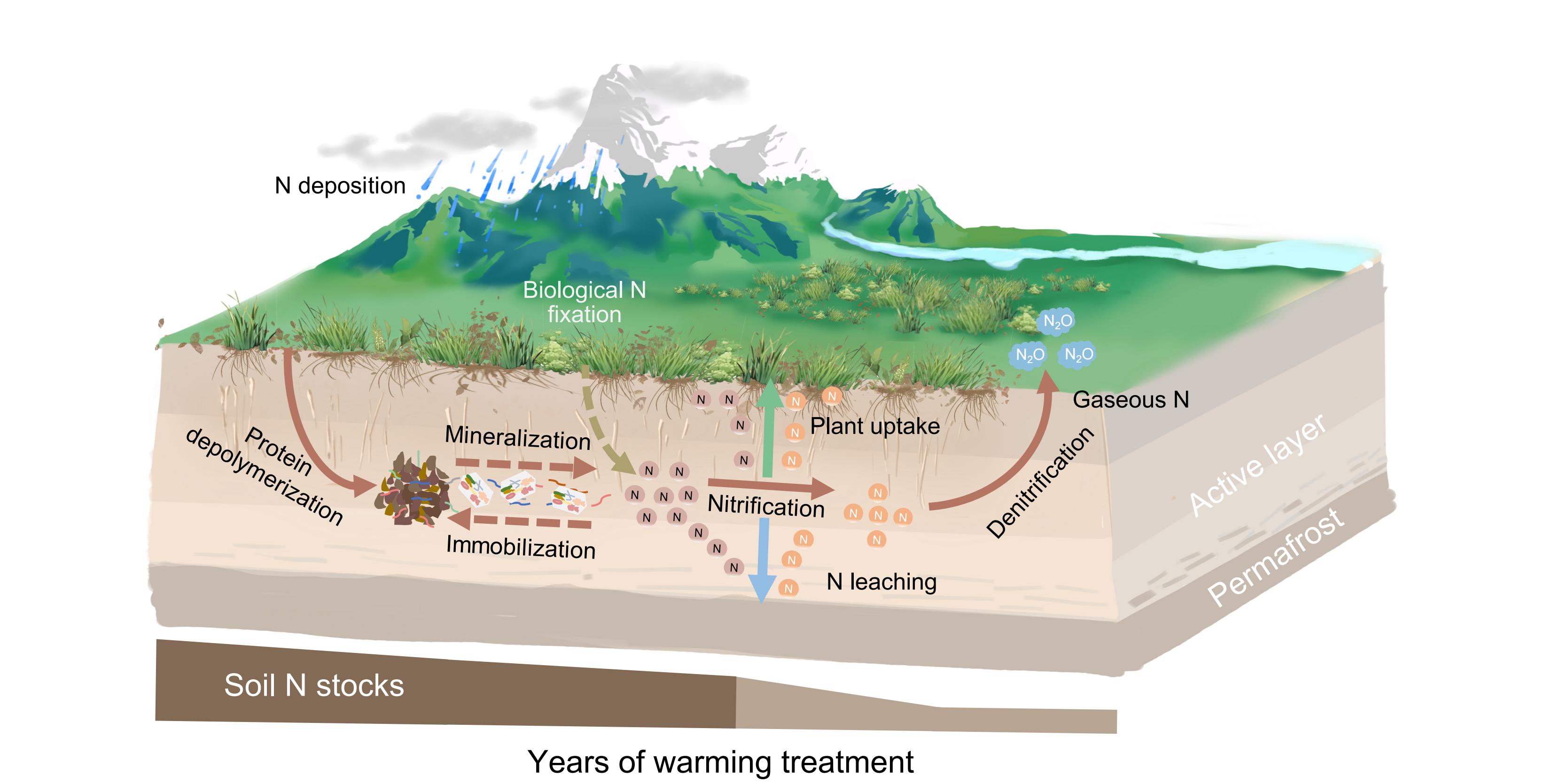
As a key component of global nutrient cycling and ecosystem productivity, SON transformation encompasses interrelated processes such as gross protein degradation, microbial nitrogen growth, gross nitrogen mineralization, and microbial nitrogen use efficiency. Climate change may alter these processes by affecting enzyme kinetics, microbial metabolism, and substrate diffusion. The direction and magnitude of the changes are regulated by ecosystem type, soil properties, and nutrient status.
In this study, researchers selected 30 forest-farmland paired plots along the subtropical climatic gradient in southwest China. They measured their soil physicochemical properties, SON transformation rates (using 15N and 18O isotope tracing methods), functional gene abundance, and enzyme activity. Using linear mixed models, hierarchical partitioning, and structural equation modeling, they analyzed the driving factors.
The results showed that land use type is the dominant factor regulating the response of SON transformation to climate change. Natural forests are highly sensitive to warming and increased precipitation due to mineral-enzyme interactions and phosphorus limitations, resulting in an increased risk of nitrogen loss. Intensive croplands buffer climate impacts through fertilization and tillage but experience a decoupling of nitrogen cycling processes.
Furthermore, researchers found that compared to intensively farmed fields that benefit from the buffering effects of fertilization and tillage, natural forest soils are more sensitive and vulnerable to climate-driven changes in the nitrogen cycle.
This study compares SON transformation processes in natural forests and intensively farmed fields across different climatic gradients, and tries to predict how land use regulates the response of the nitrogen cycle to climate change. "The findings provide a basis for soil nitrogen management under different land-use scenarios as a response to climate change," said Dr. YANG Xinyi, the first author of the study.
In the future, with climate warming and changes in precipitation, forest soils face a greater risk of nitrogen loss, necessitating a focus on phosphorus-limiting management. Farmland possesses buffering capacity, but nutrient management still needs to be optimized to maintain nitrogen use efficiency.