
Newsroom


Rice production is heavily dependent on nitrogen fertilizers, particularly in China, where application rates are two to three times the global average. At the same time, a large amount of nitrogen is lost to the environment—mainly in the form of N2. Scientists widely assumed that fertilizer nitrogen was the primary source of this N2 loss—a conclusion that was reinforced by the technical challenge of distinguishing soil-emitted N2 from the atmospheric background.
Now, a new study led by Prof. YAN Xiaoyuan from the Institute of Soil Science of the Chinese Academy of Sciences has overturned this long-held assumption about nitrogen loss in agriculture. Published in PNAS on April 22 as a cover article, the study reveals that most nitrogen gas (N2) emissions from rice paddies originate from soil organic nitrogen (SON), rather than applied fertilizers.
It also proposes a novel mechanism to explain this phenomenon, reshaping our understanding of agricultural nitrogen cycling.
In this study, the researchers employed a novel in situ observation methodology combining 15N isotope tracing with membrane inlet mass spectrometry (MIMS). This approach enabled simultaneous measurement of N2, ammonia (NH3), and nitrous oxide (N2O) emissions throughout the entire rice growing season, while partitioning their sources.
The results were striking: 72%–75% of N2 emissions were derived from SON, not fertilizer nitrogen. This finding was independently confirmed in a 14-year fertilization experiment.
In contrast, NH3 emissions were mainly linked to applied fertilizer, while N2O emissions originated from both soil and fertilizer sources. The researchers also identified a seasonal "trade-off" pattern: NH3 volatilization dominated nitrogen losses in early growth stages, whereas N2 emissions became dominant later in the season.
Based on these observations, the researchers proposed a "microbial nitrogen pump" mechanism to explain this process. Following fertilizer application, urea-derived ammonium (NH4+) is rapidly assimilated by soil microbes to support growth, creating a carbon-to-nitrogen stoichiometric imbalance. To restore this balance, microbial activities accelerate the decomposition of native soil organic matter, mobilizing SON and releasing large amounts of soil-derived NH4+.
This "old nitrogen" is subsequently converted into N2 through nitrification and denitrification processes and released into the atmosphere. The mineralized SON is only partially replenished through microbial nitrogen turnover.
"In other words, fertilizer does not directly turn into nitrogen gas. Instead, it activates soil nitrogen pools, indirectly driving larger nitrogen losses," said Prof. XIA Longlong, one of the researchers.
In addition to providing the first systematic explanation linking fertilization, microbial processes, SON mineralization, and gaseous nitrogen loss, the study offers practical solutions.
The researchers found that hybrid rice varieties improve nitrogen uptake efficiency and microbial nitrogen utilization, reducing yield-scaled gaseous nitrogen losses by approximately 43% while maintaining high productivity. This suggests that integrating crop breeding with soil–microbe regulation could help achieve both high yields and lower environmental impacts.
By identifying SON as the dominant source of N2 emissions, this study fundamentally revises our understanding of nitrogen cycling in rice ecosystems. It also provides a new theoretical framework for improving nitrogen use efficiency, refining global nitrogen budgets, and developing sustainable agricultural practices.
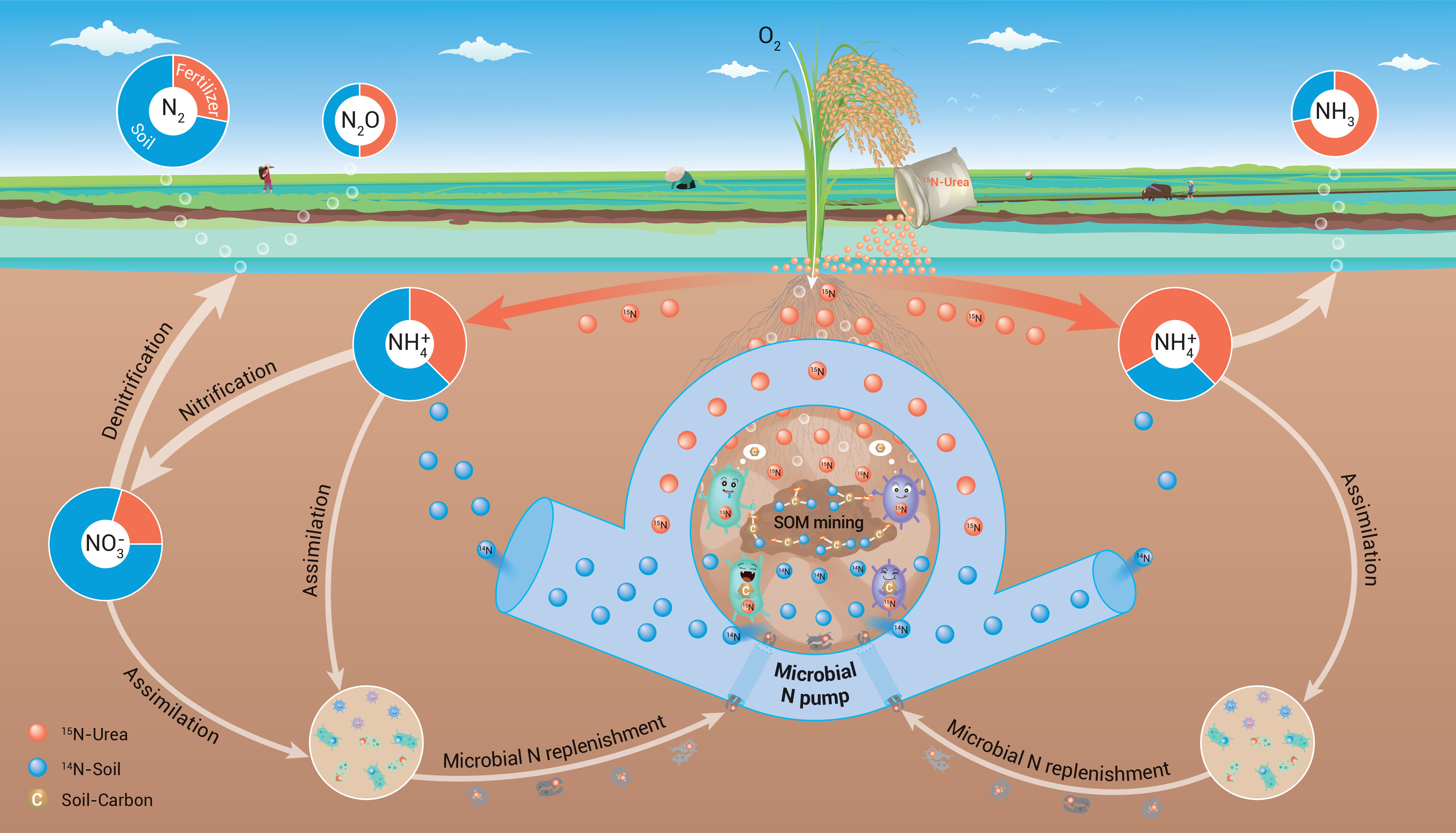
A microbial nitrogen pump driving distinct sources of soil gaseous nitrogen losses from flooded rice systems. (Image by YAN Xiaoyuan's team)
