
Newsroom


Researchers from the Institute of Applied Ecology of the Chinese Academy of Sciences discovered how soil viruses influence the accumulation and long-term storage of soil organic carbon in farmland ecosystems. They found that viral interactions with microorganisms can promote carbon sequestration through host-cell lysis and metabolic reprogramming.
The findings were published in Environmental Technology & Innovation.
Soil carbon sequestration is a key process for maintaining soil fertility and mitigating climate change. A substantial portion of soil organic carbon originates from microbial necromass. While environmental factors such as soil moisture and nutrient availability are known to influence this process, the role of soil viruses has received far less attention.
Viruses are the most abundant biological entities in soil ecosystems and influence microbial communities in two primary ways. They can lyse host cells, releasing organic compounds into the soil, and they can modify host metabolic processes and affect carbon transformation pathways through auxiliary metabolic genes (AMGs).
To investigate these mechanisms, the researchers led by Dr. LIANG Xiaolong conducted laboratory-scale incubation experiments using black soil from northeast China. They combined three soil moisture regimes with four organic amendment treatments, including straw, biochar, cattle manure and an unamended control.
The researchers found that the combined effects of organic amendments and soil moisture significantly reshaped both microbial and viral communities and their interactions. They identified a positive relationship between the abundance of lytic viruses, which reproduce by destroying host cells, and the accumulation of microbial necromass carbon and soil organic carbon. This suggests that viral lysis promotes microbial turnover and contributes to the formation of stable soil carbon pools.
In addition, viral AMGs may influence host metabolism in ways that enhance carbon fixation and organic matter transformation. Together with viral lysis, these processes appear to promote the accumulation of microbial-derived carbon in soil. Their analyses indicated that virus-driven host turnover and metabolic regulation work together to strengthen soil carbon retention.
Based on these findings, the researchers proposed a virus-mediated model of soil carbon sequestration that integrates viral ecology into the microbial carbon pump framework.
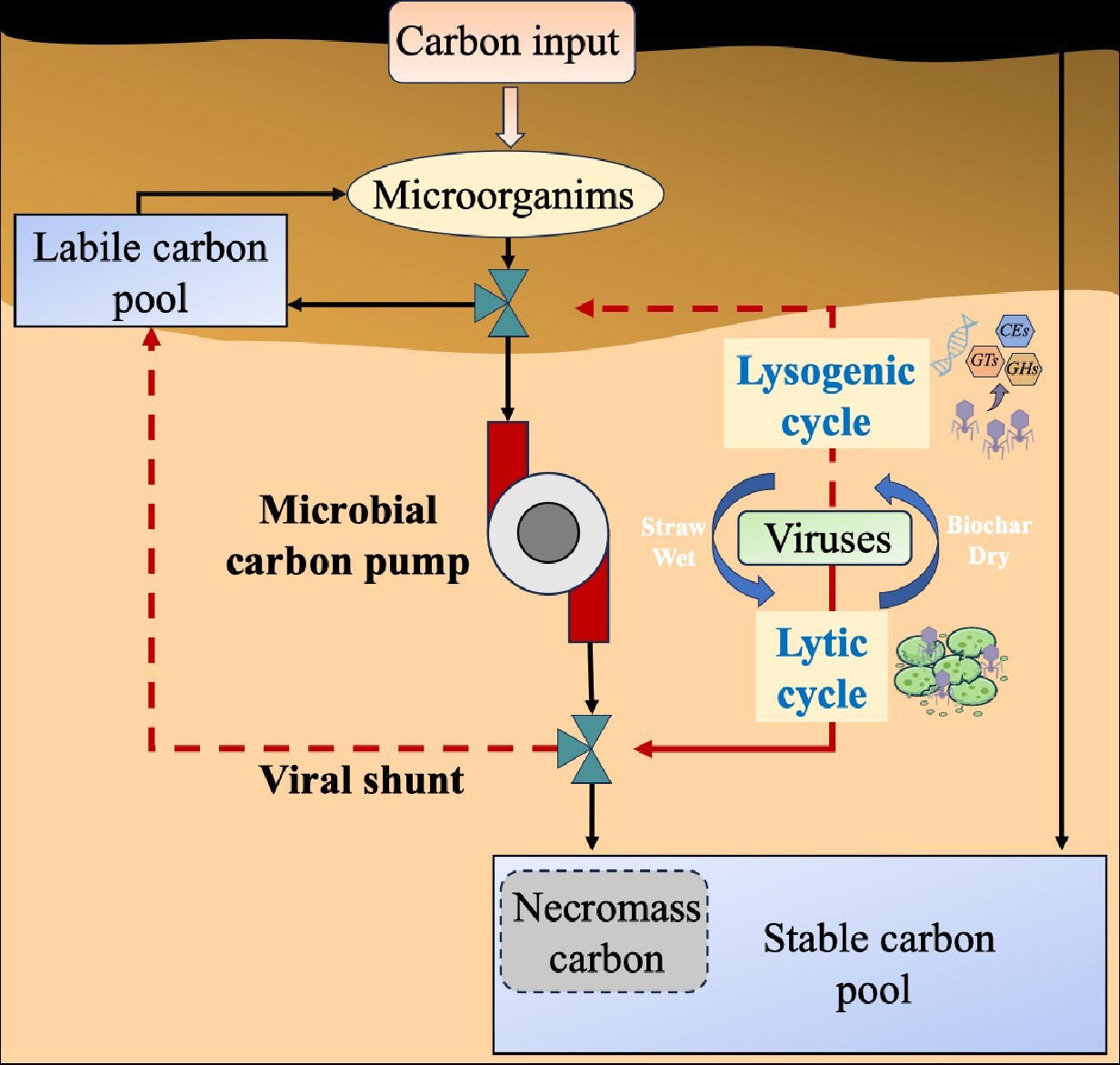
Conceptual model of the virus-mediated microbial carbon pump in soil (Image by WANG Yongfeng)
