
Newsroom


It has been assumed that brown carbon, a type of organic aerosol from biomass burning, mainly absorbs sunlight in the near-ultraviolet range, which has only a limited climate impact. However, observational evidence has showed that some wildfire-derived brown carbon appears dark brown or nearly black, absorbing light well into the visible spectrum. This "dark brown carbon" has been largely missing from global climate assessments.
In a study published in Nature Geoscience, the researchers from the Institute of Atmospheric Physics of the Chinese Academy of Sciences, Xiamen University, and Texas A&M University, revealed that dark brown carbon from wildfires exerts a powerful warming effect on the global climate, which potentially matching or even exceeding that of black carbon in the visible spectrum.
Combining aircraft, ground-based, and satellite data, the researchers analyzed wildfire plumes across North America, South America, Siberia, Africa, and Australia. They found that at a wavelength of 500 nm, the mass absorption efficiency of organic carbon in wildfire plumes ranges from 0.5 to 1.5 m2/g, far exceeding the typical value of less than 0.1 m2/g for weakly absorbing brown carbon. In the visible spectrum, dark brown carbon matches or surpasses the light absorption of black carbon.
By incorporating observation-constrained optical parameters into a global climate model, the researchers quantified dark brown carbon's radiative effect for the first time. They found that wildfire-derived brown carbon has a global direct radiative effect of +0.097 W/m2, with an uncertainty range of +0.050 to +0.276 W/m2. Notably, the upper bound of this estimate (0.276 W/m2) exceeds the radiative contribution of black carbon (0.163 W/m2).
Moreover, the researchers revealed that dark brown carbon's influence extends markedly into mid- and high-latitude regions and even the Arctic. In these snow- and ice-covered areas, deposition of dark brown carbon may reduce surface albedo and trigger a positive snow-ice albedo feedback, amplifying regional and global warming.
This study demonstrates that dark brown carbon is an underestimated but key climate warming factor. Under the background of mutual reinforcement between global warming and frequent wildfires, future climate assessments must fully account for the warming contribution of dark brown carbon.
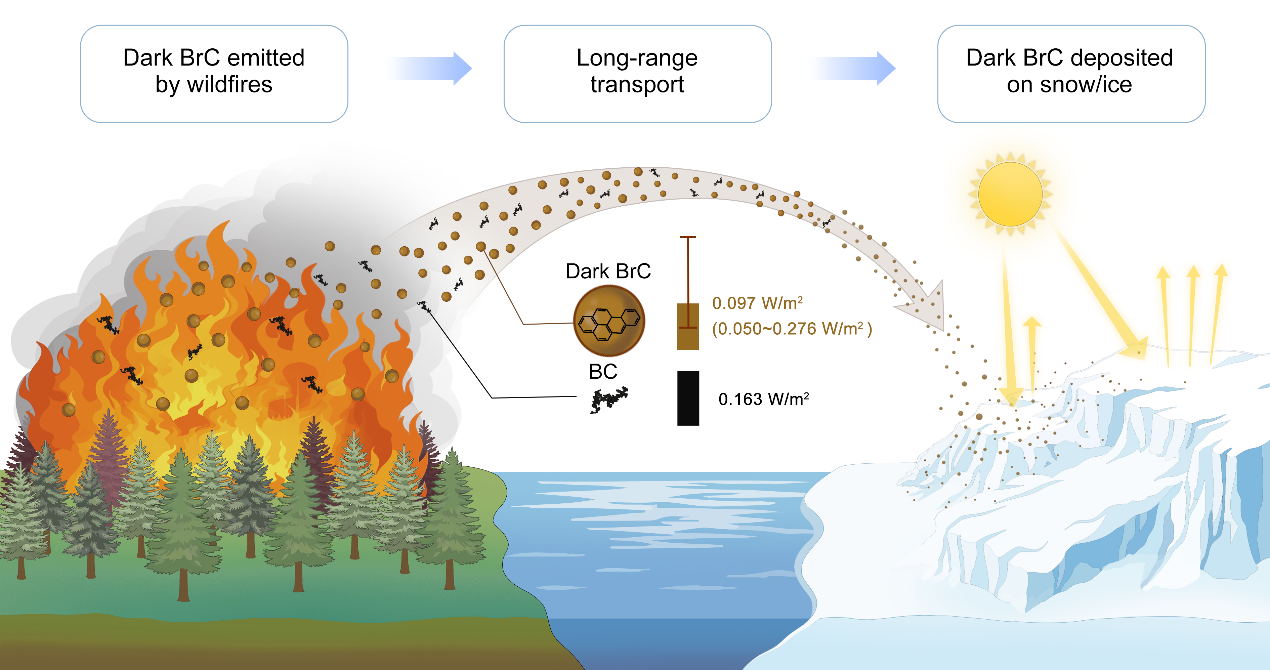
Schematic illustration of atmospheric processes and radiative effects of dark brown carbon in wildfire plumes. (Image by XU Lulu et al.)
