Newsroom


A research team at the Shanghai Institute of Ceramics, Chinese Academy of Sciences (SICCAS), has mapped out how machine learning is transforming the development of functional ceramics, and outlined an efficient machine learning workflow in a recent review published in Materials Science and Engineering: R: Reports.
The review was led by the research group of passive integrated devices and materials at SICCAS, with Dr. QIN Jincheng as the first author and Professor LIU Zhifu as the corresponding author.
Functional ceramics are essential in modern technologies because they can respond to electrical, magnetic, optical, thermal, and acoustic stimuli. However, their development has traditionally been slowed by the complex, non-linear relationships among composition, structure, and processing—making the conventional trial-and-error approach inefficient.
The review systematically outlines an end-to-end machine learning workflow that addresses these challenges. This workflow covers four key steps: data collection, featurization (converting raw material data into machine-readable inputs), algorithm selection, and model interpretation.
Rather than relying solely on predefined physical laws, machine learning learns directly from data, enabling rapid property prediction and revealing hidden correlations across different ceramic systems.
In addition, this work systematically assessed data-driven progress across major functional ceramic classes, including dielectric, ferroelectric, piezoelectric, electrocaloric, conductive, superconductive, magnetic, and luminescent ceramics.
The researchers analyzed more than 200 representative models, comparing their target properties and predictive accuracy to identify universal trends and gaps in the field. Beyond simple prediction, the review explored how machine learning can support material classification, calculation enhancement, process optimization, pattern recognition, device design, and failure analysis.
Looking forward, the researchers highlight the integration of self-driving laboratories and human-machine collaboration as a transformative approach to materials discovery. By combining closed-loop active learning with robotic synthesis and real-time characterization, research cycles can be significantly accelerated.
The researchers emphasized the need to overcome fragmented data ecosystems through standardized data infrastructures and small-data learning strategies. The synergy of explainable artificial intelligence, multimodal data fusion, and digital twins for real-time performance prediction represents the next frontier.
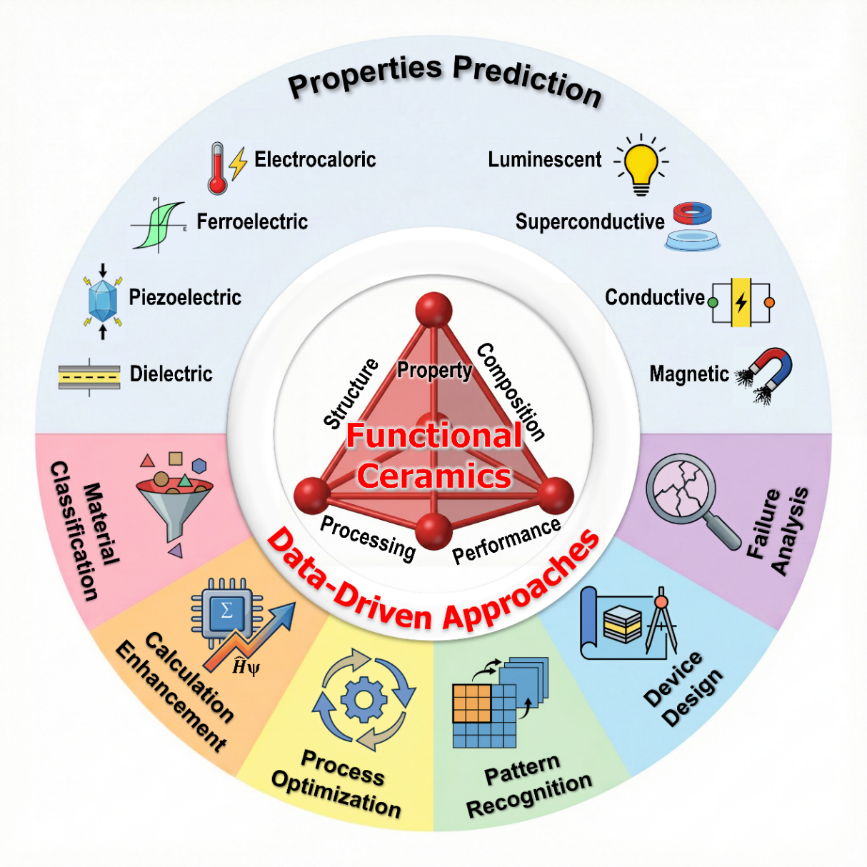
Data-driven research for functional ceramics (Image by SICCAS)