
Newsroom


According to a new study published in Analytical Chemistry on March 27, Chinese scientists have developed a rapid and broadly applicable platform for antifungal susceptibility testing, offering a potential new route to faster and more informative diagnosis of invasive fungal infections.
The study, carried out by researchers from the Qingdao Institute of Bioenergy and Bioprocess Technology (QIBEBT) of the Chinese Academy of Sciences (CAS), University of Jinan, Peking Union Medical College Hospital, Fudan University, and Institute of Microbiology of CAS, introduces a multifeature antifungal susceptibility testing platform (MAFST) designed to address a longstanding challenge in clinical mycology: current susceptibility tests are often too slow, labor-intensive, or inconsistent across fungal species and drug classes.
Invasive fungal diseases affect millions of people each year and are associated with high mortality, particularly among immunocompromised patients. Conventional methods such as broth microdilution remain the clinical reference standard, yet they typically require much longer turnaround times and may miss the dynamic, heterogeneous nature of antifungal responses at the single-cell level.
To overcome these limitations, the researchers combined single-cell Raman spectroscopy with brightfield imaging to monitor how fungal cells respond to drug exposure through multiple dimensions at once. Instead of relying on a single readout, the platform integrates metabolic vitality, cell size, and morphological switching into a unified composite inhibition index (CII), allowing susceptibility to be assessed with greater robustness.
"Antifungal responses are not one-dimensional," said corresponding author Prof. XU Jian of QIBEBT. "We wanted to capture coordinated changes in metabolism, morphology and development at the single-cell level, because that is where important drug-response information is often hidden."
Benchmarking experiments showed that the MAFST platform achieved high concordance with the gold-standard broth microdilution method across multiple Candida species and major antifungal classes, while shortening the time needed for susceptibility assessment to about six to eight hours. The researchers also validated the framework using clinical isolates, supporting its potential translational value.
"This study shows why single-parameter tests often fall short," said co-corresponding author Prof. HUANG Jiadong from the University of Jinan. "By integrating complementary phenotypic signals into one framework, we can move toward faster and more accurate antifungal diagnostics."
The researchers noted that future work will focus on expanding the platform to additional fungal pathogens, improving device integration, and standardizing the workflow for future clinical use. Even so, the study marks a promising step toward next-generation phenotypic diagnostics that are rapid, quantitative and mechanistically informative.
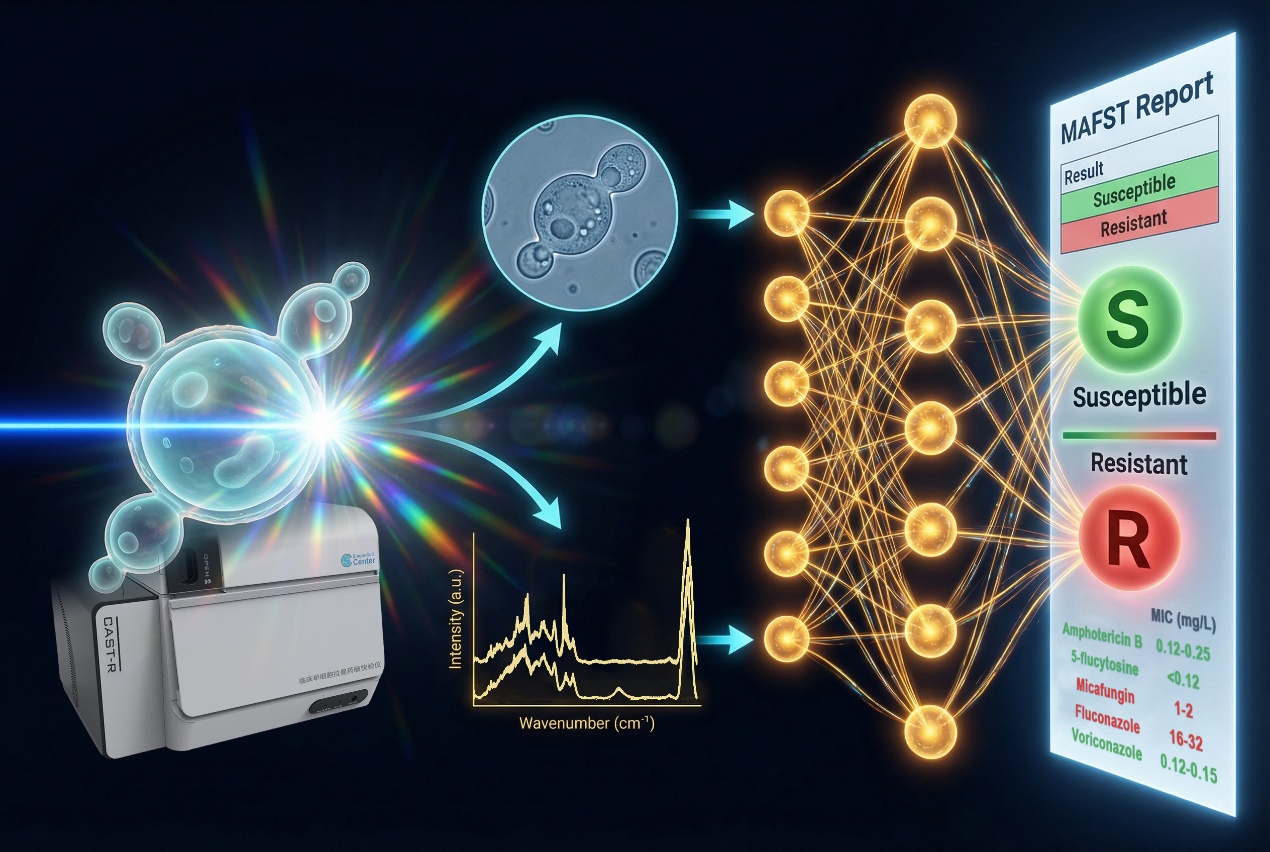
AI-assisted multimodal platform for rapid antifungal susceptibility testing (Image by LIU Yang)

