Newsroom


A long-term field study showed that soil fertility plays a decisive role in determining the distribution of tree species associated with different types of mycorrhizae.
The findings were published in the Journal of Ecology on March 16.
Most forest plants form symbiotic relationships with mycorrhizal fungi, among which arbuscular mycorrhizae (AM) and ectomycorrhizae (EcM) are the most common. AM fungi typically penetrate root cells and facilitate nutrient uptake, while EcM fungi form a sheath around roots and are more efficient at accessing nutrients in nutrient-poor environments. As a result, AM-associated tree species tend to be more prevalent in fertile soils, whereas EcM-associated species dominate in less fertile conditions. Although this distribution pattern has been widely documented, the processes that generate it remain debated.
To address this question, researchers led by Drs. ZHU Meihui and WANG Xugao from the Institute of Applied Ecology of the Chinese Academy of Sciences analyzed more than 15 years of data from a 25-hectare forest dynamics plot in the Changbai Mountain temperate forest.
The researchers found that as soil fertility increased, EcM-associated tree species exhibited higher mortality rates and lower growth rates, while AM-associated species showed the opposite pattern, with improved growth and reduced mortality. These results support the environmental filtering hypothesis, which proposes that soil nutrient conditions directly regulate species performance and thereby shape community composition.
In contrast, the alternative hypothesis that trees actively modify soil conditions to reinforce their own dominance was not supported in terms of shaping spatial distribution. Although the researchers reported that EcM-dominated communities were associated with increased total phosphorus in soils and reduced losses of available nitrogen and phosphorus, these changes did not result in a shift in tree dominance consistent with the alternative hypothesis. Instead, plant-driven soil modification appeared to occur more slowly and did not override the primary influence of existing soil conditions.
Further analysis revealed the importance of leaf litter nutrient balance (the relative proportions of elements such as carbon, nitrogen, and phosphorus) in regulating plant–soil feedback processes.
The study concludes that environmental filtering is the dominant mechanism structuring the distribution of mycorrhizal tree types along soil fertility gradients. The results also provide empirical support for the Mycorrhizal-Associated Nutrient Economy framework.
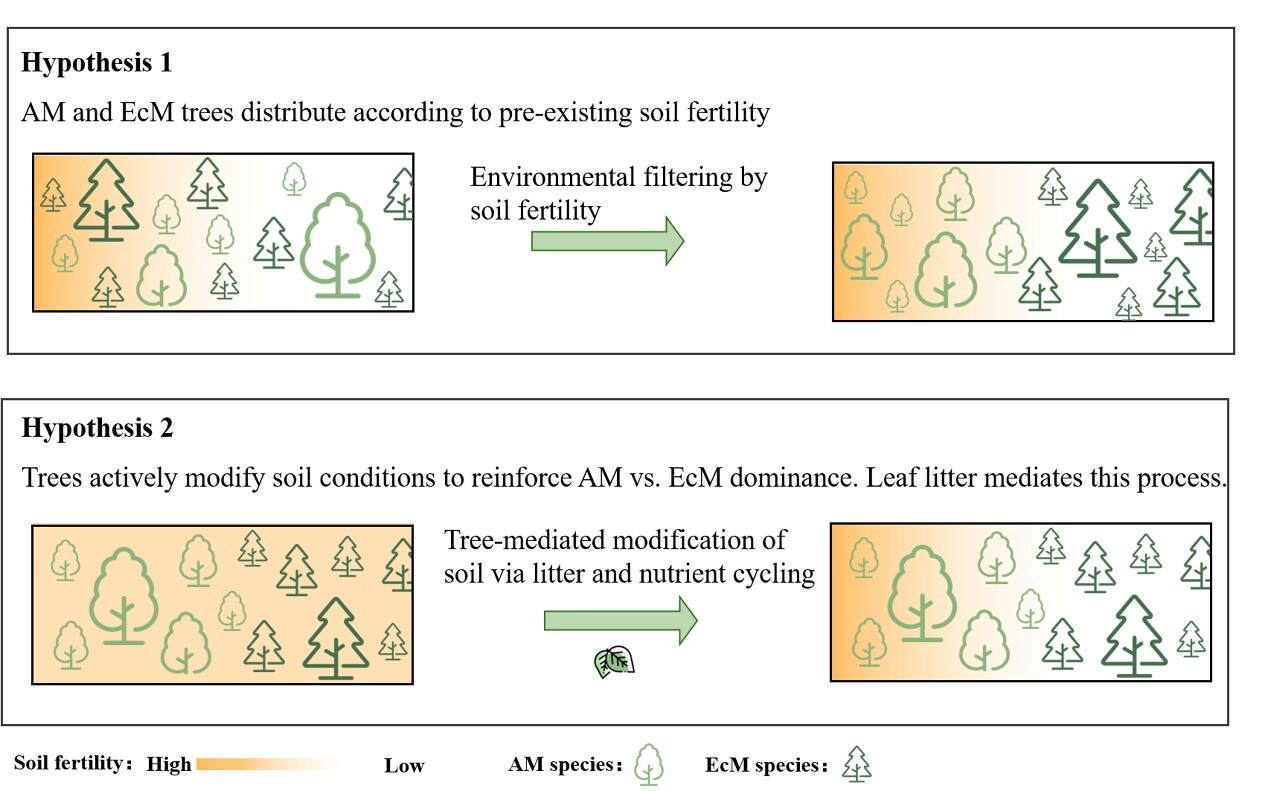
Conceptual framework illustrating two hypotheses for the distribution of AM- and EcM-associated tree species along a soil fertility gradient (Image by ZHU Meihui)