Newsroom


In a study published in Environmental Science & Technology, a research team led by Prof. JIANG Ling and Prof. LI Gang from the Dalian Institute of Chemical Physics (DICP) of the Chinese Academy of Sciences (CAS) revealed distinct roles of NOx (NO2 and NO), as well as their synergistic interactions with sulfur dioxide (SO2), in secondary organic aerosol (SOA) formation during β-myrcene photooxidation.
The formation of aerosols from molecular precursors is a key process driving particulate pollution. It is essential to make characterization of their chemical composition and nucleation mechanisms to elucidate formation pathways and take effective control measures. Nitrogen oxides (NOx = NO + NO2) and SO2 are priority pollutants in air quality management, but their roles in SOA formation from volatile organic compounds are incompletely understood.
In this study, by using a DICP-CAS smog chamber with online analytical instruments, researchers investigated the SOA formation from β-myrcene photooxidation. NO2 enhanced SOA yield and increased the oxygen-to-carbon ratio through oxidant amplification. In contrast, NO suppressed particle nucleation and reduced product oxidation states, while promoting particle growth by facilitating the partitioning of organic nitrates into the particulate phase. SO2 exhibited strong synergistic effects with both NO2 and NO, facilitating particle formation and growth.
Furthermore, researchers developed a novel aerosol mass spectrometer based on a tunable vacuum ultraviolet free electron laser (VUV-FEL). This instrument can detect compounds including organic peroxides, organic nitrate, and organosulfates. Combined the instrument with quantum chemical computations, researchers proposed detailed oxidation pathways for the formation of these compounds.
"The identification and analysis of these novel compounds help to correct the biases in SOA formation predictions and provide more precise data for understanding aerosol formation mechanisms in regions influenced by both anthropogenic and biogenic sources," said Prof. JIANG.
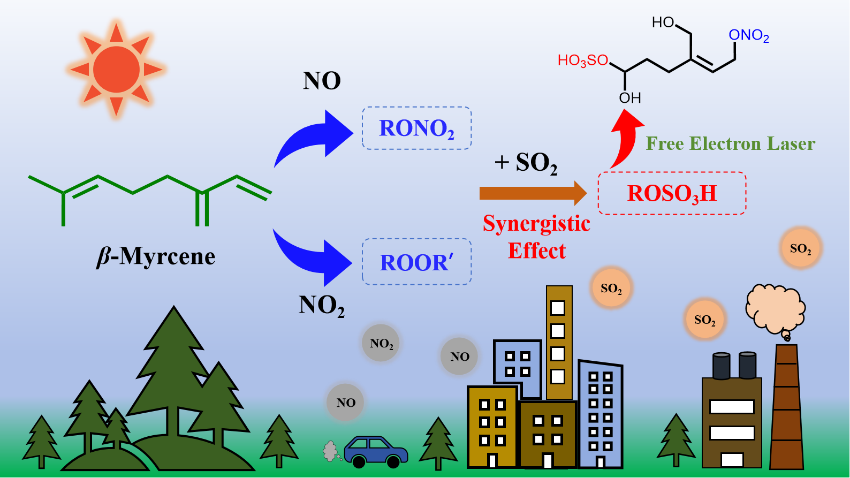
Schematic illustration of the synergistic effects of NOx and SO2 on β-myrcene photooxidation (Image by ZHAO Ya)